PerspectivesMarketing & Creator
Brand Safety in Creator Marketing Campaigns: Controlling Risk Before and After Publication

Protecting brand safety in creator marketing campaigns requires a three-gate governance system spanning pre-contract vetting, contractual message guardrails, and post-publication monitoring. Under Article 15a of Vietnam's amended Law on Advertising No. 75/2025/QH15, the sharpest risk comes from KOCs improvising unverified product claims or omitting ad disclosures.
Key takeaways
- From 2026 onward, brand safety risk in Vietnam has shifted from celebrity scandals to statutory liability when KOCs exaggerate claims or hide ad labels under Article 15a of Law No. 75/2025/QH15.
- Pre-contract vetting must audit 24-month statement history, verified audience age brackets, competitor conflicts, and draft approval discipline.
- Effective briefs and contracts separate a green zone for creative expression from mandatory statutory disclosures and red-line prohibited claims.
- A four-tier 24-hour incident response SLA enables brands to contain technical errors or invoke morality clauses before isolated mistakes trigger boycotts.
Establishing systematic brand safety in creator marketing campaigns is a core operational requirement for marketing and legal leaders in Vietnam. Many brands still approve creator rosters based on surface impressions and leave script execution entirely to improvisation. Yet a single unverified product claim or off-script remark during a sponsored livestream can erase months of brand equity overnight.
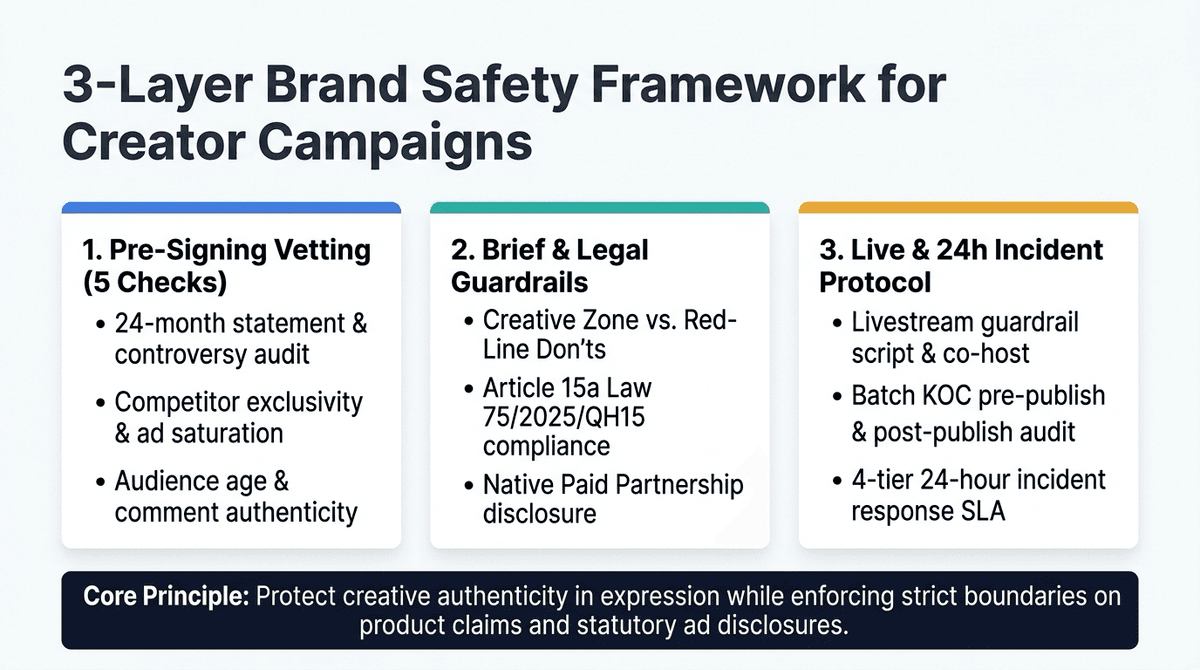
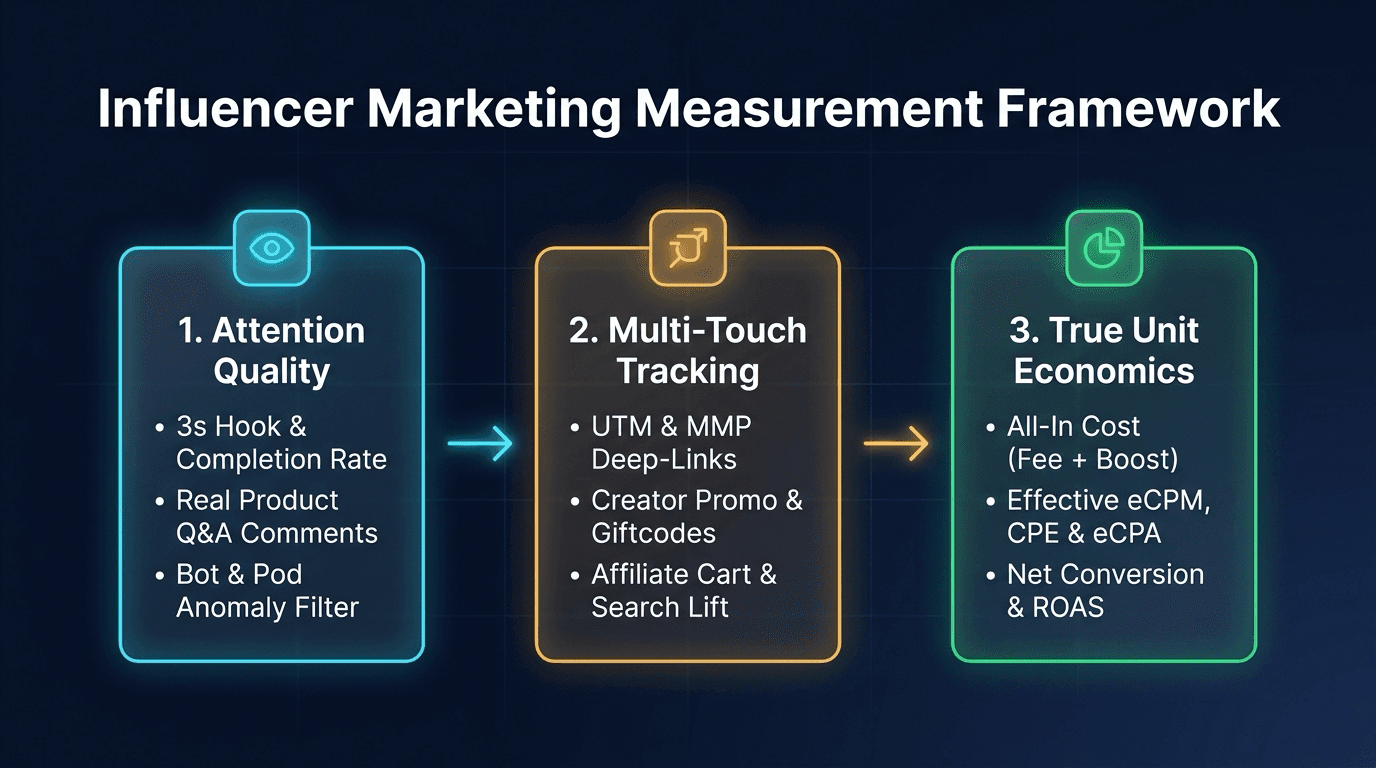
The framework above summarizes the three-layer risk governance model operated by digital marketing agency Adsota and multi-channel network OTA Network (part of the Appota ecosystem). Separating pre-contract vetting, contractual guardrails, and a 24-hour incident protocol protects regulatory compliance while preserving each creator's authentic voice.
How has brand safety in creator marketing campaigns shifted in Vietnam from 2025–2026?
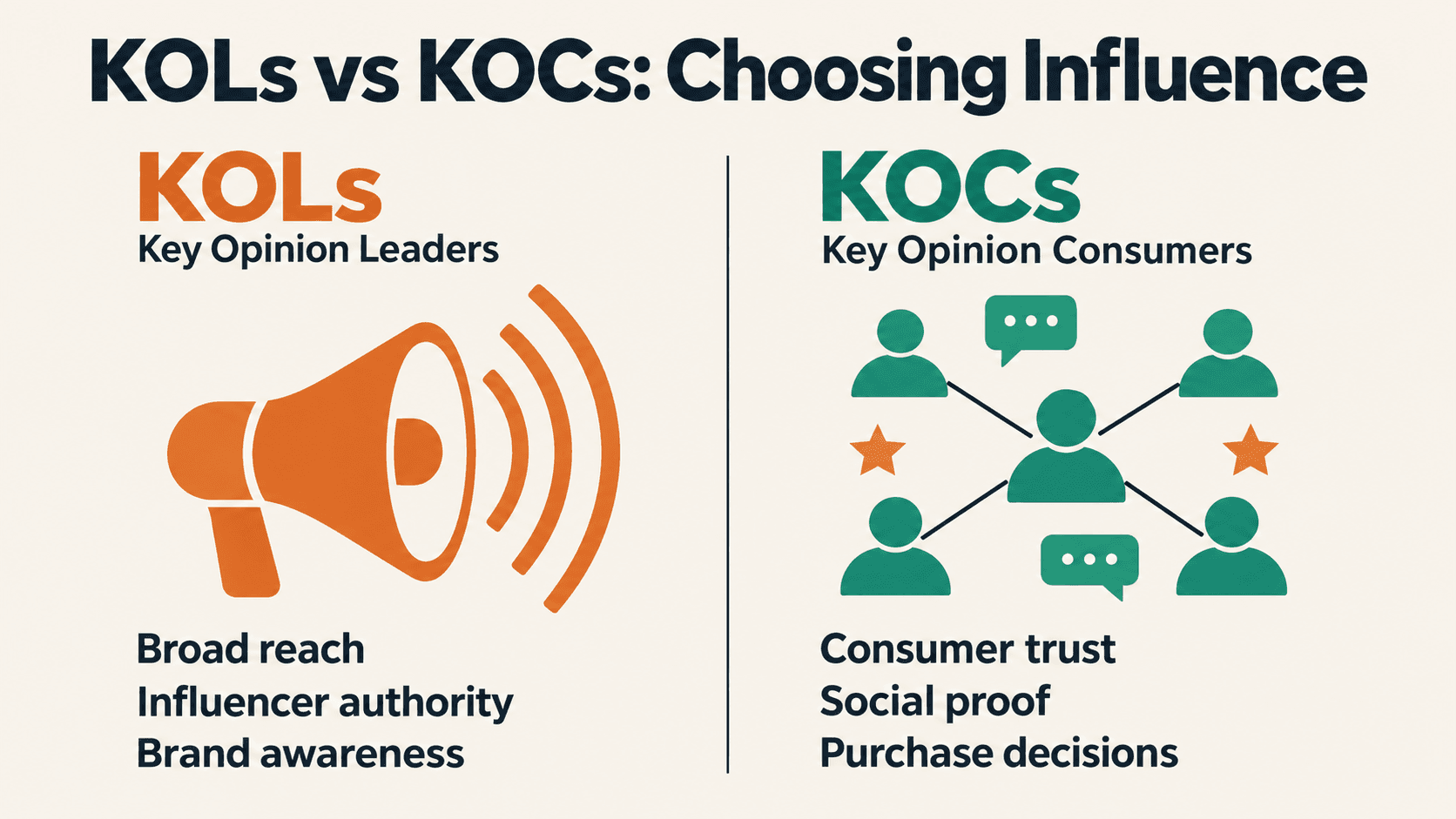
Many chief marketing officers still equate brand safety in creator marketing campaigns strictly with screening celebrity ambassadors (KOLs) for personal controversies. Operational reality across 2025 and 2026 shows that primary risk has shifted toward regulatory liability and message breakdowns among key opinion consumers (KOCs) and livestreamers.
Statutory liability under Vietnam's amended Law on Advertising No. 75/2025/QH15
Under the Law Amending and Supplementing a Number of Articles of the Law on Advertising No. 75/2025/QH15 (passed June 16, 2025, effective January 1, 2026), Article 15a codifies the legal obligations of "advertising product conveyors" across three pillars:
- Truthfulness and dossier accountability (Clause 2, Article 15a): Conveyors must comply with consumer-protection laws, provide truthful product information, fulfill tax duties, submit dossiers upon authority request, and bear legal responsibility for non-compliant content.
- Ban on endorsing untested products (Clause 3a, Article 15a): Influencers must verify advertiser credibility and inspect legal product documentation. If they have not used or do not clearly understand a product or service, they are prohibited from endorsing it.
- Mandatory real-time ad disclosure (Clause 3b, Article 15a): Influencers must explicitly notify consumers about advertising immediately before and throughout the promotional activity.
Two 2026 decrees reinforce enforcement. Decree 342/2025/ND-CP (issued December 26, 2025, effective February 15, 2026) details implementation of the Law on Advertising, replacing Decree 181/2013/ND-CP and Decree 70/2021/ND-CP. Meanwhile, Decree 87/2026/ND-CP (signed March 27, 2026, effective May 15, 2026, replacing Decree 38/2021/ND-CP) sets administrative fines for advertising violations at up to VND 100 million for individuals and VND 200 million for organizations. (Editorial note: Legal counsel should verify clauses against the official Gazette text before signing contracts.)
Why budget migration toward Micro-creators multiplies compliance blind spots
According to The State of Gaming Creators in Vietnam report published by Appota and OTA Network (March 2022), 89% of surveyed creators have under one million followers, comprising 48% Micro (10,000–100,000 followers) and 41% Medium (100,000–1,000,000 followers). The survey also recorded that 50.2% of viewers watch for live entertainment and interaction, matching 84.1% of creators who prioritize fan interaction during broadcasts.
When brands split budgets across dozens of KOCs and mid-tier streamers, pressure to entertain live chat often tempts younger talent into exaggerating product claims. For a broader structural breakdown, see our Vietnam creator ecosystem map.
Pre-campaign vetting: 5 checks required beyond follower counts
A creator's media kit only shows peak views and follower totals. From the perspective of Adsota and OTA Network, pre-signing vetting must audit five risk dimensions:
- 24-month statement and controversy audit: Review archived livestreams, short clips, and forum threads over the past 24 months to flag divisive remarks on culture, regional identity, gender, or history.
- Competitor conflict and sponsorship saturation: Check whether the channel promoted a direct competitor within the past 60–90 days. Channels running dense sponsorships across unrelated categories suffer audience fatigue and risk confusing brand names on air.
- Audience age demographics versus product eligibility: According to Appota and OTA Network's survey (March 2022), 75.8% of gaming livestream viewers are aged 13–22 (35% aged 13–17 and 40.8% aged 18–22). Channels with a large under-18 audience share must never be booked for credit services, financial investments, or
18+age-rated games. - Comment-section culture and engagement quality: Inspect live chat logs and comment threads directly. Channels that tolerate toxic harassment or cyberbullying will expose sponsoring brands to immediate backlash once a logo appears.
- Track record on draft approvals and ad disclosures: Verify past delivery through multi-channel networks (MCNs) to confirm whether the creator respects draft deadlines, keeps approved captions intact, and enables paid-partnership tags.
These five checks complement role selection under our framework for selecting and combining KOLs and KOCs by campaign objective.
Designing briefs and contracts with technical guardrails that protect the brand
The central challenge in creator governance is balancing compliance with authenticity. Forcing a streamer or KOC to recite a rigid corporate script destroys viewer retention within three seconds.
In Appota and OTA Network's March 2022 report, Pham Ba Duy — Director of OTA Network — highlighted three principles that sustain creator credibility:
"In truth, the formula here is that there is 'no fixed formula' at all, because every creator brings a unique color and expression. Still, there are three principles no creator can ignore: Sincerity—living authentically both offline and on screen to build bonds with fans that transcend pure economics; Passion—audiences never care if you treat each stream perfunctorily and ignore viewers; and Distinct Personality—'integrating without dissolving,' leaving a memorable signature in viewers' minds so media and audiences remember who you are." — Pham Ba Duy, Director of OTA Network
Separating creative briefs into three explicit governance zones
To let creators preserve their voice while maintaining brand safety in creator marketing campaigns, Adsota divides every creative brief and contract addendum into three zones:
| Brief Governance Zone | Specific Scope Defined | Creator Autonomy | Legal & Acceptance Rule |
|---|---|---|---|
| 1. Green Zone (Creative Freedom) | 3-second hook, storytelling style, humor, filming setting, and community slang | Full autonomy to match the channel's natural voice | Brand does not rewrite phrasing unless it violates cultural standards |
| 2. Mandatory Zone (Statutory Claims) | 2–3 verified product specs; hands-on product trial; Paid Partnership tags on TikTok, Meta, YouTube | Expressed in own words while keeping core specs and labels intact | Must satisfy Clause 3, Article 15a of Law No. 75/2025/QH15 and platform rules |
| 3. Red-Line Don'ts (Strictly Prohibited) | Banned medical or guaranteed-return claims; competitor disparagement; sensitive themes | Zero tolerance in any format, including jokes or chat replies | Breach triggers rejection, takedown, and contractual penalties |
Alongside the contract, advertisers must hand over verified product compliance dossiers and record sample delivery to satisfy verification duties under Article 15a of Law No. 75/2025/QH15.
Controlling brand safety risks during livestreams and high-volume KOC waves
Multi-hour livestreams and mass KOC waves represent the two highest-risk formats. Each requires dedicated technical guardrails during execution.
Guardrail scripts and real-time moderation for sponsored livestreams
Unlike pre-recorded videos (VOD), live remarks cannot be edited out before viewers clip them. Drawing on OTA Network and Adsota's broadcast operations, safe brand livestreams rely on three controls:
- One-page Guardrail Script beside the camera: Display a concise prompt card listing three approved talking points, five red-line prohibited phrases, and the mandatory verbal sponsorship disclosure.
- Co-host pairing and chat moderation: Assign a product-trained co-host or moderator to support technical explanations while automated keyword filters block provocative chat spam.
- Pre-approved graphic overlays and AR triggers: Place sensitive details—such as pricing, promo terms, or age ratings—on pre-approved banners or augmented reality (AR) pop-ups rather than relying on memory.
Three-gate audit workflow for high-volume KOC campaigns
When managing 50 to 200 KOCs at once, creators sometimes submit a compliant draft but publish the live post with a clickbait thumbnail, disable commercial disclosure toggles on TikTok, Meta, or YouTube, or attach the wrong affiliate link. Teams should lock execution across three gates:
- Gate 1 — Pre-filming outline and banned-term sign-off: KOCs confirm hands-on usage and sign off on prohibited claim lists.
- Gate 2 — Draft video and disclosure check: Reviewers verify visuals, spoken audio, captions, and native paid-partnership settings before approval.
- Gate 3 — Post-publication audit within 24–72 hours before paid boosting: Teams crawl live URLs to confirm captions and disclosures remain intact. Only compliant posts receive whitelisting codes (Spark Ads or Partnership Ads) and enter the tracking pipeline in our guide on measuring influencer marketing ROI and detecting inflated metrics.
24-hour incident response protocol when a creator faces a crisis or breaches terms
When an incident occurs, mass-deleting comments or issuing premature blame often turns a minor mistake into a boycott. Brands should execute a 24-hour response matrix across four contractually defined tiers:
| Incident Tier | Trigger Scenario | Action in Hours 2–6 | Action in Hours 6–24 | Contract Clause |
|---|---|---|---|---|
| Tier 1: Minor Spec Error | Minor spec mistake, missing disclosure tag, or broken link | Pause paid whitelisting ads; instruct creator to fix caption and enable disclosure | Re-audit batch URLs; pin clarifying comment below video | 2-to-4-hour correction SLA before acceptance |
| Tier 2: Unapproved Claim | KOC exaggerates efficacy breaching Article 15a of Law No. 75/2025/QH15 | Order immediate video takedown; lock approved draft logs as evidence | Publish transparent clarification; provide records to regulators if requested | Liability carve-out for unapproved edits |
| Tier 3: Off-Script Live Remark | Streamer makes inappropriate remarks or argues heatedly with viewers | Cut co-branded ad stream; remove overlays and revoke ad codes | Separate brand stance from personal remarks; suspend remaining streams | Unilateral broadcast suspension right |
| Tier 4: Legal or Moral Crisis | Ambassador KOL faces legal prosecution or severe ethical scandal | Remove all co-branded assets and halt paid media immediately | Issue termination notice; enforce fee clawback and damages | Morality Clause and termination for cause |
(Note: The operational perspectives and risk matrices above reflect governance practices from Adsota and OTA Network within Appota and will be confirmed by Appota's Marketing specialist before publication.)
Before launching your next creator campaign, marketing and legal teams should update contract templates for Article 15a of Amended Advertising Law No. 75/2025/QH15, attach red-line claim lists, and lock in a 24-hour incident SLA. Explore more analyses in the Marketing and Creator topic hub or contact Adsota's creator marketing team to set up creator vetting and brand safety governance.
Sources
- Luật sửa đổi, bổ sung một số điều của Luật Quảng cáo số 75/2025/QH15, Quốc hội Việt Nam (dẫn qua Thư viện Pháp luật), 2025-06-16, accessed 2026-11-02
- Nghị định 342/2025/NĐ-CP quy định chi tiết một số điều của Luật Quảng cáo, Chính phủ Việt Nam (dẫn qua Thư viện Pháp luật), 2025-12-26, accessed 2026-11-02
- Nghị định 87/2026/NĐ-CP quy định xử phạt vi phạm hành chính trong lĩnh vực văn hóa và quảng cáo, Chính phủ Việt Nam (dẫn qua LuatVietnam), 2026-03-27, accessed 2026-11-02
- E-Magazine: Tổng quan Gaming Creators Việt Nam (The State of Gaming Creators in Vietnam), Công ty Cổ phần Appota & OTA Network, 2022-03-25, accessed 2026-11-02
- TikTok Branded Content Policy, TikTok, accessed 2026-11-02
- Meta Branded Content Policies, Meta, accessed 2026-11-02
- YouTube Help — Paid product placements, sponsorships, and endorsements, Google, accessed 2026-11-02