E-Magazine 08: Education Marketing in Vietnam and Digital Enrollment Strategy
Adsota's E-Magazine 08 report on education marketing in Vietnam analyzes enrollment competition, North–South school-choice behavior, and digital conversion frameworks for schools and universities. Consumer education spending in Vietnam is projected to grow by USD 9.7 billion from 2023 to 2028 (Statista), while 69.9% of high school students begin university research on official school websites.
An executive analysis of Vietnam's USD 9.7 billion education spending growth, Edtech investment momentum, regional school-choice behavior, and enrollment CRM frameworks from Adsota.
Key findings
- 69.9%Share of high school students who begin researching universities via official institutional websites according to a survey cited by Thanh Nien Newspaper, alongside five core school-choice drivers identified by researcher Mai Thi Quynh Nhu.
- USD 9.7BProjected cumulative increase in Vietnamese consumer spending on education between 2023 and 2028 according to Statista's 2023 data, pushing annual expenditure past USD 23 billion by 2028.
- Over USD 400MCumulative capital deployed by roughly 70 investment funds into Vietnamese educational technology (Edtech) startups as of June 2023, reported by Dr. Ton Quang Cuong (VNU University of Education).
- 44.3% CAGRCompound annual growth rate placing Vietnam among the world's top 10 fastest-growing online education markets according to the Edtech market report by Ken Research.
- Over USD 30MCapital invested into Vietnam's Edtech sector during the first half of 2023 alone according to the Vietnam Innovation & Tech Investment Report 2023 (NIC & Do Ventures), alongside rounds by EQuest (USD 120M) and Vuihoc (USD 6M).
- USD 458BProjected global e-learning market valuation by 2026 according to research cited via Orbis Research, accompanied by more than 520,000 educational mobile applications released across major app stores.
- 89%Average customer retention rate achieved by organizations executing integrated omnichannel engagement according to Aberdeen Group (cited via Softtek), alongside over 90% of hiring managers valuing soft skills on par with hard skills (LinkedIn, 2019).
How are a USD 9.7 billion spending surge and Edtech capital reshaping education marketing in Vietnam?
Practice around education marketing in Vietnam has shifted from seasonal admission announcements to year-round competition for learner trust and retention. Research by M.A. Mai Thi Quynh Nhu (Duy Tan University) identifies five core variables driving how high school students select a university. Those five drivers are tuition and living costs, teaching quality, institutional promotion, post-graduation job prospects, and admission probability.
Digital touchpoints now dominate early discovery. According to a survey cited by Thanh Nien Newspaper, 69.9% of students start researching universities on the school's official website. Institutions that publish detailed curricula, graduate employment numbers, and labor-market demand forecasts capture stronger applicant interest. Modern lab equipment and continuously updated teaching technology also weigh directly on family comparisons.
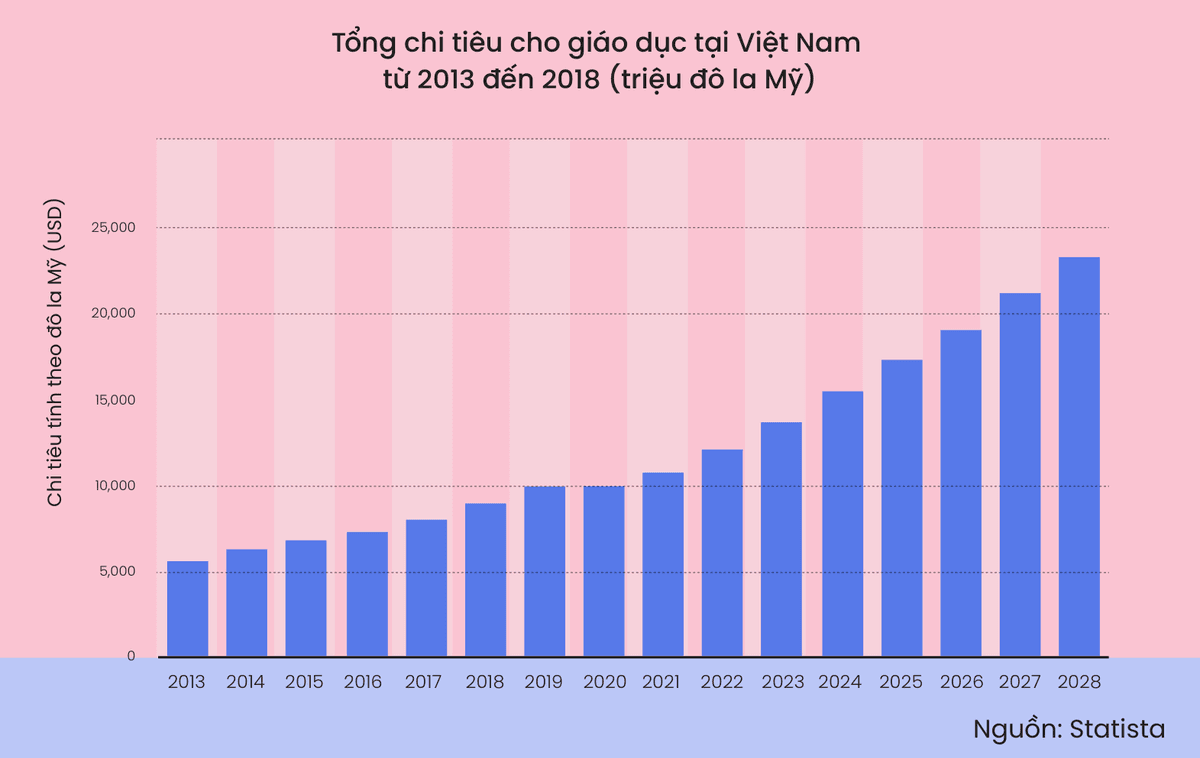
On the demand side, Statista's 2023 dataset shows steady expansion in Vietnamese household education expenditure across the 2013–2028 horizon (the chart's horizontal axis runs through 2028, though the original slide header misprinted 2018). Between 2023 and 2028, total consumer spending on education is forecast to rise by USD 9.7 billion, pushing annual spending past USD 23,000 million by 2028. Rising disposable income encourages urban families to invest more heavily in bilingual programs, international curricula, and specialized enrichment.
Private school expansion, Edtech investment, and enrollment information overload
Growing household budgets have triggered rapid supply expansion across both brick-and-mortar private schools and educational technology (Edtech) platforms:
| Education & Edtech Market Dimension | Benchmark Recorded in Report | Source and Reference Period |
|---|---|---|
| Consumer education spending growth | Projected to expand by USD 9.7 billion from 2023 to 2028 | Statista (2023 forecast dataset) |
| International and bilingual school growth | Up 4% in Hanoi and 2% in Ho Chi Minh City from 2018 levels | Savills Vietnam (2018–2022 tracking) |
| Short-term Vietnam Edtech funding | Exceeded USD 30 million in the first half of 2023 alone | NIC & Do Ventures (2023 Investment Report) |
| Notable education financing rounds | EQuest raised USD 120 million; Vuihoc secured USD 6 million from TNB Aura | Disclosed financing rounds (May–July 2023) |
| Cumulative Vietnam Edtech venture capital | Roughly 70 funds deployed over USD 400 million into domestic Edtech startups | Dr. Ton Quang Cuong — VNU (as of June 2023) |
| Online education market growth pace | 44.3% compound annual growth rate, ranking among top 10 fastest globally | Edtech Market Report (Ken Research) |
| Global e-learning market scale | Forecast to reach USD 458 billion by 2026; over 520,000 apps released | Global Industry Analysts (via Orbis Research) |
Competition now extends well beyond neighboring campuses. Massive open online courses (MOOCs), digital book libraries, and more than 520,000 educational apps on the App Store and Google Play compete directly for study hours. At the same time, social media information overload forces applicants to sift through dozens of program claims daily, rendering generic enrollment brochures ineffective.
Which three familiar student recruitment tactics remain under-optimized?
Part 1 of the publication examines three marketing tactics that most schools already run, yet rarely execute deeply enough to maximize enrollment conversion.
Vetting academic creator role models and retaining 89% of learners across channels
The first tactic is partnering with key opinion leaders (KOLs) and key opinion consumers (KOCs) during peak admission months. Many universities invite creators to speak at campus Open Days or School Tours because students trust peer perspectives on social networks. A common mistake, however, is selecting talent purely on follower counts as consumer packaged goods brands do.
Educational brands face stricter credibility standards. Featured creators must embody positive academic discipline and personal growth so both students and parents view them as worthy role models. For high school audiences, the report highlights young education-associated creators such as Khanh Vy, Giang Oi, and Khiemslays. Admissions teams can apply the framework for selecting and combining KOLs and KOCs in Vietnam to align creator selection with specific faculty positioning.
The second tactic is multi-platform content distribution built around seamless omnichannel engagement. According to Aberdeen Group research (cited via Softtek in the report), organizations executing consistent omnichannel engagement retain an average of 89% of their customers. Simply reposting identical text announcements and static flyers across Facebook, websites, and mobile apps falls short. Marketing teams need to adapt core program insights into short-form video, infographics, and multi-image carousels tailored to mobile habits.
Turning recruitment webinars into employer-linked career orientation
The third tactic involves online seminars (webinars) and thematic talkshows. Post-pandemic learners quickly tune out one-way webinars that feature only internal faculty reciting admission rules.
To drive real application intent, institutions should co-host career sessions with corporate employers operating in the same talent value chain. The report cites British University Vietnam (BUV), which pairs academic talks with career workshops, company tours, and early internships at partner firms while students are still enrolled. Similar industry-academia bridges appear in university-enterprise training and internship partnerships and hands-on student Company Tour programs inside game studios, giving applicants tangible proof of career outcomes.
Should education marketing innovation start with internal culture, personalized Edtech, or branded content?
In Part 2, Adsota argues that sustainable breakthroughs in school branding never come from isolated ad hacks. Institutions must align three pillars: responsive educational content, stage-adaptive media strategy, and data-driven performance measurement.
Aligning internal culture and closing the personalization gap in Edtech
An overlooked foundation of school marketing is internal communications. Clear operating rules, unified workflows, and shared organizational culture ensure faculty and admissions counselors deliver on external brand promises. If a school positions itself around critical thinking and youthful dynamism, internal staff training and campus initiatives must practice those exact traits first.
On the instructional technology side, online learning delivers three clear content advantages: flexible scheduling, self-paced progression, and rich digital libraries. Conversely, pure online formats still struggle with two structural constraints: limited hands-on social interaction and difficulty monitoring learner progress closely.
Across Vietnam, most Edtech platforms still deliver uniform lessons to every user rather than adapting to individual learning gaps. Personalized learning focuses on diagnosing what motivates each student and tailoring instructional pacing accordingly. Institutions that embed true diagnostic personalization into their academic model gain a durable point of differentiation.
Governing branded content through measurable performance metrics
Effective branded content serves two purposes at once: delivering practical utility to families and sparking genuine demand for enrollment. Strong educational storytelling rests on three creative standards:
- Expressing institutional mission and core values. Content should reflect the school's academic philosophy, human values, and practical career standards.
- Evoking authentic emotional resonance. Stories must address real exam anxiety, major-selection doubts, and family aspirations rather than listing facilities mechanically.
- Maintaining a consistent brand personality. Visuals and tone of voice must match the institution's identity, whether youthful and experimental or rooted in international academic rigor.
To prevent subjective content decisions, Adsota applies a Content Performance (CP) methodology combining emotional engagement indicators with conversion tracking across three disciplined steps:
- Define explicit objectives upfront. Clarify whether each content asset targets awareness, lead capture, or completed applications before choosing evaluation metrics.
- Aggregate and segment cross-functional data. Combine sales counselor logs, search trends, and competitor benchmarks into a unified dataset, then slice performance by timeframe, audience segment, and content format.
- Refresh data continuously across admission cycles. Applicant sentiment shifts rapidly around national exam milestones, requiring editors to adjust messaging as soon as engagement or inquiry quality dips.
How do school-choice priorities diverge between Northern and Southern parents while converging among students?
Within K-12 and higher education, identical demographic brackets often hide sharply different decision triggers. Across nationwide enrollment campaigns, Adsota's planning team observed clear regional differences between parents in Northern and Southern Vietnam, even as students across both regions grow increasingly aligned:
| Decision-Maker Segment | Core Selection Priorities | Campus & Learning Environment Expectations | Cultural Drivers & Messaging Implications |
|---|---|---|---|
| Parents in Northern Vietnam | Rigorous evaluation of holistic quality combining deep academic knowledge and soft skills | Accomplished faculty, modern teaching facilities, and structured peer networking | Strong social pressure around institutional prestige and high-prospect majors; emphasize academic rigor and proven outcomes |
| Parents in Southern Vietnam | Institutional reputation, solid foundational knowledge, and balanced personal growth | Strong campus amenities, extracurricular clubs, and multicultural international exposure | Open cross-cultural influences; highlight global communication skills and adaptability to new environments |
| Students across both regions | Affordable tuition matching family budgets, scholarships, fee waivers, and student loans | Practical labs aligned with labor markets, manageable curricula, and corporate internship ties | Social media narrows regional gaps; communicate transparent costs, internship pathways, and graduate employability |
Millennial parents in the AI era and public-private partnerships for soft skills
Examining generational shifts, Nguyen Danh Quan — Creative Leader and Creative Planner at Adsota — notes that Millennial parents preparing children for national high school exams face rapid disruption from artificial intelligence (AI). Rather than focusing solely on textbook memorization, parents increasingly prioritize internationalized, transferable skills and emerging majors such as Artificial Intelligence, Psychology, and Event Management.
Among younger applicants choosing universities, Nguyen Danh Quan observes that historical North–South cultural gaps are steadily narrowing through economic growth and online exchange. Northern youths traditionally emphasized academic rigor and study infrastructure rooted in scholarship-driven social mobility, whereas Southern youths leaned toward extracurricular life and campus service experience. Today, learners nationwide expect both academic depth and vibrant campus life.
Employer expectations reinforce this shift. In LinkedIn's Global Talent Trends 2019 report, over 90% of hiring managers stated that soft skills matter just as much as hard technical skills. To close capability gaps, public-private partnerships (PPP) in education have gained traction, allowing public schools to co-invest in modern labs or contract specialized private providers for foreign languages, technology, STEM, and extracurricular training.
How can schools connect UTM tracking and CRM pipelines to lift enrollment conversion and student retention?
A costly operational failure in education marketing is running disconnected ad tools and standalone spreadsheets, causing leads to leak between marketing campaigns and admissions counselors. To minimize drop-offs from initial inquiries to marketing-qualified leads (MQLs), sales-qualified leads (SQLs), and enrolled students, Adsota deploys a three-step automated tracking and customer relationship management (CRM) architecture:
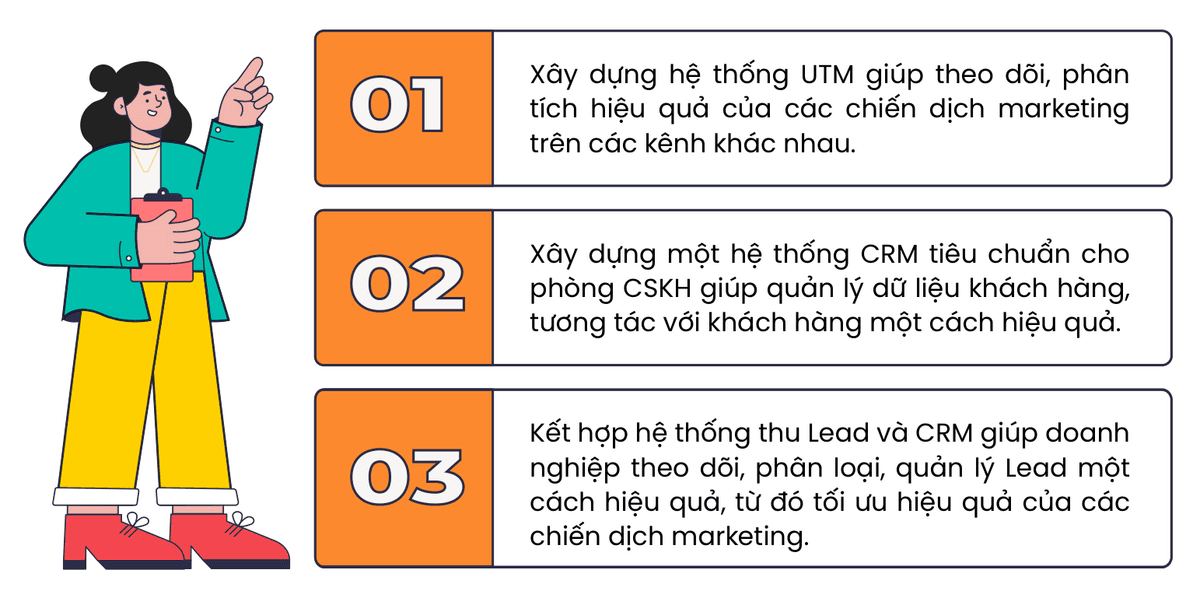
Each layer in this data pipeline eliminates a specific bottleneck in institutional recruitment:
| Implementation Stage | Core Technical Component | Enrollment Management Goal | Operational Risk Eliminated |
|---|---|---|---|
| Step 01: Standardized UTM architecture | Unified Urchin Tracking Module (UTM) tags across every paid, social, and search touchpoint | Attribute inquiry volume and quality accurately to individual channels and creative angles | Ends blind budget allocation and unattributed application forms |
| Step 02: Standardized counseling CRM | Dedicated CRM workspace tailored for admissions counseling and student support teams | Centralize contact history, counseling status, and program preferences for every prospective family | Removes manual copy-paste errors when handing leads across departments |
| Step 03: Integrated Lead-to-CRM sync | Automated ingestion from multi-channel lead forms directly into CRM for MQL–SQL scoring | Track end-to-end conversion from initial registration through tuition deposit and matriculation | Cuts late-stage lead leakage and flags under-enrolled faculties early |
From an integrated marketing communications (IMC) execution standpoint, Pham Van Nam — Senior Digital Marketing Executor at Adsota — emphasizes that multi-platform mixes across Facebook, Google, and TikTok must start from sharp brand strengths and verified applicant insights. For universities, success means hitting total headcount targets while keeping enrollment balanced across faculties rather than leaving niche majors under-filled. As Pham Van Nam states: "The defining quality metric of an enrollment campaign is the conversion rate from registered admissions leads to enrolled students."
Retaining current learners through Maslow's esteem and self-actualization tiers
Acquiring new applicants consistently costs far more than retaining and nurturing current learners. Combining digital marketing tools with CRM data and AI segmentation lets institutions tailor support around existing students' demographics and academic progress.
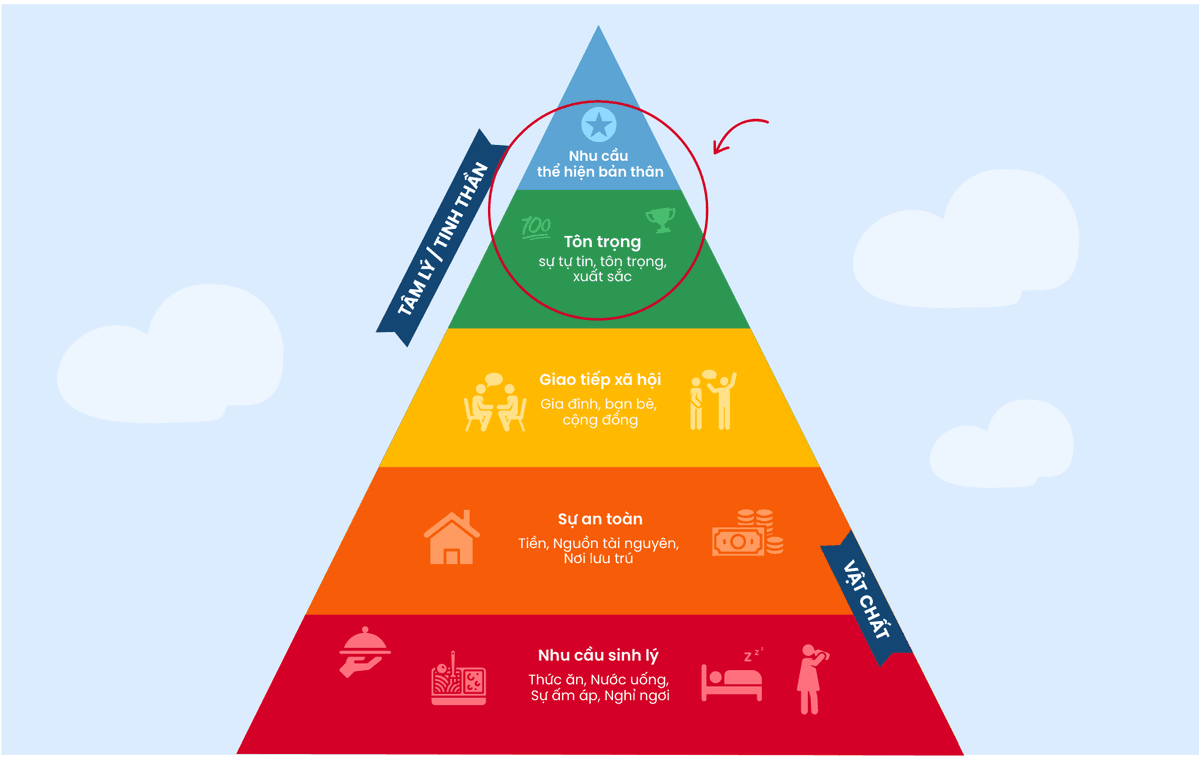
Mapped against Maslow's hierarchy of needs, the top two psychological tiers represent esteem (confidence, recognition, academic excellence) and self-actualization. When schools use data to recognize student milestones and validate families' enrollment choices, current learners feel valued within their peer community and naturally advocate for the school during future admission cycles.
Drawing on the report's findings, school boards and education marketing leaders can prioritize four actions ahead of the next intake:
- Upgrade institutional websites into career-outcome hubs. Publish clear tuition schedules, scholarship rules, course syllabi, graduate employment rates, and corporate partner lists on every program page to convert the 69.9% of students researching via school websites.
- Separate parent and student messaging by regional priorities. Highlight academic rigor and career stability for Northern parents, emphasize international exposure and extracurricular depth for Southern parents, and foreground financial aid plus internships for students nationwide.
- Connect multi-channel UTM tracking directly into admissions CRM. Shift agency and internal KPIs away from raw cost-per-lead toward lead-to-enrolled-student conversion rates and balanced quota fulfillment across faculties.
- Build structured retention programs for current students and alumni. Pair CRM milestone tracking with student recognition, industry clubs, and employer networking; explore additional campaign frameworks across our marketing and creator economy insights.
This web edition synthesizes the source-verified market benchmarks and enrollment conversion frameworks for education leaders. Readers can complete the download form on this page to access the full 29-page PDF compiled by Adsota, including the original visual layouts and complete specialist commentary.
Sources
- E-Magazine 08: Marketing giáo dục mùa 2 — Đổi mới và sáng tạo trong kỷ nguyên 4.0, Công ty Cổ phần Adsota Việt Nam, 2024-01-15, accessed 2026-10-30
- Consumer Market Insights: Education Spending in Vietnam (2013–2028), Statista, 2023-09-01, accessed 2026-10-30
- Báo cáo Đầu tư công nghệ và đổi mới sáng tạo Việt Nam 2023 (Vietnam Innovation & Tech Investment Report 2023), Trung tâm Đổi mới sáng tạo Quốc gia (NIC — Bộ Tài chính) & Do Ventures, 2023-06-21, accessed 2026-10-30
- Báo cáo Công nghệ Giáo dục Việt Nam 2023 và số liệu vốn đầu tư Edtech đến tháng 6/2023, TS. Tôn Quang Cường (Trường Đại học Giáo dục — ĐHQGHN) & Ken Research, 2023-07-08, accessed 2026-10-30
- Global E-Learning Market Trajectory & Analytics (2020–2026), Global Industry Analysts Inc. (dẫn qua Orbis Research), 2022-04-15, accessed 2026-10-30
- Khảo sát kênh tra cứu tuyển sinh đại học và nghiên cứu 5 yếu tố chọn trường đại học của học sinh THPT, Báo Thanh Niên & ThS. Mai Thị Quỳnh Như (Trường Đại học Duy Tân), 2023-04-10, accessed 2026-10-30
- Thống kê tăng trưởng hệ thống trường quốc tế và song ngữ tại Việt Nam từ năm 2018, Savills Việt Nam, 2023-05-15, accessed 2026-10-30
- Omni-Channel Customer Care: Empowered Customers Demand a Seamless Experience, Aberdeen Group (dẫn qua Softtek), 2022-08-01, accessed 2026-10-30
- Global Talent Trends 2019, LinkedIn, 2019-01-28, accessed 2026-10-30