
E-Magazine: The State of Gaming Creators in Vietnam
Published by Appota and OTA Network, this E-Magazine analyzes gaming creators in Vietnam across livestreaming platforms, audience demographics, monetization models, creative trends, and structural barriers. Appota survey data shows 75.8% of viewers are aged 13–22, 89% of creators have under one million followers, 40.6% earn brand sponsorship income, and 84.1% prioritize live fan interaction.
An executive analysis of gaming creators in Vietnam from Appota and OTA Network: 75.8% Gen Z viewership, five monetization models, booking rate benchmarks, and MCN ecosystems.
Key findings
- 75.8% Gen Z viewersCombined share of viewers aged 13–22 following gaming streamers in Appota's audience survey (40.8% aged 18–22 and 35% aged 13–17), driving high mobile engagement volume.
- 89% under 1M followersCreator supply concentrates heavily in Micro (48%, 10,000–100,000 followers) and Medium (41%, 100,000–1M followers) tiers, while the top 11% in Macro (6%) and Celebrity (5%) capture most sponsorship budgets.
- 40.6% earn brand dealsShare of surveyed creators earning ancillary income from sponsorships, events, and brand bookings, with per-livestream rates spanning USD 250+ (Micro) to USD 2,000+ (Celebrity) (Appota).
- 9.1M hardcore fansVietnam's hard-core esports fan base in 2021 according to Statista—expanding 3.25x from 2.8 million in 2016 atop an addressable pool of 18 million users who have played esports.
- 80.2% watched moreShare of viewers who spent more time watching gaming creators during COVID-19 outbreaks (averaging 2.2 hours/day per VIRESA), yet only 43.8% of creator channels gained interaction while 40.7% declined.
- 50.2% and 84.1%Share of viewers citing entertainment and live interaction as their primary draw (50.2%, ahead of 29.3% watching for gameplay skills), aligned with 84.1% of creators prioritizing fan engagement.
- 3x viewer retentionRetention lift recorded in the AR-enabled Talkshow Mentos livestream delivering 150–250 facial-expression ad pop-ups per hour (Adsota), alongside 10M+ reach in Sendo's SenLive tournament.
Which three core pillars structure livestreaming and gaming creators in Vietnam?
Pandemic disruptions across 2020 and 2021 halted outdoor entertainment events while accelerating online media consumption across Southeast Asia. That shift elevated gaming creators in Vietnam from informal hobbyist broadcasters into an organized commercial media channel. In this March 2022 E-Magazine, Appota and OTA Network map Vietnam's game streaming market around three interdependent pillars:
- Gaming Creators: Broadcasters who play games live, provide real-time commentary, and interact directly with viewers while acting as key opinion leaders (KOLs) shaping community tastes.
- Livestreaming Platforms: Distribution networks providing low-latency video delivery, real-time chat tools, social sharing, and ad or virtual-gifting monetization infrastructure.
- Gaming and Esports Communities: Casual gamers and dedicated esports fans who form the core viewership base, generating watch hours, chat engagement, and commercial demand.
Platform competition from 2017 to 2021 under an ad-funded free-to-watch model
Unlike subscription video-on-demand services, almost every livestreaming platform operating in Vietnam runs on a free-to-watch model for end users. Platform operators monetize traffic primarily through inserted advertising inventory and revenue sharing on virtual fan gifts. Consequently, streamers tailor broadcast schedules and creative formats to each platform's discovery algorithm to maximize concurrent viewers and live chat velocity.
Historically, organized game streaming appeared in Vietnam around 2014 (led early on by TalkTV) before entering fierce multi-platform competition between 2017 and 2021 following Twitch's global rise. International tech giants and regional publishers invested heavily in exclusive talent contracts across two complementary platform categories:
| Platform Category | Prominent Platforms in Vietnam (2017–2021) | Strategic Role in a Creator's Growth Funnel |
|---|---|---|
| Dedicated game streaming platforms | Facebook Gaming, YouTube Gaming, Nimo TV, Booyah! (Garena / Sea Group), Nonolive, Cube TV, Garena Live | Primary broadcast home for multi-hour gaming sessions; optimized for real-time fan interaction, ad-break monetization, and virtual gifting |
| Non-game social and live networks | Facebook profiles/Fanpages, TikTok, Instagram, Bigo Live | Secondary discovery channels for short-form video highlights, lifestyle photos, and casual clips that expand personal brand reach to mainstream audiences |
How do Gen Z audiences, follower tiers, and five revenue streams shape gaming creators in Vietnam?
Chapter 2 examines viewer demographics alongside the commercial economics of professional streaming. Understanding the gap between raw engagement volume and immediate purchasing power helps marketing leaders price sponsorships accurately.
A 75.8% Gen Z audience base and a common brand misconception on direct conversion
According to Appota's viewer survey, audiences following gaming creators skew heavily toward youth cohorts. Young adults aged 18–22 represent the largest bracket at 40.8%, followed closely by teenagers aged 13–17 at 35%. Combined, Gen Z viewers aged 13–22 account for 75.8% of total audience share; the remaining segments comprise ages 23–27 (12.7%), 27–32 (6.5%), over 32 (3.8%), and under 13 (1.2%).
A frequent mistake among brands entering game streaming is judging early campaigns solely on immediate high-ticket retail sales. Because most 13–22-year-old viewers are students or early-career entrants, their discretionary spending power remains moderate. Their primary commercial value lies in high-frequency digital attention: Vietnamese users spend an average of 5.1 hours daily on smartphones, watch esports livestreams for 2.2 hours per day, and willingly watch mobile video ads for an average of 19 seconds (according to VIRESA and Appota benchmarks).
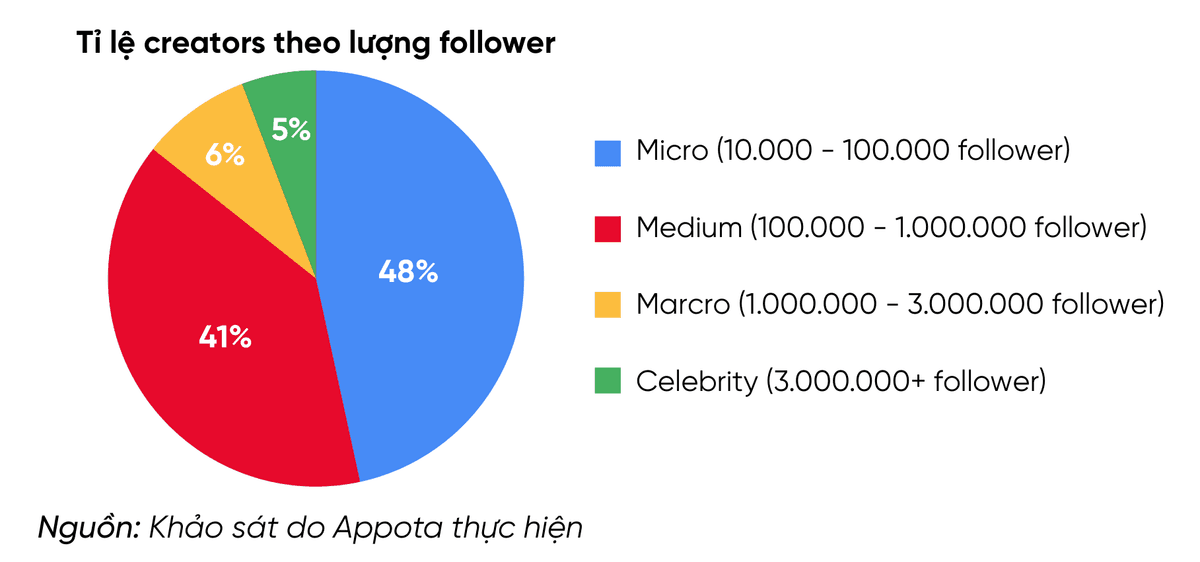
On the creator supply side, Appota's follower-tier segmentation reveals a steep pyramid. Micro creators (10,000–100,000 followers) make up 48% of the market and Medium creators (100,000–1,000,000 followers) account for 41%, meaning 89% of active streamers operate below the one-million-follower threshold. At the apex, Macro creators (1,000,000–3,000,000 followers) and Celebrity creators (over 3,000,000 followers) represent just 6% and 5% respectively, led by veteran personalities such as Do Mixi, ViruSs, PewPew, MisThy, and Linh Ngoc Dam.
Five creator monetization channels and advertising booking rate benchmarks
The report identifies five complementary income streams supporting full-time and semi-professional streamers in Vietnam, blending predictable platform stipends with brand-driven upside:
- Platform base stipends and ad-break revenue sharing: Beyond fixed monthly pay tied to contracted broadcast hours on Facebook Gaming, YouTube Gaming, Nimo TV, Nonolive, or Booyah!, creators earn a share of mid-roll ad-break inventory purchased by advertisers through the host platform.
- Brand advertising bookings and event appearances: In Appota's creator survey, 40.6% of respondents (rounded to 40% in the text narrative) reported earning ancillary revenue from brand sponsorships, commercial bookings, and offline or online events, whereas 59.4% had not yet unlocked sponsor deals. Standard commercial deliverables span sponsored social posts, television or online video commercials (TVCs), in-stream overlay banners, and live product-experience streams.
- Esports tournament prize pools: Mechanically skilled streamers compete in professional circuits—exemplified by Chim Se Di Nang in Age of Empires—or grassroots community tournaments to earn prize money while reinforcing competitive credibility.
- Personal merchandise and off-stream retail ventures: Top-tier creators monetize fan loyalty through branded apparel and packaged snacks—such as Do Mixi's MixiShop—or expand into food-and-beverage outlets like MisThy's MisMenu eatery and hospitality ventures by Linh Ngoc Dam.
- Direct viewer tipping (Fan Donations): Fans support favorite broadcasters natively during streams—such as buying Facebook Gaming "Stars" priced in the report's illustration from VND 45,000 (95 stars) and VND 109,000 (250 stars) up to VND 219,000 (530 stars) and VND 449,000 (1,200 stars)—or through third-party local tipping gateways including PlayerDuo (
playerduo.com) and Ung Ho Toi (unghotoi.com).
To provide media planners with transparent budgeting anchors, Appota's survey details baseline advertising booking rates across five follower brackets and three core deliverable formats:
| Creator Tier | Follower Range | Market Share | Sponsored Livestream (USD) | Sponsored VOD Video (USD) | Social Media Post (USD) |
|---|---|---|---|---|---|
| Micro | 10,000 – 100,000 | 48% | USD 250+ | USD 180+ | USD 80+ |
| Medium (Sub-tier 1) | 100,000 – 500,000 | 41% (combined) | USD 320+ | USD 300+ | USD 80+ |
| Medium (Sub-tier 2) | 500,000 – 1,000,000 | 41% (combined) | USD 420+ | USD 400+ | USD 120+ |
| Macro | 1,000,000 – 3,000,000 | 6% | USD 850+ | USD 700+ | USD 220 – 420 |
| Celebrity | 3,000,000+ | 5% | USD 2,000+ | USD 2,000+ | Over USD 800 |
The commercial impact of combining multiple creator tiers appears in the Streamer Tranh Ba — Sendo Championship 2020 case study (executed March 23–27, 2020) promoting e-commerce marketplace Sendo's SenLive feature. Rather than relying on a single celebrity endorsement, the campaign assembled creators spanning 107,000 to 3 million followers—including Nam Blue (3M), Quang Cuon (2.2M), Nhu Hexi (1.6M), Ha Mi (1.3M), Hoa Nhat Huynh (930K), Hy Nam (334K), and Tuan Tien Ti (107K)—for live esports showmatches and interactive minigames. Paired with data-targeted ad distribution across fan segments, the campaign generated over 10 million reach, 800,000+ engagements, and 20,000+ shares.
Which three growth drivers fueled game streaming—and why did pandemic performance diverge?
The E-Magazine traces the rapid expansion of Vietnam's creator ecosystem to three structural tailwinds: mobile broadband penetration, habitual daily esports engagement, and COVID-19 stay-at-home behavioral shifts.
A 61-million smartphone user base and 9.1 million hard-core esports fans
At the telecom infrastructure layer, 77% of Vietnam's population uses the Internet for an average of 6.5 hours per day. Smartphone users reached 61 million (averaging 5.1 hours of daily usage), while social media penetration among Gen Z hit 90%. On Android devices, games account for 64.7% of all app downloads in Vietnam, driving 400,000 hours of gaming livestreams watched daily and making gaming the most-watched content vertical on Facebook Gaming.
Appota's weekly habit surveys across Vietnam's pool of 18 million esports players underscore how deeply gaming integrates into everyday routines:
| Weekly Activity Frequency | Esports Livestream Viewing Share (Appota) | Active Esports Gameplay Share (Appota) |
|---|---|---|
| Every day | 45.5% | 52.5% |
| 4 – 5 times per week | 16.5% | 22.2% |
| 2 – 3 times per week | 24.8% | 18.9% |
| Once per week | 8.9% | 4.9% |
| Do not watch / Do not play | 4.2% | 1.5% |
Over half of surveyed players (52.5%) play esports titles daily for nearly 3 hours on average (the report's online comparison chart records 3.0 hours/day watching online esports content, approaching the 3 hours 24 minutes spent watching traditional sports online). Meanwhile, 45.5% of viewers watch esports streams every single day. Broader device preferences and in-game spending patterns across this same community are detailed in the Vietnam Esports Whitebook 2021.
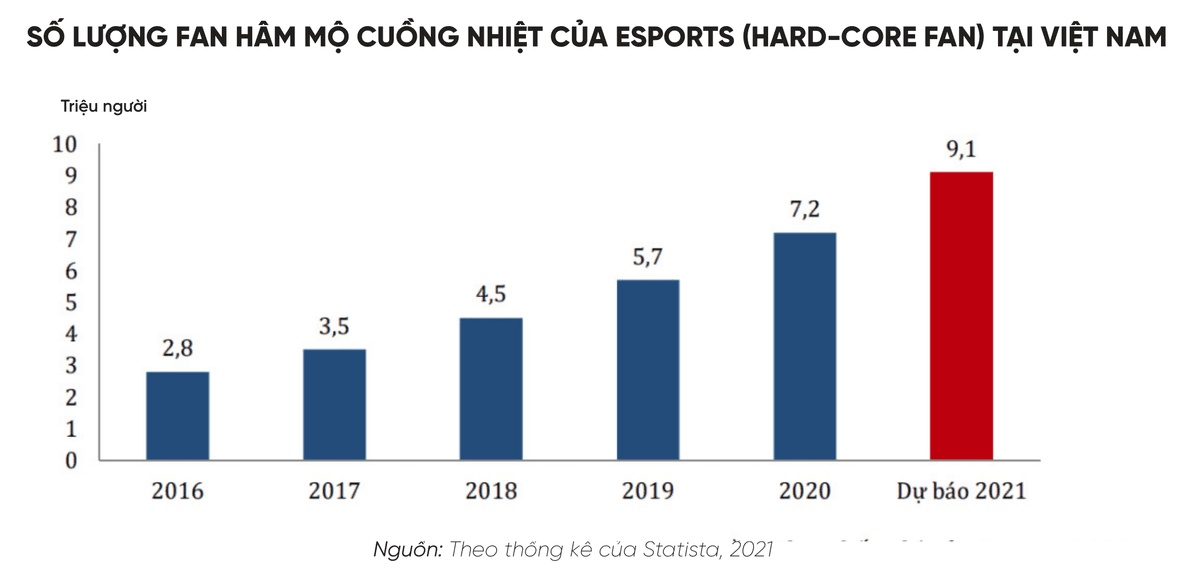
Statista's 2021 market series reinforces this demand trajectory: Vietnam's hard-core esports fan base expanded 3.25x over five years, climbing from 2.8 million in 2016 to 3.5 million (2017), 4.5 million (2018), 5.7 million (2019), 7.2 million (2020), and a projected 9.1 million in 2021—roughly half of all users who had ever played esports. Long-lived competitive titles create a two-way flywheel between game communities and creator fandoms across four flagship games:
- Teamfight Tactics (Dau Truong Chan Ly): Turn-based auto-battler pacing leaves streamers free to converse extensively with chat; favored by ViruSs (4.2M followers), PewPew (4.1M), Nang (630K), Manh An (495K), and Duc Manh (439K).
- Arena of Valor (Lien Quan Mobile): Fast 10–15-minute mobile MOBA matches with massive local player density; anchored by Thay Giao X (1.5M), Cong Kien (1.3M), Ha Mi (1.2M), Tung Hoa Mi (1M), and Dang YM (882K).
- League of Legends (Lien Minh Huyen Thoai): PC MOBA cornerstone with deep competitive heritage and retired pros transitioning into streaming; represented by Trau TV (1.4M), Thuy Tien (1.4M), Hoa Nhat Huynh (930K), Sadness Ezreal (80K), and Duy Com TV (60K).
- PUBG Mobile: High-tension mobile battle royale supporting squad showmatches; led by Nam Blue (3M), ABCT36 Gaming (626K), Giang Black (464K), VyVy (422K), and Du Dang (370K).
The COVID-19 paradox: 80.2% of viewers watched more, yet 40.7% of creator channels lost engagement
During Vietnam's 2020–2021 COVID-19 waves, 80.2% of surveyed community members (rounded to 80% in prose) reported spending more time watching gaming creators, compared with 19.8% who did not. At face value, surging aggregate watch time suggested an effortless windfall for every broadcaster.
Creator-side survey results reveal sharp competitive polarization instead. Only 43.8% of surveyed creators saw higher per-stream interaction than pre-pandemic baselines—comprising 37.5% with modest gains and just 6.3% achieving breakout growth (summarized as 43% in prose). Conversely, 15.6% saw flat engagement and 40.7% suffered declining interaction (21.9% slight decline and 18.8% sharp drop). As thousands of newcomers started streaming simultaneously during lockdowns, curious viewers sampled new channels briefly, but sustained retention concentrated strictly around creators with distinctive personalities.
How are interactive entertainment, AR ad technology, and MCN agencies reshaping creator content?
Chapter 3 documents a structural shift in creative strategy: moving beyond pure mechanical gameplay toward interactive talk entertainment, cross-platform lifestyle storytelling, augmented reality (AR) ad integration, and professional agency management.
Why 50.2% of viewers prioritize live interaction—and how AR tripled viewer retention
In the early years of game streaming, elite mechanical skill alone could anchor a channel. By 2021–2022, Appota's paired surveys of viewers and creators confirmed that personality-driven interaction had overtaken pure gameplay mastery:
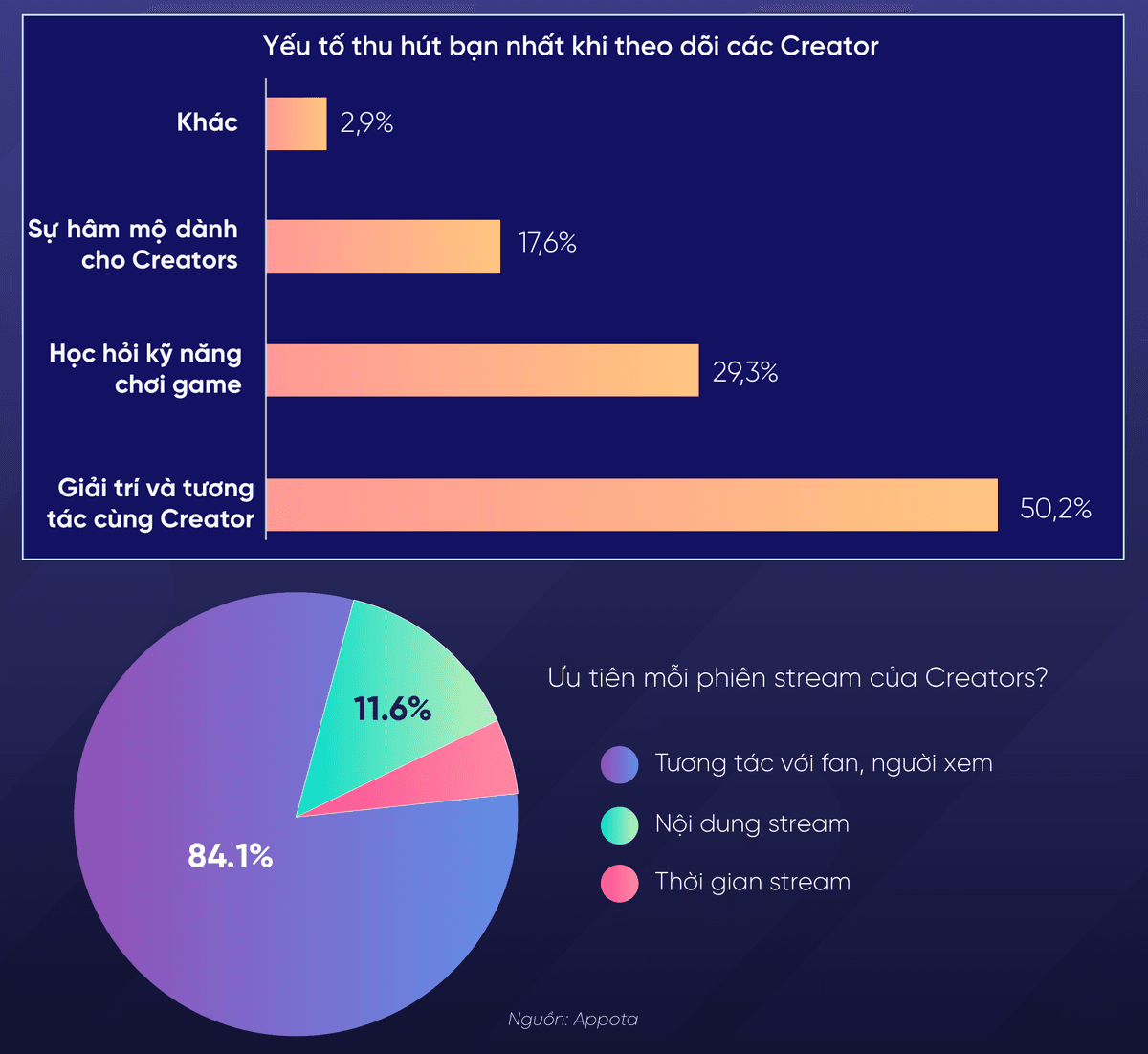
Slightly over half of surveyed viewers (50.2%) named entertainment and real-time interaction with the streamer as their primary reason for watching—far ahead of learning gameplay skills (29.3%), pre-existing personal fandom (17.6%), and other factors (2.9%). Creators recognized this demand clearly: 84.1% ranked interacting with fans and viewers as their single highest priority in every broadcast, eclipsing stream topic scripting (11.6%) and broadcast duration (4.3%).
Building on interaction-first programming, three creative and commercial trends gained momentum across Vietnam:
- Viewer-participatory community tournaments and multi-platform lifestyle formats: Leading streamers co-organized open community cups with Nimo TV, Cube TV, Facebook Gaming, and 500Bros—including MixiGaming's Custom PUBG, Allstar PUBG, and ABCT36 Challenge, while the Ao Lang All Star tournament (December 30, 2020) drew 3.4 million YouTube views. Creators simultaneously expanded onto TikTok short videos, daily vlogs, life-advice talkshows (Do Mixi), original music videos (Stream Den Bao Gio), and music-theory reaction streams (ViruSs).
- Crossover appearances on mainstream television gameshows: Social followings in the millions propelled gaming personalities such as PewPew, MisThy (Giong Ai Giong Ai, Manh Ghep Tinh Yeu), and CrisDevilGamer (Nhanh Nhu Chop) onto prime-time television, legitimizing streaming as mainstream entertainment.
- Augmented Reality (AR) ad triggers synced to streamer facial expressions: Moving past static banner overlays, Adsota documented the "Talkshow Mentos" livestream featuring creators Thay Giao X and Cong Kien. Production engineers applied AR facial-expression tracking to trigger contextual Mentos brand pop-ups automatically whenever streamers reacted on camera, delivering 150–250 organic ad impressions per livestream hour and tripling (3x) viewer retention rates.
Professionalizing talent operations through specialized MCNs and agencies
Starting from 2018 through early 2019, solo independent streaming increasingly gave way to specialized talent agencies and multi-channel networks (MCNs), each focusing on distinct platform ecosystems and commercial functions:
| Agency / MCN Organization | Agency Classification | Core Operational Scope in Vietnam |
|---|---|---|
| Creatory | Influencer Marketing Agency | Executes brand influencer campaigns; manages talent and produces video content for creators (with core strength on YouTube) |
| OTA Network | Gaming Creators Network Agency | Manages and supports exclusive Facebook Gaming creators in Vietnam during the report period; brokers influencer sponsorship campaigns |
| Box Studio | Esports Agency | Produces esports tournaments and gaming events; manages caster/streamer rosters and original content production |
| Takademy | Talent Training Academy | Trains gaming KOL skills (centered on Arena of Valor); advises on content direction, channel operations, and fan-community management |
| V Gaming | KOLs Agency | Coordinates gaming KOL commercial bookings and consults on online gaming content strategy |
Which four barriers constrain creator growth, and what actions should brands prioritize today?
Chapter 4 balances the industry's growth narrative by examining four structural bottlenecks that keep creator attrition high across Vietnam.
VND 30–40M upfront hardware costs, an 11% top-tier bottleneck, and training gaps
The first barrier is high upfront equipment and paid-discovery costs relative to average youth incomes. A desktop PC powerful enough to run modern games while encoding live video costs at least VND 20 million; adding a quality camera and microphone raises minimum hardware investment to VND 30–40 million. Beyond hardware, emerging streamers must fund custom visual branding (overlays and backgrounds) and spend VND 500,000 to several million VND per livestream session on Facebook or YouTube ad boosting to reach relevant game audiences.
The second barrier is intense competition and top-heavy revenue concentration. Despite constant platform recruitment drives, Appota's survey shows only 11% of Vietnamese gaming creators exceed 1 million followers per platform (6% Macro plus 5% Celebrity)—and that top 11% captures the vast majority of brand sponsorship spending. Addressing how talent can stand out sustainably, Pham Ba Duy — Director of OTA Network — emphasized three non-negotiable principles:
"In truth, the formula here is that there is 'no fixed formula' at all, because every creator brings a unique color and expression. Still, there are three principles no creator can ignore: Sincerity—living authentically both offline and on screen to build bonds with fans that transcend pure economics; Passion—audiences never care if you treat each stream perfunctorily and ignore viewers; and Distinct Personality—'integrating without dissolving,' leaving a memorable signature in viewers' minds so media and audiences remember who you are." — Pham Ba Duy, Director of OTA Network
The third barrier is the absence of standardized vocational curricula. Most studios and agencies train talent through trial-and-error apprenticeship. Although structured incubation initiatives have emerged—such as OTA Plus (by OTA Network) alongside recruitment programs from Box Studio and Nimo TV—training methods remain fragmented across individual organizations, leaving newcomers uncertain when choosing platforms, game titles, and personal positioning.
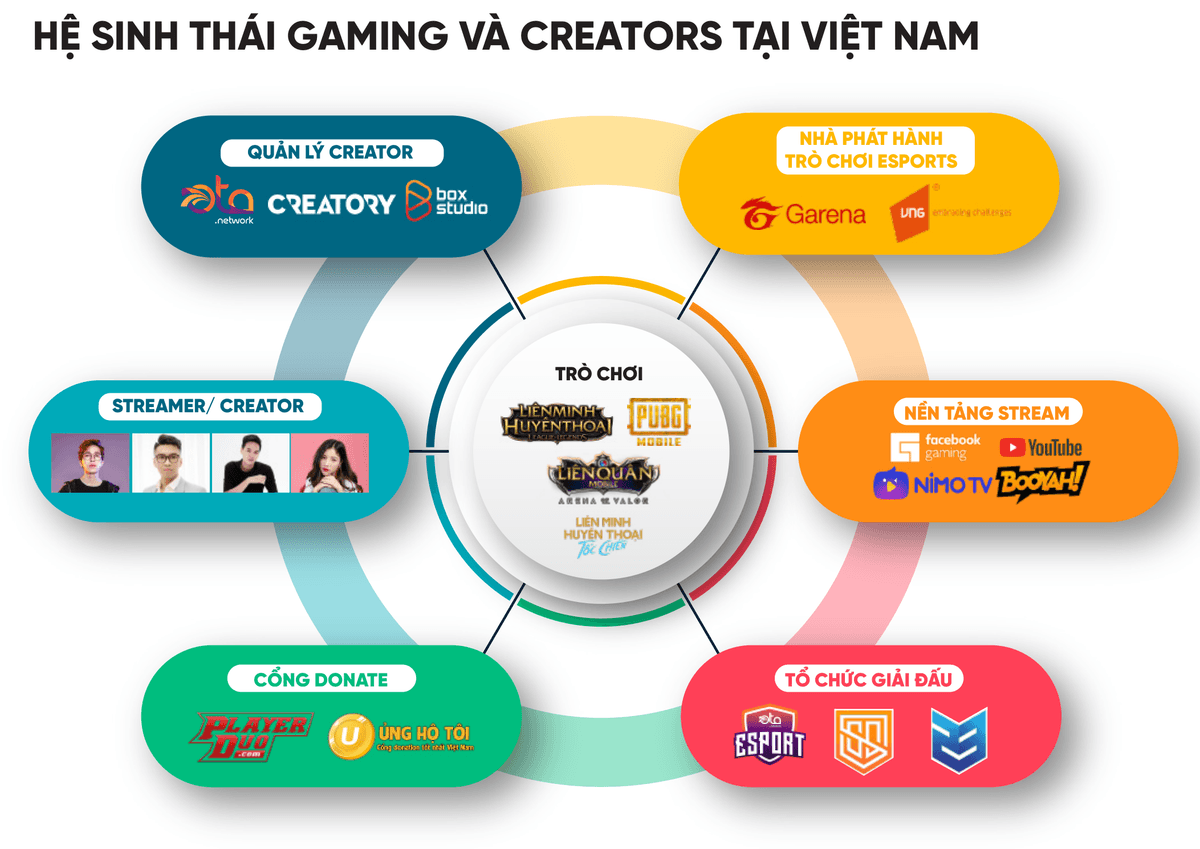
The fourth barrier involves lingering societal skepticism toward gaming careers outside younger demographics. However, the report highlights the SEA Games 31 Organizing Committee's landmark decision to include esports among 40 official medal sports as a turning point placing competitive gaming on par with traditional sports—momentum that accelerated further in subsequent years as documented in the Vietnam Esports Whitebook 2022–2023. Across Appota's ecosystem map, six commercial nodes—Creator Management, Esports Publishers, Streaming Platforms, Tournament Organizers, Donation Gateways, and Streamers/Creators—now form an integrated value chain around core Game IP.
Four priority actions for brands, game publishers, and talent managers
Translating the E-Magazine's foundational benchmarks into Vietnam's current regulatory and commercial landscape, marketing leaders and game studios should execute four priorities:
- Pair top-11% awareness anchors with the 89% Micro–Medium creator base. Avoid concentrating entire campaign budgets on one or two Celebrity streamers when conversion and community depth matter. Brands should combine Macro/Celebrity talent for launch visibility with mid-tier creators (USD 250–420 per live session) using Appota's framework for selecting and combining KOLs and KOCs by campaign objective.
- Replace passive banner overlays with participatory tournaments and AR triggers. Because 50.2% of viewers tune in for live entertainment and grant mobile ads roughly 19 seconds of attention, brands should embed products inside community showmatches (SenLive model) or facial-expression AR integrations (Talkshow Mentos model) to multiply retention.
- Enforce statutory ad disclosure under Vietnam's amended Advertising Law. Effective January 1, 2026, Article 15a of Law No. 75/2025/QH15 Amending and Supplementing the Law on Advertising (guided by Decree 342/2025/ND-CP effective February 15, 2026, and Decree 87/2026/ND-CP effective May 15, 2026) establishes strict legal duties for "advertising product conveyors." Brands and MCNs must supply verified product dossiers, ensure creators genuinely experience promoted offerings, and display explicit sponsorship disclosures during livestreams.
- Align game-launch creator campaigns with G1–G4 local licensing rules. Publishers mobilizing Vietnamese streamers to promote new titles or host community cups must secure local G1–G4 game licenses and comply with virtual-item rules under Decree 147/2024/ND-CP (effective December 25, 2024), following Appota's six-step guide to mobile game publishing in Vietnam; further analyses appear in the marketing and creator economy topic hub.
This web edition synthesizes the verified survey benchmarks, booking rate cards, and ecosystem frameworks from the original publication for business decision-makers. Readers can complete the download form on this page to obtain the full 37-page PDF compiled by Appota Group and OTA Network (featuring campaign intelligence from Adsota), including complete visual infographics, 20 creator profiles across four flagship esports titles, and full brand case layouts.
Sources
- E-Magazine: Tổng quan Gaming Creators Việt Nam (The State of Gaming Creators in Vietnam), Công ty Cổ phần Appota & OTA Network, 2022-03-25, accessed 2026-10-31
- Sách trắng Thể thao điện tử Việt Nam 2021 (Vietnam Esports Whitebook 2021), Hội Thể thao điện tử giải trí Việt Nam (VIRESA) & Appota Esports, 2021-06-01, accessed 2026-10-31
- eSports Market Outlook: Hard-core eSports Fans in Vietnam (2016–2021), Statista, 2021-06-01, accessed 2026-10-31
- Khảo sát phân khúc người theo dõi, báo giá booking, biến động tương tác mùa dịch và ưu tiên nội dung của Gaming Creators Việt Nam, Appota Group & OTA Network, 2022-03-25, accessed 2026-10-31
- Hồ sơ chiến dịch livestream thương hiệu: Streamer Tranh Bá (Sendo SenLive) và Talkshow Mentos ứng dụng AR, Adsota & OTA Network (Appota Group), 2021-12-01, accessed 2026-10-31
- Luật sửa đổi, bổ sung một số điều của Luật Quảng cáo số 75/2025/QH15 và Nghị định 147/2024/NĐ-CP, Quốc hội & Chính phủ nước Cộng hòa xã hội chủ nghĩa Việt Nam, 2025-06-16, accessed 2026-10-31