
Vietnam Esports Whitebook 2021
Issued by the Vietnam Recreational and Electronic Sports Association (VIRESA) and produced by Appota Esports, this inaugural Whitebook maps the Vietnam esports ecosystem across nearly 10,000 surveyed users. Vietnam reached 18 million esports players in 2020, with 75.8% aged 13–22, 70.7% watching on smartphones, and official medal inclusion at SEA Games 31.
VIRESA and Appota Esports' inaugural annual whitebook mapping Vietnam's 18 million esports players, 10,000-user Gen Z survey, nine-pillar value chain, and SEA Games 31 roadmap.
Key findings
- 18M playersEstimated users in Vietnam who had played esports titles out of 40 million total gamers in 2020; regular esports viewers quadrupled from 2 million (2016) to 8 million (2019) (Appota).
- 75.8% Gen ZShare of respondents aged 13–22 in the nearly 10,000-user community survey (40.8% aged 18–22 and 35% aged 13–17), alongside a 69.7% male and 30.3% female split (VIRESA & Appota Esports).
- 58.3% and 70.7%Share of Vietnamese participants using smartphones as their primary device for playing esports (58.3%) and watching esports content (70.7%), far ahead of PC/laptop at 39.5% and 22.3%.
- 55.5% paying usersShare of players who have spent on official esports items despite 56.7% reporting no personal income; payer conversion rises from 51% (ages 13–17) and 57% (18–22) to 64% (23–32).
- 2h 55m daily playAverage daily esports playtime among surveyed Vietnamese players, paired with 52.5% watching esports content daily and clear MOBA leadership (54.1% active play, 54% viewership).
- +81.37% stream viewsSurge in total views on Facebook Gaming in Vietnam during COVID-19 (+79.6% reach and +50% engagement per Adsota), while 80% of surveyed users reported playing and watching more esports.
- USD 950.3M globalRevised 2020 global esports revenue (-0.8% YoY due to canceled offline events, led by USD 584.1M in sponsorships) across 495 million global viewers (+11.7% YoY) (Newzoo).
What do 18 million players reveal about the Vietnam esports ecosystem?
Published in 2021 by VIRESA and produced by Appota Esports, this inaugural report established the first annual baseline for the Vietnam esports ecosystem. Out of 40 million video game players nationwide in 2020, Appota recorded 18 million users who had played competitive esports titles. Readers tracking post-pandemic venue recovery can compare our Vietnam Esports Whitebook 2022–2023.
Part I situates Vietnam within a sharply bifurcated 2020 global market shaped by COVID-19. In Newzoo's October 2020 revision, canceled arena events pushed global esports revenue down 0.8% year-on-year to USD 950.3 million. Newzoo had previously cut its 2020 forecast twice, from USD 1.1 billion in April to USD 973 million in July. Ticket and merchandise revenue fell 50.3% to USD 52.5 million, while publisher fees dropped 11.6% to USD 108.9 million.
Non-venue revenue streams nevertheless continued expanding throughout 2020. Global sponsorships rose 7.5% to USD 584.1 million, and media rights reached USD 163.3 million (+3.3%). Digital revenues climbed 60.9% to USD 21.5 million, while streaming revenue grew 44.9% to USD 19.9 million.
Global audience demand accelerated even faster during lockdowns. Newzoo tracked worldwide viewership rising 11.7% from 443 million (2019) to 495 million in 2020. That audience comprised 223 million esports enthusiasts (~45%) and 272 million occasional viewers. According to Streamlabs Q3 2020 data, Twitch captured 91.1% of live-streamed hours watched (889 billion minutes across 2020, +34% YoY). YouTube Gaming Live held 5.5% of hours watched, followed by Facebook Gaming at 3.4%.
Telecom infrastructure readiness and sixfold domestic player expansion
Vietnam's competitive gaming roots date back to early-2000s PC communities competing at World Cyber Games 2002. Between 2003 and 2008, clan culture matured rapidly, highlighted by StarsBoba's Asian DotA championships. On January 13, 2009, the Ministry of Home Affairs issued Decision 42/QD-BNV establishing VIRESA. Professional publisher investments starting in 2011–2012 then scaled esports into mainstream digital entertainment.
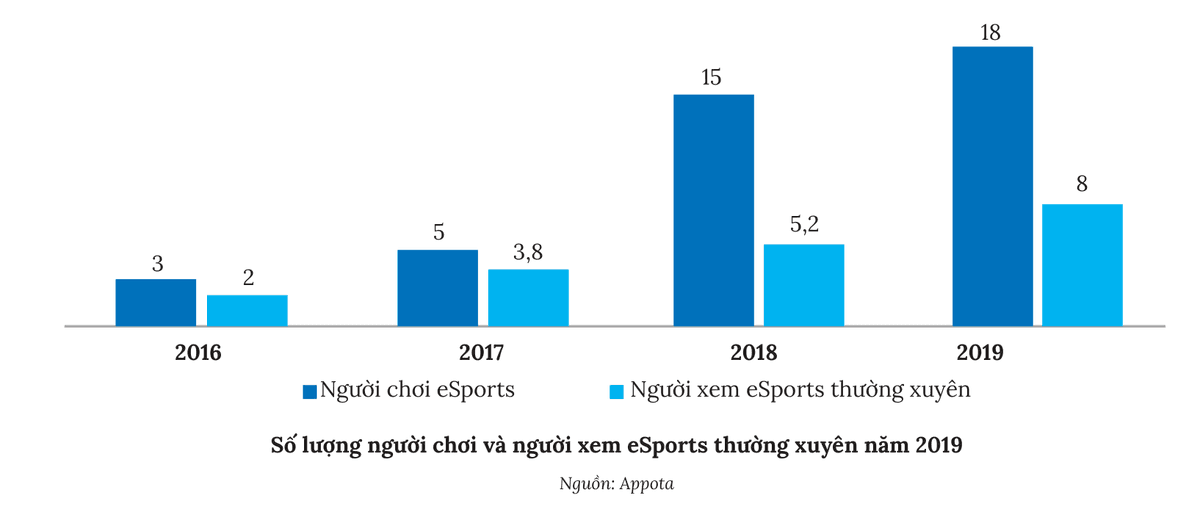
Appota's 2016–2019 market tracker illustrates rapid domestic adoption. Vietnam's esports player base expanded sixfold—from 3 million (2016) to 5 million (2017), 15 million (2018), and 18 million in 2019. Over the same four-year window, regular esports viewers quadrupled from 2 million (2016) to 8 million in 2019.
Expanding mobile connectivity underpinned that surge. In 2020, Vietnam recorded 70% Internet penetration, 45% smartphone ownership, and 43% mobile Internet access. Among smartphone owners, 53% subscribed to 3G or 4G mobile data plans.
In the November 2020 Speedtest Global Index, Vietnam averaged 60.88 Mbps on mobile and 34.51 Mbps on fixed broadband. Among benchmarked Southeast Asian peers, Vietnam's mobile speed trailed only Thailand (66.82 Mbps). Through December 2020, Pops eSports recorded USD 4 million in cumulative tournament prize earnings for Vietnam. That total surpassed Singapore (USD 3.7 million) while trailing Thailand (USD 7M), the Philippines (USD 8.5M), and Malaysia (USD 10M).
Gen Z demographics and payer conversion across nearly 10,000 surveyed users
VIRESA and Appota Esports surveyed nearly 10,000 community members, recording a 69.7% male and 30.3% female split. Most respondents are recent entrants: 75.1% started following esports within the preceding one to five years. Users with two years of tenure accounted for 17.2%, followed by three-year participants at 16.9%.
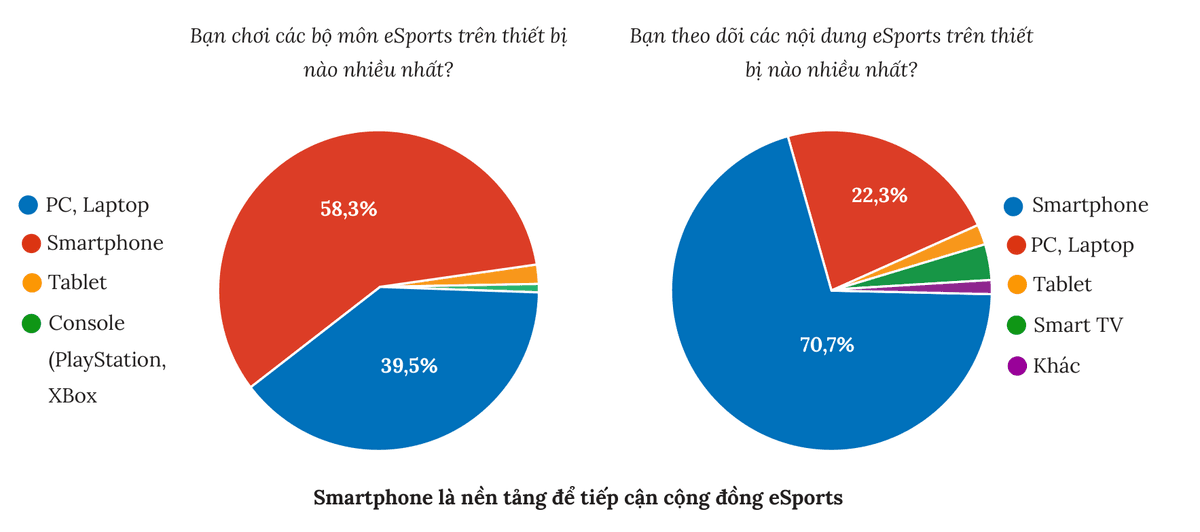
Google and Niko Partners' 2020 report ranked Vietnam second in Southeast Asia for mobile esports tournaments, behind Indonesia. Device preferences explain why: 58.3% of Vietnamese players compete primarily on smartphones versus 39.5% on PC/laptop. Mobile dominance is even sharper in content consumption, with 70.7% watching on smartphones versus 22.3% on PC/laptop.
| Survey Metric (N ≈ 10,000) | Community Share | Behavioral Note |
|---|---|---|
| Gen Z share (ages 13–22) | 75.8% of total | Ages 18–22: 40.8%; ages 13–17: 35% |
| Young adults (ages 23–27) | 12.7% of total | Entering early career earning years |
| No personal income | 56.7% of users | Primarily secondary and university students |
| Earned monthly income | 43.3% of users | VND 2.5–12M (24.6%); 1–2.5M (9.4%); >12M (9.3%) |
| Official item payers | 55.5% of players | Rises from 51% (13–17) and 57% (18–22) to 64% (23–32) |
| Daily play and viewing | 2h 55m daily play | 52.5% watch daily; 2 titles played, 1.75 watched |
| Leading game genres | MOBA 54.1% play | MOBA 54% watch; Battle Royale 19.4% play, 22.1% watch |
| Core motivations | Entertainment 37% | Playing with friends 26.8%; skill mastery 14.8% |
Consumer brands entering gaming often assume that because 56.7% of respondents lack personal income, young players rarely spend. Survey data disproves this assumption. Exactly 51% of 13-to-17-year-olds and 57% of 18-to-22-year-olds have purchased official items, closely trailing ages 23–32 (64%).
How do the nine commercial pillars of Vietnam's domestic value chain interact?
Part II.B maps nine interconnected commercial stakeholders operating around game intellectual property. Those nine pillars comprise publishers, titles, leagues, pro clubs, event agencies, venues, streamers/MCNs, broadcasters/media, and corporate sponsors.
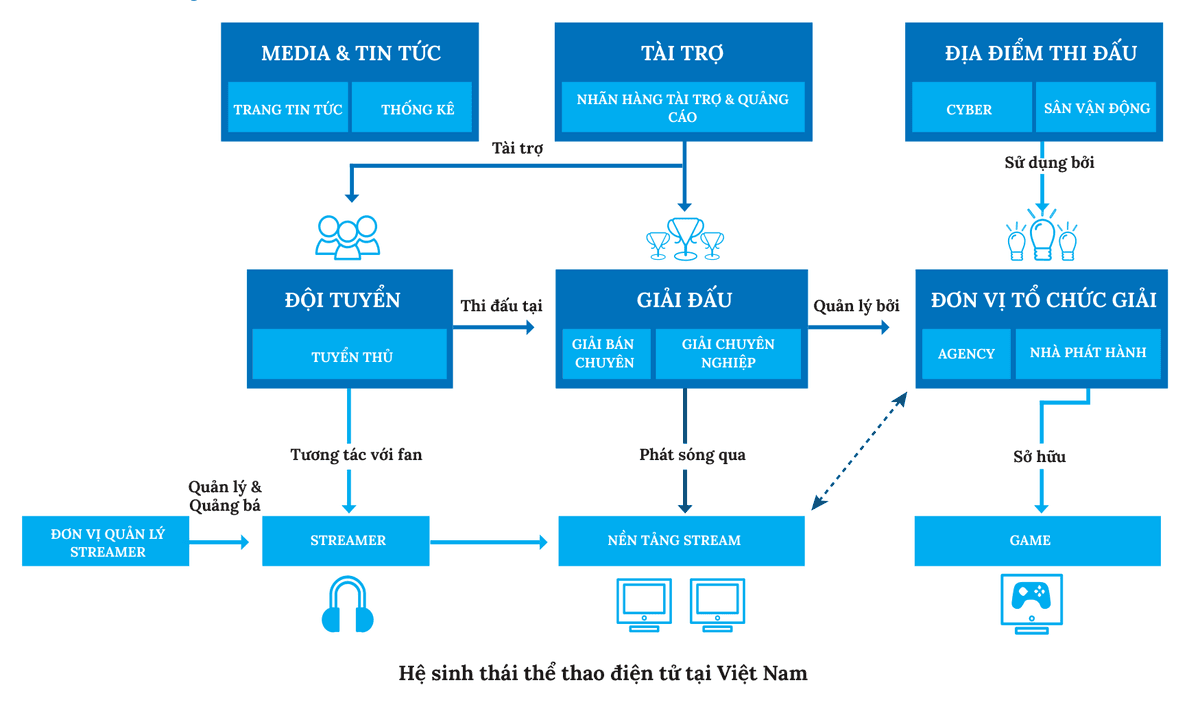
As the diagram illustrates, league financing and IP rights concentrate around licensed domestic publishers. Globally self-published PC and console titles—such as DOTA 2, CS:GO, StarCraft II, and Tekken—rely mainly on smaller grassroots events.
The Garena–VNG publishing duopoly, flagship leagues, and professional clubs
During 2020–2021, competitive publishing centered on a head-to-head rivalry between Garena and VNG, alongside VTC Online (Crossfire):
- Garena: Launched Garena Plus in 2009, introduced League of Legends and FIFA Online 3 in 2011–2012, and scaled mobile hits Arena of Valor (2016) and Free Fire (2017). Its ecosystem reached 30M+ monthly users, 20M+ monthly web visits, and 1.6M+ VETV YouTube subscribers. Its GCafe cafe management software covered 27,000+ cyber cafes and 600,000+ client PCs.
- VNG: Expanded aggressively into esports from 2017–2018 with a broader multi-genre catalog. Key titles included Mobile Legends: Bang Bang, PUBG Mobile, Call of Duty: Mobile, Auto Chess, and LoL: Wild Rift (December 2020).
Publisher investment drove record prize pools across 2020. Twelve flagship tournaments run by VIRESA members totaled VND 14.435 billion in prizes. Arena of Valor's Đấu Trường Danh Vọng grew from 37.5 million views (Spring 2019) to ~90 million views (Winter 2020). Winter 2020 carried an announced VND 2.5 billion purse and VND 2.9 billion in VIRESA's aggregate table.
Three 2020 Free Fire national splits totaled VND 4.5 billion in prize money. VCS (League of Legends) Spring and Summer splits offered VND 1.225 billion each, while PMPL Vietnam S2 awarded VND 1.569 billion across 160 teams. Internationally, AIC 2020 drew 109 million YouTube views and 631,029 peak concurrent viewers (CCV).
Among professional clubs, only a few operate corporate multi-title organizations, led by GAM Esports (290,000 followers) and Team Flash (222,000). Team Flash raised USD 1.5 million, won AWC 2019 and VND 11 billion in 2019 prizes, and swept both 2020 VCS splits. Other multi-title clubs include Heavy (200,000), EVOS (180,000), and V Gaming (~120,000), whereas Saigon Buffalo and Refund Gaming remain single-title squads.
Team Flash CEO Terence Ting placed Vietnam alongside Indonesia and Thailand among Southeast Asia's three core esports markets. He noted Vietnam's strong digital consumption, deep youth talent, and competitive operating costs, while observing that monetization remains in an early phase.
Through October 2020, Esports Earnings ranked four Team Flash Arena of Valor starters atop Vietnam's cumulative prize leaderboard. They were XB (USD 178,302.51), ProE (USD 167,135.99), ADC (USD 156,918.92), and Gấu (USD 156,808.34). League of Legends jungler SofM ranked fifth (USD 133,601.15) and reached the 2020 Worlds Grand Final, drawing 3.8M global peak CCV and 668,000 peak CCV on YouTube Vietnam.
Event agencies, arena tiers, creator MCNs, and non-endemic brand sponsors
Four specialized service layers connect tournament competition to brand monetization:
- Agencies and venues: Agencies such as 500Bros Studio, 23 Creative VN, VPT Studio, GTV, and eFire League manage end-to-end production. Khổng Quốc Hưng (23 Creative VN) emphasized zero-defect live broadcasts and star pros or KOLs as essential audience magnets. Venues span the 1,500 m² Vikings Esports Arena, Pegasus, and Kingdom NextGen up to GG Stadium and the National Convention Center.
- Streamers and MCNs: By October 2020, leading creators included CrisDevilGamer (9M YouTube), MisThy (5.66M), Độ Mixi (4.27M), and PewPew (3.94M). Creator income combines platform contracts, brand deals, and donations via Facebook Gaming, PlayerDuo, PayPal, and Ủng Hộ Tôi. OTA Network Managing Director Phạm Bá Duy highlighted game-specific emotion, authenticity, and personal identity as key retention drivers.
- Broadcasting and press: Free-to-watch streams on Facebook Gaming, YouTube, and Nimo TV pair with television coverage on VTVcab, HTV, VTC, and QPVN. Dedicated portals drew strong traffic in October 2020, led by GameK.vn (8.42M monthly visits), XemGame (1.94M), Game8.vn (1.58M), and 2Game.vn (937,000).
- Corporate sponsors: Alongside endemic tech brands (Viettel, ASUS ROG, Intel, Samsung, Phong Vũ), major FMCG and service brands entered leagues. Active non-endemic sponsors included Clear Men (Unilever), Sting (Suntory PepsiCo), Coca-Cola, Yomost, and Vietjet Air. Viettel Media Director Võ Thanh Hải noted three sponsorship criteria: mobile KPI fit, agency KPI commitments, and pro/caster reputation.
How do legal frameworks, SEA Games 31, and VEC–UEC leagues resolve policy bottlenecks?
In Section II.A.4 and Thematic Study III.E, IPS Director Nguyễn Quang Đồng and VIRESA Secretary General Đỗ Việt Hùng examine regulatory foundations. Both experts stress that clear legal rules and official sports status are prerequisites for institutional capital.
Four regulatory pillars across permits, OTT copyright, and player contracts
Operators in Vietnam must manage compliance across four distinct legal domains:
- Tournament permitting and VIRESA oversight: Events follow the Law on Physical Training and Sports No. 77/2006/QH11 (effective July 1, 2007; amended by Law No. 26/2018/QH14 effective January 1, 2019). Tiered mass-sport permitting follows Ministry of Culture, Sports and Tourism Circular 09/2012/TT-BVHTTDL (effective January 3, 2013). On February 3, 2021, the Ministry issued Circular 01/2021/TT-BVHTTDL (effective March 25, 2021; reporting clauses amended by Circular 09/2022/TT-BVHTTDL effective December 15, 2022). This framework strengthens VIRESA's mandate over 10-title competition rules and professional registration.
- Online content governance and game licensing: In 2021, game content fell under the 2015 Cyberinformation Security Law, the 2018 Cybersecurity Law, Decree 72/2013/ND-CP, and Decree 27/2018/ND-CP. Today, publishers must comply with the superseding Decree 147/2024/ND-CP (effective December 25, 2024). It governs G1–G4 game licensing, player verification, and virtual items under the Ministry of Culture, Sports and Tourism.
- Software copyright and OTT neighboring rights: Games are protected as computer programs under the Law on Intellectual Property No. 50/2005/QH11 (effective July 1, 2006; amended through Law No. 07/2022/QH15 effective January 1, 2023). Independent organizers must secure publisher IP licenses and define neighboring rights for OTT livestream recordings.
- Cooperation contracts and technical force majeure: Agreements uniting players, agencies, and sponsors typically invoke Article 504 of the Civil Code No. 91/2015/QH13 (effective January 1, 2017). Contracts must distinguish business cooperation from employment regarding revenue splits and image rights. Legal contributors advise adding network outages, server failures, and cyberattacks to force majeure clauses.
Official medal status at SEA Games 31 and the VEC–UEC national circuits
In November 2020, esports was officially approved among 40 medal sports for SEA Games 31 in Vietnam under 100% socialized funding. VIRESA President Nguyễn Xuân Cường noted that medal inclusion places esports alongside traditional sports and reduces parental stigma. Official status also expanded international cooperation with AESF, IESF, and KeSPA.
On January 13, 2021, VIRESA launched the Vietnam Esports Championship (VEC) and collegiate University Esports Championship (UEC) to select national teams. Five mobile titles were approved: LoL: Wild Rift, Mobile Legends: Bang Bang, PUBG Mobile, Arena of Valor, and Free Fire. Five PC/console titles completed the slate: League of Legends, FIFA Online 4, Crossfire, DOTA 2, and eFootball PES.
How do digital transformation, 5G, and university clubs unlock future growth?
Part III examines four structural drivers shaping the long-term economics of Vietnam's competitive gaming sector.
Sports digital transformation and online resilience during COVID-19
According to WPP, COVID-19 cut 2020 global traditional sports revenue to USD 73 billion against a USD 135 billion pre-pandemic forecast. Properties like the Tour de France (on Zwift) and the NBA pivoted rapidly toward virtual engagement. In Vietnam, smart-device marathons such as Brave Đà Nẵng drew 3,400+ registrants, while Màu xanh hy vọng attracted over 2,000 runners.
Although travel restrictions kept Vietnamese teams out of Worlds 2020 and canceled AWC 2020, domestic leagues pivoted smoothly online. Eighty percent of surveyed Vietnamese users played and watched more esports during lockdowns, led by Arena of Valor, Free Fire, and PUBG Mobile.
Adsota tracked sharp surges on Facebook Gaming in Vietnam: total views rose 81.37%, reach grew 79.6%, and engagement climbed 50%. At 500Bros Studio, Director Vũ Quốc Hoàn reported the Online:Offline tournament ratio shifting from 60:40 to 70:30 in 2020. Brand sponsorship packages likewise shifted from venue booths toward digital engagement and conversion KPIs.
Six revenue drivers, commercial 5G latency gains, and the NEC student model
The Whitebook breaks industry monetization into six mutually reinforcing revenue streams:
- Hardware and connectivity: Players spend at least USD 250 annually on smartphones, PCs, peripherals, and broadband or 4G plans.
- In-game purchases (IAP): Skill-balanced esports titles convert 5–6% of monthly players at roughly USD 10/month across multi-year lifecycles.
- Digital payment gateways: Top-ups have shifted decisively from prepaid scratch cards to bank accounts, e-wallets, and online gateways.
- Media, sponsorships, and merchandise: Spanning streamer ads and fan donations, league/club sponsorships, and live event tickets plus apparel.
On infrastructure, on August 20, 2020, the Ministry of Science and Technology (then the Ministry of Information and Communications) allocated the 24.25–27.5 GHz spectrum for 5G. In late 2020, Viettel, VNPT (VinaPhone), and MobiFone launched commercial 5G trials. Nguyễn Quý Tính (Viettel Telecom) noted that 5G delivers 10–20 Gbps theoretical download speeds (10x 4G) and 1 million connections/km². Cutting latency from 4G's 75 ms down to 1–4 ms eliminates input lag for mobile tournaments.
On talent development, Vũ Quốc Hoàn highlighted acute staffing shortages due to the lack of formal university degrees. Retiring pros around age 30 increasingly transition into coaching, casting, or content creation, exemplified by QTV and Bomman.
At the campus level, National Economics University's Esports Club (NEC, founded in 2018 with five functional departments) pioneered student-led organization. NEC self-funded Hanoi Fall Battle 2019 across 47 universities/colleges and 14 high schools with 2,000 on-site spectators. In January 2021, NEC became the first non-profit student club admitted to VIRESA.
What execution priorities should publishers and brands take from this baseline?
Translating the 2021 Whitebook baseline into current market operations, publishers and brands should prioritize four actions:
- Secure local game licensing and IP tournament permits early. Whitebook data confirms that only locally licensed titles sustain major leagues and pro pipelines. Foreign studios entering Vietnam should complete G1–G4 licensing under Decree 147/2024/ND-CP via our six-stage guide to mobile game publishing in Vietnam.
- Design mobile-first broadcasts and social squad features for Gen Z. With 75.8% of users aged 13–22 and 70.7% watching on smartphones, leagues must optimize mobile stream UX. Product loops should also emphasize team play to capture the 26.8% motivated by playing with friends.
- Pair tournament sponsorships with creator MCN activations. Because 52.5% of fans watch daily, non-endemic brands maximize conversion by combining league branding with creator bookings. Marketing teams can apply our framework for choosing and combining KOLs and KOCs.
- Optimize bank and e-wallet checkouts for USD 10 microtransactions. Serving the 5–6% monthly paying cohort requires low-friction mobile payments rather than legacy scratch cards. Teams should audit payment flows using our payment gateway integration checklist for websites and mobile apps and follow sector updates in our Gaming industry insights hub.
This report summary synthesizes the core benchmarks from Vietnam's inaugural annual esports Whitebook. Complete the download form on this page to receive the full 86-page PDF published by VIRESA and produced by Appota Esports (with specialist contributions from OTA Network), including profiles of 18 pro clubs, metrics for 20 leading streamers, and full executive interviews.
Sources
- Sách trắng Thể thao điện tử Việt Nam 2021 (Vietnam Esports Whitebook 2021), Hội Thể thao điện tử giải trí Việt Nam (VIRESA) & Appota Esports, 2021-06-23, accessed 2026-10-31
- COVID-19 Continues to Impact the Esports Market: Newzoo Revises Its Esports Revenue Forecast, Newzoo, 2020-10-14, accessed 2026-10-31
- Speedtest Global Index — Southeast Asia Fixed Broadband and Mobile Speeds (November 2020), Ookla, 2020-12-15, accessed 2026-10-31
- Vietnam Esports Player Prize Earnings & Tournament Rankings (as of October 2020), Esports Earnings, 2020-10-31, accessed 2026-10-31
- Streamlabs & Stream Hatchet Q3 2020 Live Streaming Industry Report, Streamlabs & Stream Hatchet, 2020-10-28, accessed 2026-10-31
- Asia Mobile Esports Report: The Rise of Mobile Esports in Southeast Asia, Google & Niko Partners, 2020-07-01, accessed 2026-10-31
- COVID-19 Crisis: Impact and Recovery in Vietnam's Digital & Gaming Market, Adsota (Appota Group), 2020-06-01, accessed 2026-10-31
- Why COVID-19 Will Usher in a New World Order in Sport, WPP, 2020-07-15, accessed 2026-10-31
- Thông tư 09/2012/TT-BVHTTDL về tổ chức giải thi đấu thể thao quần chúng và Thông tư 01/2021/TT-BVHTTDL về quản lý nhà nước đối với hội thể thao quốc gia, Bộ Văn hóa, Thể thao và Du lịch, 2021-02-03, accessed 2026-10-31
- Nghị định 147/2024/NĐ-CP về quản lý, cung cấp, sử dụng dịch vụ Internet và thông tin trên mạng, Chính phủ, 2024-11-09, accessed 2026-10-31