
E-Magazine 05: Holiday Marketing in Vietnam and Post-Lockdown Customer Reconnection (2021–2022)
Adsota's E-Magazine 05 report on holiday marketing in Vietnam examines post-lockdown spending psychology, multi-generational digital habits, and Gaming Influencer execution for the 2021–2022 festive season. Vietnam reached 72 million active social media users in early 2021 (DataReportal), while 88% of Internet users shopped online (Ministry of Industry and Trade) and 90% trusted influencer reviews (7SAT).
An executive analysis of post-lockdown consumer spending shifts, multi-generational digital touchpoints across 72 million social users, and 4-step Gaming Influencer execution from Adsota.
Key findings
- 0.2% and 0.4%Planned household budget shares dropped from 10% to 0.2% for consumer electronics and from 4% to 0.4% for entertainment and travel as families prioritized essential goods (Deloitte Vietnam, February 2021).
- 47% vs. 37%Share of consumers expressing somewhat optimistic sentiment in Ho Chi Minh City (47%, plus 7% very optimistic) compared with Hanoi (37%, plus 2% very optimistic) despite pandemic disruption (Deloitte Vietnam, February 2021).
- 40% (down from 51%)Share of consumers feeling anxious about shopping in physical stores during the 2021 holiday season—down from 51% in 2020—alongside nearly 30% researching holiday purchases via social media (Deloitte Holiday Retail Survey, 2021).
- 68.72M (70.3%)Total Internet users in Vietnam in early 2021 (up from 64.00M in 2019), accompanied by 72.00 million social media users representing 73.7% of the population (DataReportal, February 2021) and 7 hours of daily online time (Adsota).
- 48% and 65%Share of Gen X (48%, up 13%) and Millennial (65%, up 10%) consumers in Vietnam using four or more social media apps simultaneously, alongside 72% among Gen Z (Decision Lab, Q2 2021).
- 72% and 61%Proportion of Vietnamese gamers playing daily (72%) and searching for new games weekly (61%) in 2020, while online video formats reached 97.6% of Internet sessions (Adsota, June 2021).
- 88% and 90%Online shopping participation among Vietnamese Internet users rose from 77% in 2019 to 88% in 2020 (Ministry of Industry and Trade, July 2021), while 90% of Vietnamese buyers trust influencer reviews versus 33% trusting brand ads (7SAT, 2020).
How did fourth-wave lockdowns reshape consumer psychology for holiday marketing in Vietnam?
Planning around holiday marketing in Vietnam for late 2021 and early 2022 unfolded immediately after prolonged social distancing across four COVID-19 waves. Disrupted household incomes pushed Vietnamese families away from indulgent seasonal shopping toward strict financial precaution. Consumers scrutinized big-ticket purchases carefully and concentrated monthly budgets on essential household staples.
According to Deloitte Vietnam's The Vietnam Consumer Survey: Resilient through Hardship (February 2021), planned discretionary spending contracted sharply across non-essential categories. Intended expenditure on consumer electronics fell from 10% to 0.2%. Spending allocated to leisure, entertainment, and travel similarly dropped from 4% to 0.4%.
Vietnam's fourth pandemic wave—marked by four-digit daily case counts—also reversed regional spending habits in Southern Vietnam. In Deloitte Vietnam's February 2021 survey, Ho Chi Minh City residents had previously outspent Hanoi consumers on shopping, personal care, and entertainment (10% versus 6%). Entering late 2021, Ho Chi Minh City households actively curbed discretionary outlays to build financial buffers for their families.
Why tighter Southern budgets coexisted with higher urban consumer optimism
A frequent strategic misjudgment among consumer brands is equating tighter discretionary budgets in Southern cities with deeper emotional pessimism. Empirical city-level data reveals that consumer sentiment diverged sharply across regions due to cultural savings norms and local economic structures.
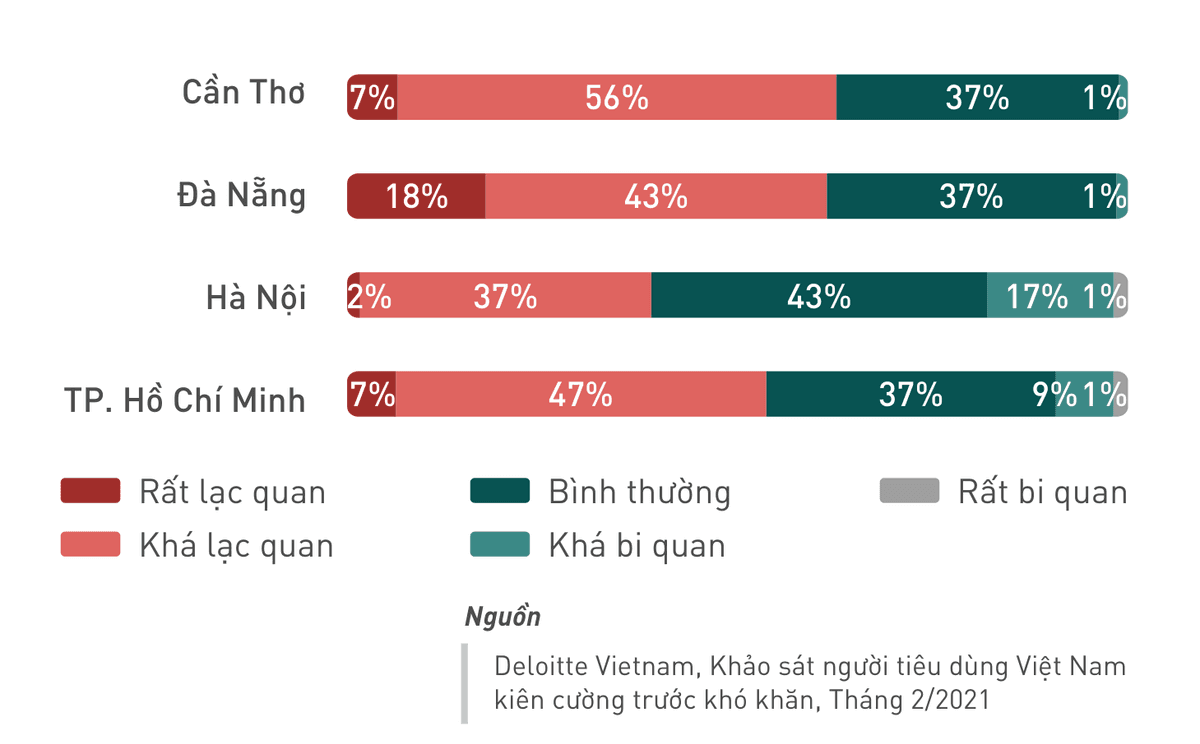
Deloitte Vietnam's February 2021 city breakdown above shows Ho Chi Minh City residents maintained notably stronger optimism than Hanoi respondents despite severe pandemic disruption. The share of somewhat optimistic consumers reached 47% in Ho Chi Minh City versus 37% in Hanoi, while Can Tho and Da Nang recorded the highest combined positive sentiment:
| Surveyed City | Very Optimistic | Somewhat Optimistic | Neutral | Somewhat Pessimistic | Very Pessimistic |
|---|---|---|---|---|---|
| Can Tho | 7% | 56% | 37% | 1% | 0% |
| Da Nang | 18% | 43% | 37% | 1% | 0% |
| Ho Chi Minh City | 7% | 47% | 37% | 9% | 1% |
| Hanoi | 2% | 37% | 43% | 17% | 1% |
Adsota attributes Hanoi's higher caution to long-standing Northern traditions of conservative household saving during economic uncertainty. Meanwhile, in tourism-reliant cities such as Da Nang, extended travel restrictions directly eroded business revenues and household livelihoods.
Beyond financial strain, communities absorbed heavy emotional fatigue from social isolation, cancelled hometown trips, and bereavement. Prolonged disruption made audiences defensive toward aggressive promotional noise. Entering the new normal, consumers looked for brand empathy, emotional healing, and authentic family reconnection.
How did Vietnamese shoppers reallocate holiday baskets, C2C channels, and early stockpiling?
Part 2 of the publication identifies four behavioral shifts reshaping shopping journeys ahead of New Year and Lunar New Year (Tet) 2022. Within food and family healthcare categories, product quality and established brand trust outweighed short-term price discounting. Conversely, household budgets for long-distance travel and holiday vacations remained compressed amid ongoing mobility risks.
Neighborhood C2C group commerce alongside physical retail store recovery
Extended lockdowns onboarded older consumers—historically loyal to wet markets and traditional shops—onto e-commerce marketplaces. A distinctive development following the fourth wave was the surge in consumer-to-consumer (C2C) neighborhood commerce. Apartment-building and residential groups across Facebook and Zalo traded fresh produce, frozen goods, vegetarian dishes, and traditional ceremonial offerings at high velocity.
Residential C2C groups solved two acute holiday pain points simultaneously: delivery speed and product accountability. Because buyers and sellers lived within the same apartment complex or neighborhood, shoppers could verify food quality through peer feedback and return defective items directly to a neighbor's door.
At the same time, brick-and-mortar stores retained an essential role in holiday retail as health anxieties eased. According to Deloitte's 2021 Holiday Retail Survey (October 2021), the share of shoppers feeling anxious about in-store shopping declined from 51% during the 2020 holiday season to 40% in 2021.
That same Deloitte survey found nearly 30% (28%) of holiday shoppers used social media to research products, evaluate brands, and make purchase decisions. How this hybrid discovery habit evolved into long-term omnichannel retail is tracked further in our Vietnam retail market research and trend forecast. Brands must connect online discovery with frictionless offline fulfillment to capture cross-channel buyers.
Post-lockdown self-gifting and the early November stockpiling window
Alongside everyday budget discipline, the lifting of lockdowns across major cities triggered waves of "revenge spending" and self-reward. After months of pent-up frustration, segments of urban shoppers spent more decisively on self-gifting to compensate for lost time.
Even so, most households preferred celebrating major holidays at home through cooking, family movies, and small gatherings rather than crowded venues. Concerns over sudden outbreak recurrences or shipping bottlenecks prompted families to plan budgets and stockpile essential goods starting in November and early December. Brands delaying seasonal campaigns until the final weeks before Tet risk missing early basket lock-in.
Which three digital touchpoint shifts redefined access to 72 million social media users?
Part 3 examines Vietnam's irreversible transition toward an always-on digital lifestyle. Consecutive lockdown periods expanded both first-time Internet adoption and daily screen intensity nationwide.
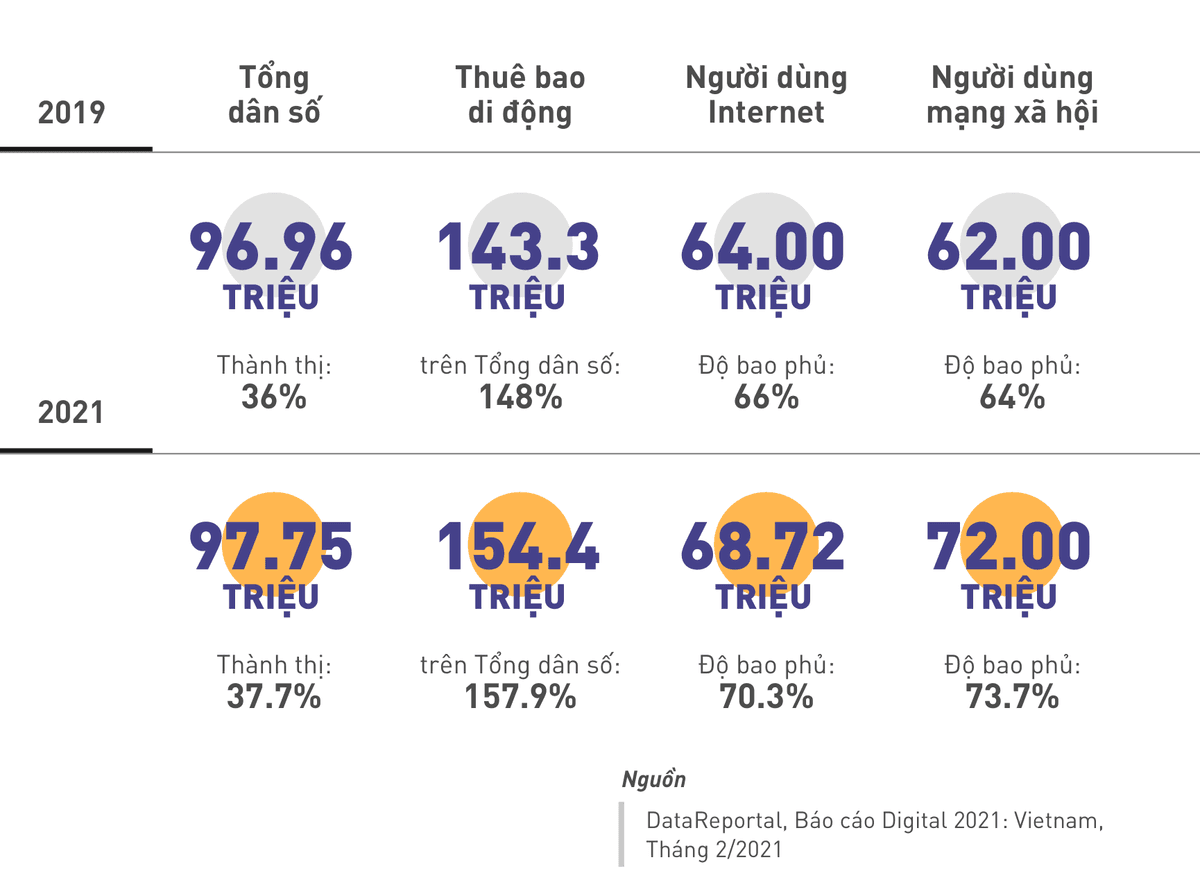
Data from DataReportal's Digital 2021: Vietnam report (February 2021) in the chart above confirms Vietnam added nearly 5 million new Internet users and 10 million social media accounts within two years. Internet penetration rose from 66% to 70.3% of the population, while active social media accounts reached 72.00 million (73.7% of the population, spanning ages 13 to 65+). According to Adsota's Vietnam Digital Advertising Report 2021 (June 2021), average daily time spent online also increased from 6.5 hours to 7 hours.
Multi-platform adoption among Gen X and Millennials alongside gaming and online video growth
Rather than staying confined to a single social app, consumers across every generation broadened their daily platform mix. Decision Lab's The Connected Consumer Q2 2021 report recorded double-digit jumps among Gen X and Millennial users active on four or more social networks simultaneously:
| Digital Infrastructure & Multi-App Dimension | Baseline / 3-App Usage Tier | 2021 Benchmark / 4+ App Usage Tier | Source and Reference Period |
|---|---|---|---|
| Total population and urban share | 96.96 million (36% urban in 2019) | 97.75 million (37.7% urban in 2021) | DataReportal (February 2021) |
| Active mobile connections | 143.3 million (148% of population in 2019) | 154.4 million (157.9% of population in 2021) | DataReportal (February 2021) |
| Total Internet users in Vietnam | 64.00 million (66% penetration in 2019) | 68.72 million (70.3% penetration in 2021) | DataReportal (February 2021) |
| Active social media user accounts | 62.00 million (64% penetration in 2019) | 72.00 million (73.7% penetration in 2021) | DataReportal (February 2021) |
| Gen X multi-platform social usage | 52% using 3 social apps | 48% using 4+ social apps (up 13%) | Decision Lab (Q2 2021) |
| Millennial multi-platform social usage | 35% using 3 social apps | 65% using 4+ social apps (up 10%) | Decision Lab (Q2 2021) |
| Gen Z multi-platform social usage | 28% using 3 social apps (up 2%) | 72% using 4+ social apps | Decision Lab (Q2 2021) |
Alongside social networking, gaming and online video emerged as Vietnam's dominant interactive entertainment formats. Per Adsota's June 2021 report, Vietnam's gamer population expanded by more than 30% compared with two years earlier, encompassing two-thirds of young adults aged 18–30. Across online video—spanning webinars, livestreams, short-form and long-form videos, and product reviews—viewer reach hit 97.6% per Internet session.
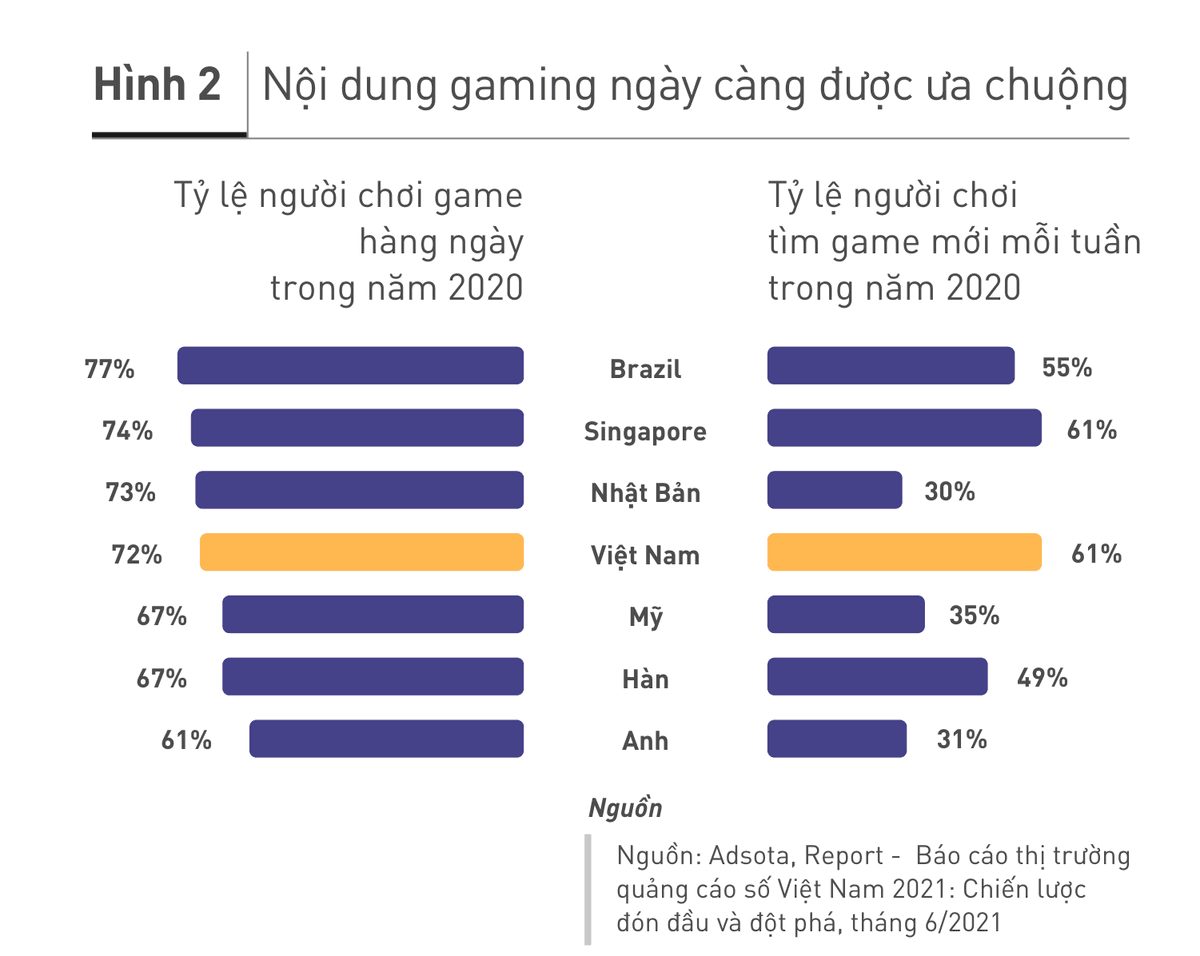
Adsota's seven-country comparison for 2020 above demonstrates that Vietnamese players combine high daily play frequency (72%) with exceptional openness to new titles. Fully 61% of Vietnamese gamers searched for new games every week—matching Singapore (61%) and outpacing Brazil (55%), South Korea (49%), the United States (35%), the United Kingdom (31%), and Japan (30%). How this engagement base matured commercially is examined in our Vietnam mobile game market report.
Which empathetic messaging themes and creative strategies help brands stand out during Tet?
In Part 4, the report reviews four messaging pillars that dominated Tet 2021 social campaigns: Home Coming, Appreciations, New Beginning, and Celebration. Entering the 2021–2022 festive season, Adsota advises brands to pair familiar family reunion motifs with deeper empathy, shared resilience, and emotional renewal (Tet as Connection and Tet as Rebirth).
To break through thousands of competing advertisers crowding digital feeds at year-end, creative teams should coordinate three differentiators:
- Refresh visual packaging across every seasonal touchpoint. Because visual cues drive initial product judgment, marketers should deploy festive color palettes (green, red, yellow, purple) across product packaging, websites, and social feeds while releasing holiday limited-edition SKUs to spark scarcity value.
- Diversify online video and native gaming ad placements. Combine short-form clips, product reviews, webinars, and livestreams to refresh brand storytelling; for 18–30 audiences, deploy non-intrusive placements inside gaming streams to lift conversion.
- Differentiate talent strategy through Gaming Influencers. While major advertisers bid up the same pool of mainstream singers and actors, Gaming Influencers connect with Gen Z and young Millennial buyers through candid, everyday storytelling.
Early campaign launch, e-commerce digitization, and sustained creator investment
Beyond creative themes, holiday campaign returns hinge on three structural execution principles:
- Launch seasonal campaigns ahead of the traditional Tet rush. With many competitors freezing marketing budgets post-lockdown, entering the market early while households compile stockpiling lists captures top-of-mind awareness at lower auction competition.
- Digitize retail storefronts and mobile shopping experiences. Data from Vietnam's Ministry of Industry and Trade (July 2021) shows online shopping participation among domestic Internet users climbed from 77% in 2019 to 88% in 2020. Concurrently, Adsota's June 2021 report recorded 43% year-on-year user growth across mobile shopping apps in Vietnam.
- Commit to sustained Influencer Marketing rather than isolated posts. According to 7SAT's State of Influencer Marketing in Vietnam 2020 report, 90% of Vietnamese shoppers trust reviews and recommendations from influencers, whereas only 33% trust direct brand advertisements. Creators need sustained, multi-touchpoint partnerships to build audience conviction ahead of peak checkout periods.
How does a 4-step Gaming Influencer Marketing workflow drive holiday conversion?
Across Parts 5 and 7, Adsota structures Gaming Influencer campaigns into a four-step operational framework backed by its network of over 500 gaming creators in Vietnam within the Facebook Gaming partner ecosystem (including creators such as PewPew, ViruSs, NamBlue, and Chim Se Di Nang):
| Execution Stage | Core Operational Focus | Input Structure & Selection Logic | Governance & Measurement Criteria |
|---|---|---|---|
| Step 01: Define goals & Influencer Brief | Anchor campaign around either new audience reach or purchase conversion | Three-part Influencer Brief built on Target Audience, Big Idea, and Key Message: deliverables, execution method, and KPIs | Clarity on content volume, publishing schedule, event appearances, and target metrics |
| Step 02: Select Gaming Influencers | Match creator tier to funnel goal and brand personality alignment | Macro creators for broad awareness; mid-tier and micro creators for high-trust calls-to-action (CTA) and conversion | Image alignment verification and prior sponsor audit to prevent competitor overlap |
| Step 03: Co-create content & ad tech | Translate brand messaging into native community formats across 5 options | TVC/VOD video production, social posts with community pages, online events, livestream demos, and AI/AR ad overlays | Authenticity of message integration and live viewer retention |
| Step 04: Measure Output & Outcome | Separate contracted deliverables from business and engagement impact | Output: completed co-created and published assets; Outcome: reach, views, engagement, and agency-creator workflow review | Post-campaign retrospective optimizing creator mix for future seasonal cycles |
At the talent selection stage, the report challenges the misconception that only mega-streamers deliver commercial ROI. Mid-tier and micro gaming creators maintain tight-knit community rapport, enabling persuasive calls-to-action when conversion is the primary goal. Marketing leaders can pair this logic with our guide to choosing KOLs vs. KOCs by campaign goal and budget.
Five co-creation formats from interactive livestreams to AI and AR active display ads
To cut through promotional fatigue, brands can combine five co-creation and ad-technology formats outlined in Adsota's holiday reconnection suite:
- TVC and VOD video production. Feature Gaming Influencers in television commercials (TVC) or video-on-demand (VOD) assets to bring fresh energy across multi-screen campaigns. The report highlights benchmark collaborations including Warrior x ViruSs, the Tet Tan Suu 2021 music campaign FIFA Online 4 x Do Mixi, and Maybelline x MisThy.
- Social media posts amplified via community fanpages. Pair posts on a creator's personal channels with established youth entertainment pages such as Nha Cap 4, Kho Tau TV, or Bao Hong to scale organic reach.
- Featured appearances at online brand events. Inviting gaming creators to share personal stories during virtual events boosts concurrent viewership and audience rapport.
- Live product demonstrations and Q&A during livestreams. Unlike polished static ads, livestreams let audiences watch creators test products unscripted, ask real-time questions, and validate peer reactions in the live chat.
- Instream Banners and AI/AR active display advertising. Alongside Instream Banner placements anchored beneath live video feeds, active display ads apply artificial intelligence (AI) and augmented/virtual reality (AR) to trigger customizable brand visuals across frames, chat boxes, and backgrounds in real time based on a streamer's facial expressions and in-game actions.
Which six common brand mistakes undermine Gaming Influencer campaigns and how can teams fix them?
Drawing on campaign delivery across consumer goods, e-commerce, and beauty brands such as Mentos, Sendo, and Maybelline New York, Part 6 synthesizes six recurring pitfalls that erode returns when brands partner with gaming creators:
| Common Brand Mistake | Operational Consequence | Corrective Action for Marketing Teams |
|---|---|---|
| 1. Lack of phased campaign planning | Fragmented posts disconnected from stage-by-stage funnel KPIs | Map creator deliverables across campaign phases with explicit KPIs, content angles, and review deadlines |
| 2. Deploying on mismatched platforms | Placing gaming creator assets on Twitter or LinkedIn yields minimal engagement | Concentrate distribution where gaming communities actually gather: Facebook, YouTube, and livestream platforms |
| 3. Mismatched brand voice and lifestyle | Audiences reject promotions when a creator's real habits contradict the product | Vet creator lifestyle affinity and category fit (such as consumer tech, beverages, personal care, and youth services) |
| 4. Assuming only massive budgets work | Small and mid-sized brands miss an accessible, high-converting Gen Z channel | Blend creator tiers strategically, leveraging affordable micro gaming creators with focused niche audiences |
| 5. Enforcing 100% word-for-word scripts | Streamers sound unnatural like stiff actors, causing viewers to tune out | Lock core brand claims and safety guardrails, then let creators express the message in their own everyday voice |
| 6. Unstructured creator communication | Missed deadlines or misaligned expectations with instinctive, informal creators | Standardize briefing workflows or coordinate through a specialized gaming agency to manage timelines and brand safety |
Translating E-Magazine 05's findings into execution, chief marketing officers and brand managers can prioritize four actions for upcoming peak seasonal campaigns:
- Tailor seasonal messaging and product bundles to regional consumer psychology. Pair essential household and health bundles with empathetic family-reconnection storytelling while offering limited-edition self-reward SKUs for urban youth segments.
- Open seasonal media funnels 4 to 6 weeks ahead of peak holidays. Capture early stockpiling demand by connecting social discovery, community groups, e-commerce storefronts, and physical retail checkouts.
- Tier Gaming Influencer rosters across reach and conversion roles. Combine broad-reach creators at campaign launch with micro and mid-tier livestreamer product demos to maximize lower-funnel conversion rather than chasing vanity follower counts.
- Balance creative freedom with dual Output–Outcome governance. Deliver structured three-part briefs, test interactive livestream display formats, and evaluate end-to-end conversion efficiency; explore further frameworks in our marketing and creator economy insights.
This web edition synthesizes the source-verified consumer benchmarks and Gaming Influencer execution frameworks for marketing leaders. Readers can complete the download form on this page to access the full 30-page PDF compiled by Adsota, including the seasonal holiday calendar layouts and original visual spreads.
Sources
- E-Magazine 05: Tái kết nối với khách hàng mùa lễ hội 2021–2022, Công ty Cổ phần Adsota Việt Nam, 2021-11-23, accessed 2026-10-31
- Khảo sát người tiêu dùng Việt Nam: Kiên cường trước khó khăn (The Vietnam Consumer Survey: Resilient through Hardship), Deloitte Vietnam, 2021-02-01, accessed 2026-10-31
- 2021 Deloitte Holiday Retail Survey, Deloitte, 2021-10-19, accessed 2026-10-31
- Digital 2021: Vietnam, DataReportal (We Are Social & Hootsuite), 2021-02-11, accessed 2026-10-31
- The Connected Consumer Q2 2021, Decision Lab, 2021-07-20, accessed 2026-10-31
- Báo cáo thị trường quảng cáo số Việt Nam 2021: Chiến lược đón đầu và đột phá, Công ty Cổ phần Adsota Việt Nam, 2021-06-15, accessed 2026-10-31
- Sách trắng Thương mại điện tử Việt Nam 2021 và phân tích mua sắm trực tuyến thời dịch COVID-19, Bộ Công Thương (Cục Thương mại điện tử và Kinh tế số), 2021-07-15, accessed 2026-10-31
- The State of Influencer Marketing in Vietnam 2020, 7SAT, 2020-08-01, accessed 2026-10-31