
What Vietnam Game Publishers Evaluate Before Signing a Game for Local Release
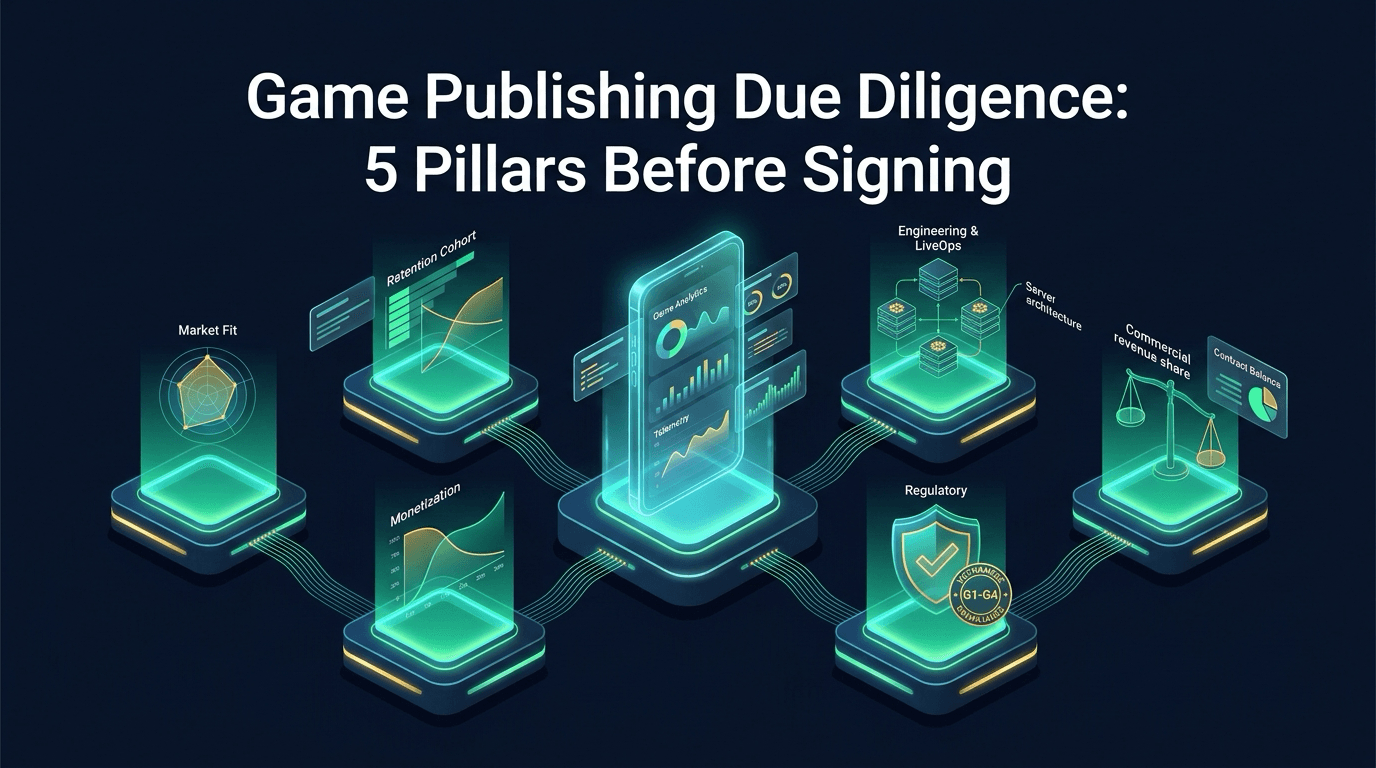
What Vietnam game publishers evaluate before signing a title spans five pillars beyond visuals: local sub-genre fit, cohort retention and monetization depth, studio technical support, G1–G4 compliance under Decree 147/2024/ND-CP, and balanced Minimum Guarantee terms. Even an overseas hit can lose money in Vietnam if starter packs are overpriced or unflagged maps delay licensing.
Key takeaways
- Chart-topping revenue in South Korea or China does not guarantee profit in Vietnam. In 2024, revenue across 127 new launches dropped 22% because 70.1% crowded into Team Battle and MMORPG.
- Committees audit economic durability via D1/D7/D30 retention curves, first-time payer conversion at VND 20,000–50,000 tiers, and balance between F2P liquidity and VIP spenders.
- Partner studios must maintain a dedicated Vietnam build branch for local phone verification, under-18 playtime caps under Decree 147/2024/ND-CP, webshop APIs, and a 6–12 month roadmap.
- Balanced contracts split Minimum Guarantees (MG) across technical milestones, calculate royalties on Net Revenue after 15%–30% store fees and FWT tax, and lock in minimum UA budgets.
Understanding what Vietnam game publishers evaluate during pre-contract due diligence determines whether a mobile title can scale profitably in Vietnam. Studios regularly pitch builds backed by strong charts in South Korea or China, yet receive a pass from local greenlight committees. A licensed Vietnamese publisher is underwriting a multi-year live service across five commercial, technical, and legal gates.
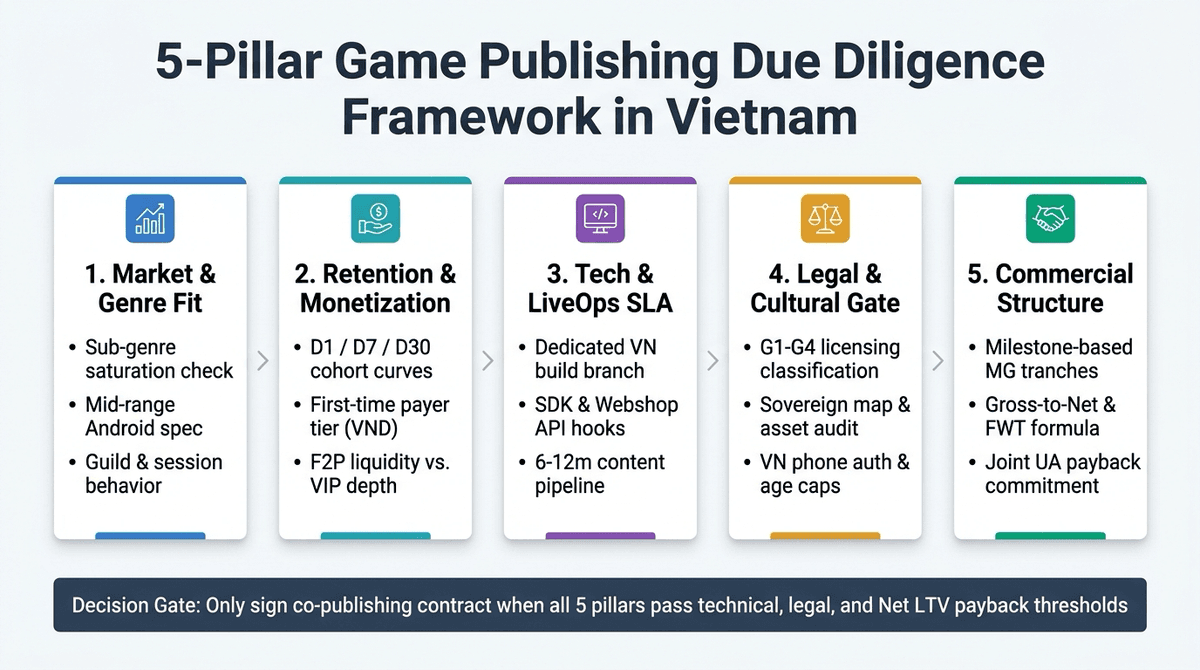
As the framework above shows, the product evaluation committee at Gamota (part of the Appota ecosystem) scores every candidate title across five pillars. Only when a build clears all five gates can projected Net Lifetime Value (Net LTV) recover User Acquisition (UA) and compliance costs.
Why does a hit game from South Korea or China not automatically win in Vietnam?
Studio executives and business development (BD) leads often assume East Asian chart success guarantees high returns in Vietnam. Empirical data shows Vietnam operates under distinct sub-genre saturation and purchasing-power constraints.
According to the Vietnam Mobile Game Market Report 2024 published by Gamota's R&D team in February 2025, total market revenue exceeded USD 800 million in 2024 (+2% YoY), while downloads fell 10% to over 1.6 billion. Domestic Vietnamese publishers captured USD 292 million (36.5% of total revenue) across 130 million-plus downloads (-15% YoY, or 8.1% of installs).
In 2024, Vietnamese publishers launched 127 new mobile games (+25 titles YoY) and generated over 40 million downloads (+12%), yet new-release revenue dropped 22% to just over USD 70 million (Gamota, February 2025). Severe genre crowding drove that decline: 70.1% of new launches clustered into Team Battle RPGs (45 titles, 35.4%) and MMORPGs (44 titles, 34.6%, whose downloads fell 42%). Conversely, Roguelike (+91%) and Idle RPG (+66%) grew fastest but made up only 4.7% and 9.4% of new supply.
Four behavioral and hardware differences in Vietnam
From Gamota's perspective, importing an unmodified overseas build into Vietnam hits four friction points:
- Starter-pack price sensitivity. A USD 4.99–9.99 starter pack creates a steep barrier for first-time payers in Vietnam. Unlocking initial conversion requires starter bundles priced at VND 20,000–50,000 (USD 0.80–2.00), matching local e-wallet balances and instant QR transfers (VietQR).
- Short, automated sessions. Working-age players favor three-to-five-minute portrait sessions over multi-hour grinding. Legacy MMORPGs lose early cohorts to hybrid Idle RPG and Roguelike titles.
- Mid-range Android hardware. Most installs run on mid-range Android phones with tight storage and frequent Wi-Fi to 4G/5G handoffs. Unsplit builds above 4–5 GB lose paid installs during asset extraction.
- Guild rivalry and community. Vietnamese mid-core spenders monetize around guild wars, cross-server rankings, and offline meetups. Games lacking social competition decay rapidly after Day 30.
How Vietnam game publishers evaluate product lifecycle and monetization depth
When auditing test telemetry, Vietnam game publishers evaluate cohort mechanics rather than headline Month-1 gross billings. Strong IP hype can create a Week-1 spike while masking a shallow mid-game economy.
Three telemetry layers that reveal economic durability
- Slope of the D1, D7, and D30 retention curve. Day-1 (D1) retention measures onboarding clarity (FTUE) and stability, while D7 and D30 prove whether progression supports paid UA scale. Strong D1 paired with a steep D7 drop signals an uncalibrated difficulty wall around Day 3.
- First-time payer conversion and monetization breadth. Analysts check when the first purchase prompt appears and how spend distributes across starter packs, monthly cards, battle passes, and events. Durable economies convert a broad base of low- and mid-tier spenders.
- Balance between free-to-play (F2P) liquidity and VIP spenders. In multiplayer G1 titles, F2P players provide matchmaking liquidity for VIP spenders. If Week-1 power gaps drive F2P players out, VIP spenders churn from empty servers within 30–45 days.
Studios preparing cohort data can benchmark their telemetry against our three-gate mobile game soft-launch checklist.
Evaluating the development studio's technical and LiveOps responsiveness
A two-to-three-year co-publishing deal is a continuous live-service operation. According to Gamota's Vietnam Mobile Game Market Report 2024 (February 2025), Gamota launched 12 new mobile titles in 2024, including 10 co-published (Co-Pub) projects with international studios. Experience from Gamota's committee shows post-signing delays usually happen when a studio's engineering team is stretched across regions without dedicated capacity for Vietnam.
Four technical readiness criteria verified before signing
- Dedicated Vietnam build branch and emergency SLAs. The studio must maintain an isolated code branch for Vietnam so local SDKs and compliance edits never wait on global releases. Contracts require a 2-to-4-hour hotfix SLA for outages, login failures, or duplicate item-grant bugs.
- Backend API hooks for webshops and settlement. Alongside native In-App Purchases (IAP) under Section 3.1 of Apple's App Store Review Guidelines and Google's Play Payments Policy, core titles in Vietnam use official web billing portals connected to licensed local intermediaries. Studio servers must support webhook verification and idempotency locks as outlined in our guide to direct-to-consumer mobile game webshops.
- Flexible Game Master (GM) tooling. Publishers prioritize builds where local LiveOps teams can configure events, adjust bundles, send compensation, and open servers via a web GM console without a binary rebuild.
- Verified 6-to-12-month content pipeline. The studio must show playable updates—new heroes, cross-server modes, and holiday events—built or in production for two to four quarters post-launch.
Screening early for G1–G4 licensing red flags and cultural compliance in Vietnam
Releasing an online game in Vietnam requires statutory licensing and mandatory technical controls inside the binary. Compliance screening must happen during initial build review because a sovereignty violation blocks legal release.
Regulatory framework under Decree 147/2024/ND-CP and Decree 174/2026/ND-CP
Under Decree 147/2024/ND-CP (signed November 9, 2024, effective December 25, 2024), only enterprises established under Vietnamese law may provide online game services in Vietnam. Article 37 classifies titles into G1 (multiplayer interaction via the operator's server system, requiring a G1 Service License and per-title G1 Release Decision) and G2, G3, and G4 (handled via provincial Service Certificates and Release Notification Confirmations).
State administration transferred to the Ministry of Culture, Sports and Tourism (MCST) on March 1, 2025; under Decree 298/2026/ND-CP (signed July 27, 2026, effective July 28, 2026), specialized oversight sits under the Authority of Electronic Information and Digital Transformation. Meanwhile, Decree 174/2026/ND-CP (signed May 15, 2026, effective July 1, 2026) enforces administrative penalties for failing to verify player accounts via a Vietnamese mobile phone number across G1–G4 games or violating virtual item rules. (Editorial note: Legal counsel must verify filings against the official Gazette text before submission.)
Four compliance red flags that trigger mandatory fixes or rejection
- Maps infringing territorial sovereignty. Every map and icon is audited. Any unlawful nine-dash line depiction or inaccurate representation of Vietnam's sovereignty over the Hoang Sa (Paracel) and Truong Sa (Spratly) archipelagos must be removed from source assets.
- Cash-out or trading violating Article 57 of Decree 147/2024/ND-CP. Vietnamese law prohibits converting virtual items or points into money, payment cards, or external goods, and bans item trading between players.
- Cultural and age-rating rules (Articles 38 and 43). Distorted history or excessive gore will fail G1 appraisal. Games must display age badges (
18+,16+,12+,00+) and show the health warning "Playing more than 180 minutes a day will negatively affect your health" every 30 minutes. - Vietnamese phone verification and 60 / 180-minute caps. Under Articles 39 and 48 of Decree 147/2024/ND-CP, onboarding must collect full name and birth date and verify players via a Vietnamese mobile phone number (with parent or guardian registration under 16). Servers must cap under-18 playtime at 60 minutes per game per day and 180 minutes total per day. See our six-stage guide to mobile game publishing in Vietnam for full details.
| Pillar | Evidence Reviewed | Early Deal-Breakers |
|---|---|---|
| 1. Market Fit | Genre share (Gamota Report), RAM/ROM footprint | Generic MMORPG/Team Battle clone; >5 GB unsplit binary |
| 2. Monetization | D1/D7/D30 cohorts, VND 20,000–50,000 starter packs | Steep D7 cliff from early paywalls; rigid USD pricing |
| 3. Tech & SLA | 2–4h hotfix SLA, GM tool, webshop APIs, 6–12m roadmap | Single global branch; minor edits need binary rebuild |
| 4. G1–G4 Legal | Map audit, Article 38/39/48/57 Decree 147/2024/ND-CP | Nine-dash line maps; cash-out loops; no 60/180m caps |
| 5. Commercial | Milestone MG schedule, Gross-to-Net formula, UA terms | Oversized upfront MG draining UA cash; Gross split |
Structuring a balanced commercial deal across Minimum Guarantee (MG), revenue share, and UA commitments
The fifth pillar balances the Minimum Guarantee (MG) against Royalty Revenue Share and User Acquisition (UA) Commitments.
Why an oversized upfront MG starves a game's launch
From Gamota's perspective, studios entering Southeast Asia often push for a high upfront MG to recoup production costs on signature. However, every publisher allocates a finite pre-launch risk budget.
When an inflated upfront MG consumes most of that capital, funds for performance UA and creator (KOL/KOC) campaigns during the first 30 days shrink. Thin install volume breaks matchmaking and guild competition, preventing revenue from crossing the MG recoupment line. The publisher takes a write-off, and the studio collects zero backend royalties.
Three principles for structuring an aligned co-publishing deal
- Split MG tranches across verifiable milestones. Release MG across 3–4 gates: contract signing, delivery of the compliant Vietnam build with phone verification for G1–G4 filing, User Acceptance Testing (UAT) approval, and commercial Open Beta.
- Define a transparent Gross-to-Net Revenue formula. Calculate royalties and MG recoupment on Net Revenue rather than Gross Billings, deducting 15%–30% Apple and Google store fees or local gateway fees (MDR), verified refunds, VAT, and Foreign Contractor Withholding Tax (FWT).
- Pair a moderate MG with contractual UA commitments. Protect the studio's localization effort with a reasonable MG while locking in a binding minimum launch UA budget from the publisher, plus automatic UA scaling tiers when Net LTV clears target thresholds.
(Note: These due diligence insights reflect the perspective of Gamota's product evaluation committee and will be confirmed by Appota's Gaming specialist before publication.)
Before pitching a mobile title for Vietnam, studios should prepare a test build for mid-range Android devices, raw D1/D7/D30 cohorts, a pre-audited map list, and commitment for a dedicated Vietnam branch. Explore more analyses in the Gaming topic hub on Appota Insights or send your pitch deck and build to Gamota's game publishing team to schedule a due diligence review.
Sources
- Báo cáo thị trường game mobile Việt Nam 2024, Gamota R&D, 2025-02-19, accessed 2026-11-02
- Nghị định 147/2024/NĐ-CP về quản lý dịch vụ Internet và thông tin trên mạng, Chính phủ Việt Nam, 2024-11-09, accessed 2026-11-02
- Điều kiện cung cấp dịch vụ trò chơi điện tử trên mạng, Báo Điện tử Chính phủ, 2026-09-28, accessed 2026-11-02
- Nghị định 174/2026/NĐ-CP về xử phạt vi phạm hành chính lĩnh vực viễn thông và CNTT, Chính phủ Việt Nam, 2026-05-15, accessed 2026-11-02
- Nghị định 298/2026/NĐ-CP về cơ cấu tổ chức của Bộ Văn hóa, Thể thao và Du lịch, Chính phủ Việt Nam, 2026-07-27, accessed 2026-11-02
- Google Play Payments Policy & Service Fees, Google, accessed 2026-11-02
- App Store Review Guidelines — Section 3.1 Payments, Apple, accessed 2026-11-02