
Mobile Game User Acquisition Channels in Vietnam and How to Measure ROAS

Mobile game user acquisition channels in Vietnam span four core pillars: paid ad networks, gaming creator livestreams, local community hubs on Zalo and Facebook, and App Store Optimization (ASO). Rather than optimizing for raw Cost Per Install (CPI), UA teams must track D1, D7, and D30 cohort Net ROAS through an MMP reconciled against server-side payment records.
Key takeaways
- Commercial user acquisition (UA) in Vietnam combines four channel groups: paid ad networks, gaming creators and livestreams, owned communities (Zalo OA, Facebook Groups), and App Store Optimization (ASO).
- Channel allocation must match genre economics: MMORPGs, 4X strategy, Battle Royale, and MOBA titles prioritize deep-spending player segments and guild communities, while Casual, Sandbox, Block Puzzle, and Idle RPG titles lean on short-form video and in-game SDK ad networks.
- UA managers should never evaluate performance on raw CPI alone; tracking must connect IPM, onboarding eCPA (tutorial completion or first top-up), Classic Retention, and Net Cohort ROAS calculated from cohort net revenue against corresponding UA spend.
- On iOS, Apple's SKAdNetwork 4.0 and AdAttributionKit deliver postbacks across three windows (with Window 1 spanning days 0–2) under crowd-anonymity thresholds, making campaign consolidation a helpful UA operational practice while out-of-app Webshop transactions require separate server-side (S2S) measurement.
Structuring the right mix of mobile game user acquisition channels in Vietnam determines how quickly a studio recovers marketing capital after server launch. According to Gamota's Vietnam Mobile Gaming Year-in-Review 2025 (published February 2026), Vietnam's mobile game market revenue reached USD 825 million in 2025 (+9.16% YoY) across 54 million players, yet only 7%–10% of players are payers and only 12 of the Top 50 most-downloaded games also ranked in the Top 50 by IAP revenue. Because high install volume does not automatically convert into revenue, buying cheap installs without cohort tracking quickly erodes margins.
How do the four main mobile game user acquisition channels in Vietnam differ?
A commercial launch in Vietnam combines four channel groups:
- Paid UA Ad Networks: Social/search platforms (Meta Ads, Google App Campaigns, TikTok Ads) and SDK networks (Unity Ads, AppLovin, Mintegral, IronSource) deliver fast install volume and event/value bidding.
- Gaming Creators and Livestreaming: According to Appota and OTA Network's The State of Gaming Creators in Vietnam (2022), 75.8% of livestream viewers are aged 13–22 and 50.2% watch for entertainment, building social proof and organic search lift.
- Owned Communities and CRM: Facebook Groups, Zalo OA, and Discord nurture pre-launch guilds and anchor Day-1 payer liquidity.
- App Store Optimization (ASO): Keywords, Custom Product Pages (iOS), Custom Store Listings (Android), and In-App Events capture organic searches and improve store conversion.
| Channel Group | Mechanism | Speed | Payer Quality | Latency | Key Risks |
|---|---|---|---|---|---|
| 1. Paid UA (Meta, Google, TikTok, Unity, AppLovin) | MAI, AEO, VO / tROAS bidding | Immediate | Varies; cheap CPI yields fewer payers | Immediate via MMP | Creative fatigue in 5–7d; sub-network fraud |
| 2. Creators (KOLs, KOCs, Streamers) | Live gameplay, giftcodes, guilds | Moderate | Strong fit; drives tutorial completion | Delayed 24–72h | Audience mismatch; missing ad disclosure |
| 3. Communities (Facebook, Zalo OA, Discord) | Two-way CRM, guild rewards | Slow (2–4w) | Very high; core payers in first 48h | First 48h via codes | Churn if moderators respond slowly |
| 4. ASO & Store (App Store, Google Play) | Keywords, featuring, ad alignment | Steady | High intent and D1 retention |
Continuous | Store CVR drops if ratings fall and negative reviews accumulate |
When should a studio hold off on scaling paid UA budgets?
UA leads should halt budget scaling in three situations:
- Pending G1–G4 licenses: Under Decree 147/2024/ND-CP (amended by Decree 116/2026/ND-CP effective April 8, 2026), games serving Vietnam require a G1 Release Decision or G2–G4 Notification Confirmation under a Vietnamese enterprise acting as the license holder. See publishing a mobile game in Vietnam.
- Unresolved Day-1 leaks: Crashes, stalled asset downloads, or phone-verification drop-offs generate negative store reviews. Clear all gates in our mobile game soft-launch checklist.
- Unfiltered sandbox orders in the MMP: Firing purchase events on sandbox test orders distorts ad network optimization.
How should you allocate UA channels by game genre (Mid-core/Hardcore RPG and Strategy vs. Casual)?
According to Gamota's Vietnam Mobile Gaming Year-in-Review 2025 (compiled with AppMagic and MAF), download rankings are led by Sandbox and Block Puzzle titles such as Roblox VN (25.4 million) and Block Blast! (23.3 million). Conversely, IAP revenue concentrates in Battle Royale (Free Fire MAX: Winterlands USD 9.4 million), 4X Strategy (Last War: Survival VN USD 8.1 million, Rise of Kingdoms – Gamota USD 4.1 million), MOBA (Garena Liên Quân Mobile USD 5.6 million), and MMORPG.
With high spenders representing 2%–3% of players and ARPU averaging USD 15.27/year, channel weights must match genre economics:
| Genre | Unit Economics | Primary UA Mix | Creative Formats | Optimization Goal |
|---|---|---|---|---|
| 1. Hardcore MMORPG | High CPI; VIP-driven; D30–D90+ payback |
Meta (AEO/VO), Google (tROAS), KOLs, Zalo OA | Boss raids, rare gear drops, guild calls | VO / D7 tROAS, Cost Per First Payer |
| 2. Strategy (SLG / 4X) | Very high CPI; deep LTV (2%–3% whales) | Meta, YouTube, strategy creators | 3s tactical hooks, base upgrades | Base milestone or D7 starter pack |
| 3. Idle RPG & Roguelike | Moderate CPI; D7–D30 payback |
TikTok, Reels, AppLovin, Unity, KOCs | 9:16 vertical videos, skill picks | Tutorial completion, D7 ROAS |
| 4. Casual, Sandbox & Puzzle | Low CPI; high volume; D1–D7 payback |
AppLovin, Unity, Mintegral, TikTok | Playable Ads, 15s puzzle hooks | Blended IAA + IAP ROAS at D1/D3 |
Coordinating Paid UA and Gaming Creators: Operational takeaways from Appota's ecosystem
Experience across Gamota, Adsota, and OTA Network shows strong lift when paid media and creators run as one pipeline. Survey data (2022) shows 89% of Vietnamese gaming creators are Micro (48%, 10,000–100,000 followers) or Medium (41%, 100,000–1M):
- Sync livestreams with server openings: Streamers form guilds on new servers and drop unique giftcodes for MMP tracking.
- Turn top KOC videos into paid ads: Within 48 hours, high-thumbstop KOC clips are whitelisted for Spark Ads (TikTok) and Partnership Ads (Meta). See choosing and combining KOLs and KOCs.
- Route to Custom Store Pages: Creator ads land on Custom Product Pages (iOS) or Custom Store Listings (Android) matching the featured hero.
Statutory compliance rules for game advertising and creator campaigns in Vietnam
- Game content and virtual items: Under Articles 38 and 57 of Decree 147/2024/ND-CP, ads must display age ratings (
18+,16+,12+,00+) and never promote virtual item cash-out or player trading. - Influencer obligations and penalties: Under Article 15a of Law No. 75/2025/QH15 (effective January 1, 2026) and Decree 342/2025/ND-CP (effective February 15, 2026), influencers must verify licensing eligibility, experience the game firsthand, and clearly disclose sponsorships; violations are penalized under Decree 87/2026/ND-CP (effective May 15, 2026).
Which UA measurement metrics must teams track across each funnel stage?
Judging a UA team solely on Cost Per Install (CPI) causes constant friction between marketing and product operations. A sensationalized ad can produce cheap CPIs while filling servers with low-intent users who quit as soon as the client requests additional resource downloads.
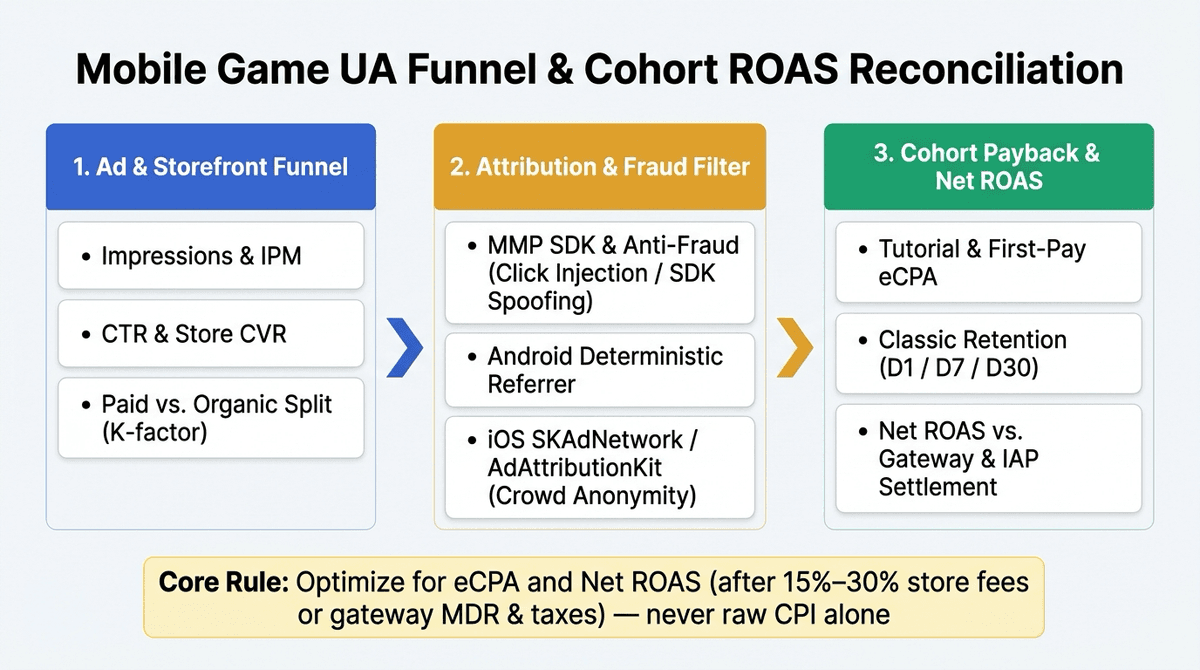
As the measurement diagram above shows, a disciplined UA pipeline connects four data layers: storefront creative power, onboarding activation cost, cohort retention durability, and Net Cohort ROAS reconciled against actual payment settlements.
Four core metric layers on a UA manager's dashboard
To see where marketing spend leaks, UA leads must separate four sequential indicator groups:
- Layer 1 — Creative and Storefront Power (
CTR,CVR,IPM): SDK ad networks (AppLovin, Unity) rank creatives byIPM(Installs Per Mille — installs per 1,000 impressions), calculated asIPM = CTR × CVR × 1,000. HigherIPMboosts effective revenue per thousand impressions (eCPM = CPI × IPM), letting campaigns win auctions at lower CPIs. - Layer 2 — Onboarding Activation Cost (
CPIvs.eCPA): For games in Vietnam requiring secondary asset downloads and Vietnamese phone verification under Decree 147/2024/ND-CP, a notable share of raw installs may drop off before reaching the lobby. Channel evaluation must center oneCPA(Effective Cost Per Action) at verified milestones: asset download, phone verification,Role Creation, andTutorial Completion. - Layer 3 — Cohort Retention and Payer Conversion (
Classic Retention&Cohort Payer %): Users installing on dayD0form one install cohort. UA teams track exact return rates onD1,D7, andD30using Classic Retention (separated from Rolling Retention), alongside first-purchase conversion. - Layer 4 — Net Revenue Return on Ad Spend (
Net Cohort ROAS): Net Cohort ROAS is calculated based on the player cohort's net revenue relative to the corresponding UA spend. Net revenue must be determined consistently according to the business model, payment channel, and applicable deductions (such as app store service fees, payment gateway fees, refunds, and taxes).
The table below standardizes formulas and diagnostic traps across six core UA metrics:
| Tracked Metric | Standard Formula | Management Question | Analytical Trap to Avoid |
|---|---|---|---|
| 1. IPM | (Total Installs / Impressions) × 1,000 |
Do the ad and store listing win auctions effectively? | Replacing videos when IPM drops without checking store ratings and negative reviews |
| 2. CPI | Total Ad Spend / Attributed Installs |
How does install cost compare against genre baselines? | Using CPI as the sole KPI, incentivizing non-monetizing traffic |
| 3. eCPA | Total Ad Spend / Tutorial Completions |
What is the cost to bring one active player into the core loop? | Firing character-creation on app open instead of after asset download |
| 4. Classic Retention | D0 Installers Returning on Dn / Total D0 |
Does this channel's audience fit the core loop? | Mixing Rolling Retention into channel reports, inflating retention |
| 5. Cost Per Payer | Cohort Ad Spend / First-Time Payers |
How much spend converts one player into a verified payer? | Judging payer cost after 24h on strategy games that monetize at D3–D7 |
| 6. Net Cohort ROAS | Cohort Net Revenue by Dn / Corresponding Cohort UA Spend |
What share of UA spend is recovered in net revenue by D7/D30? | Failing to apply consistent channel deductions or including sandbox test orders |
How does attribution differ between iOS (SKAdNetwork / AdAttributionKit) and Android?
According to Gamota's Vietnam Mobile Gaming Year-in-Review 2025 (citing 2025 Statcounter data), Vietnam's mobile OS market share stands at 57% Android and 43% iOS. However, attribution mechanics on the two operating systems follow very different technical rules.
Technical differences in attribution mechanics between Android and iOS
On Android, Mobile Measurement Partners (AppsFlyer, Adjust, Singular) support more granular attribution via the Google Play Install Referrer API and Google Advertising ID (GAID), passing campaign parameters, click timestamps, and install timestamps to the MMP SDK on first launch. Even so, Android attribution is not 100% deterministic in every situation—particularly when users limit ad tracking, reset or delete their GAID, or install outside standard store referrer flows.
On iOS, under Apple's App Tracking Transparency (ATT) framework, most users opt out of sharing their IDFA. Per Apple Developer documentation, attribution for opted-out users routes through SKAdNetwork (SKAN 4.0) and AdAttributionKit, with three key technical characteristics:
- Crowd Anonymity (Privacy Thresholds): Only when a campaign reaches Apple's privacy threshold for install volume does the postback deliver a 64-state fine conversion value (
0–63); otherwise, Apple masks source parameters or returns a 3-state coarse value (low,medium,high) ornull. - Three Postback Windows with Random Delays: Per Apple's documentation on receiving postbacks in multiple conversion windows, SKAdNetwork 4.0 and AdAttributionKit group postbacks into three conversion windows (
0–2 days,3–7 days,8–35 days) with random delays of 24 to 144 hours after window close. - In-app conversion value encoding versus out-of-app Webshop payments: SKAdNetwork is not limited to measuring IAP; developers can encode a wide range of in-app actions (such as tutorial completion, level milestones, feature unlocks, or IAP tiers) into Conversion Values. However, top-ups completed on a publisher's web portal (Webshop via VietQR, e-wallets, or bank cards) take place outside the app binary, so they do not automatically appear in Apple's SKAN postbacks and must be measured separately via the server backend (Server-to-Server — S2S).
The table below outlines how UA teams bridge measurement differences between Android and iOS:
| Dimension | Android Attribution | iOS Attribution (ATT Opt-Out) | Reference Operational Playbook for UA Teams |
|---|---|---|---|
| Core Signal | Granular tracking via Google Play Install Referrer & GAID (with gaps if users reset/delete GAID) | SKAdNetwork 4.0 / AdAttributionKit (subject to Apple crowd-anonymity thresholds) | Test creatives on Android first; port winning concepts into iOS campaigns |
| Latency | Near real time after first app open | First conversion window spans days 0–2 (0–2d) plus 24–48h postback delay |
Avoid pausing iOS campaigns within the first 24h; evaluate on 72-hour cycles |
| Budget Split | Supports granular ad-set splitting and A/B testing | Splitting campaigns thin reduces postback data granularity (coarse or null) |
Reference UA operational practice: consolidate iOS budgets (e.g., into 2–3 campaigns per network) |
| Webshop Orders | Tied to user_id in MMP via Server-to-Server (S2S) |
SKAN encodes in-app actions & IAP; out-of-app Webshop orders require separate server tracking | Track Webshop orders via server-side (S2S) logs; distinguish Cohort ROAS from Blended Net ROAS |
Four-step workflow to reconcile ad network dashboards, MMP data, and payment gateways
To align numbers across ad network managers, MMP dashboards, and finance reports, publishing teams enforce four steps:
- Design the 64-value Conversion Schema for SKAN 4.0's first window (
0–2 days): Under Apple's specification, SKAN 4.0's first conversion window spans days 0 to 2 (D0–D2), and the 64 fine conversion values (0–63) are only returned when campaigns meet Apple's privacy threshold. Developers map these values to composite in-app actions (tutorial completion, level milestones, guild join, and early IAP tiers); locking conversion signals within the first 24 hours is an optional operational choice some UA teams use to receive postbacks earlier rather than an Apple requirement. - Fire Server-to-Server (S2S) purchase events only after IPN verification: Game servers should send S2S revenue events to the MMP only after verifying Instant Payment Notification (IPN) signatures from the payment gateway or store receipt validation.
- Separate Cohort View from Activity Accounting View: Lock one timezone (
UTC+7orUTC) across ad accounts, MMP settings, and backend databases before comparing cohort revenue against monthly cash accounting. - Distinguish
Cohort ROASfromBlended Net ROASon iOS: UseCohort ROASto measure the performance of user groups attributed to specific paid ad campaigns, and useBlended Net ROAS(total iOS net revenue across paid, organic, and Webshop channels divided by total iOS UA spend) to evaluate overall capital recovery across the iOS platform.
Common mistakes that burn UA budgets without acquiring paying players
Even with MMP integration, studios frequently exhaust launch marketing budgets within two weeks due to five operational mistakes:
- Leaving campaigns on cheap install optimization (MAI) too long for mid-core/hardcore titles: Bidding solely for lowest-cost Mobile App Installs (MAI) steers impressions toward free-app clickers who never link a payment method. Run MAI briefly to seed volume before shifting to App Event Optimization (AEO) or Value Optimization (VO / tROAS).
- Failing to separate Organic Uplift from paid attribution: Launch-week creator streams drive thousands of players to search the game's title on the app stores. Broad 7-day view-through windows let ad networks claim credit for organic searchers, while judging creators solely by tracking-link clicks causes teams to cut profitable creator waves.
- Ignoring mobile install fraud (Click Injection and SDK Spoofing): Expanding onto unvetted sub-networks without MMP anti-fraud filters exposes budgets to fraud. In Click Injection, Android malware detects when a download starts and fires a fake click right before installation completes to hijack CPI credit. In SDK Spoofing, bots simulate fake install packets from emulators. UA teams should inspect Click-to-Install Time (CTIT) distributions alongside Google Play Install Referrer timestamps and multi-signal anti-fraud filters in the MMP to block sources showing abnormal short-CTIT spikes.
- Misaligning ad creatives with the first 10 minutes of gameplay: Misleading puzzle ads for a turn-based RPG inflate CTR briefly, but collapse
D1retention and trigger store ranking penalties due to rapid uninstalls. - Evaluating payback on Gross ROAS without consistent net revenue deductions: Judging campaigns on gross billings before deducting store fees, payment gateway fees, and refunds creates an illusion of break-even performance while net cash flow remains negative.
Six-step UA control checklist before and during budget scaling
Before approving weekly UA budget increases, marketing directors and UA leads should verify this six-step checklist:
| Step | Control Area | Acceptance Gate Before Scaling Spend | Owner |
|---|---|---|---|
| 1 | Regulatory & Disclosure | Active G1–G4 credentials (Decree 147/2024/ND-CP, Decree 116/2026/ND-CP); age badges; zero cash-out claims; KOL/KOC ad disclosure (Law 75/2025/QH15) | Legal, Brand, UA |
| 2 | MMP & S2S Audit | Character creation, tutorial, and verified purchases (in-app IAP + out-of-app Webshop) fire via server-side S2S matching gateway logs; sandbox excluded | Backend, Data, UA |
| 3 | SKAN / iOS Setup | 64-value schema configured for Window 1 (0–2 days); reference practice of consolidating iOS budgets (e.g., 2–3 campaigns/network) to meet privacy thresholds |
UA Lead, Data |
| 4 | Anti-Fraud Rules | MMP filters active for Click Injection and SDK Spoofing; CTIT distributions audited alongside Google Play Install Referrer timestamps | UA Lead, MMP |
| 5 | Creative – Store Page | Top KOC videos whitelisted for Spark Ads / Partnership Ads and routed to Custom Store Pages | UA, Creator, ASO |
| 6 | eCPA & Net ROAS | Channels evaluated on tutorial eCPA, Classic Retention D1/D7, and separated Cohort ROAS vs. Blended Net ROAS using consistent net revenue definitions |
Publishing, UA |
Readers can download the full Vietnam Mobile Gaming Year-in-Review 2025 report by Gamota for complete 2025 download and IAP rankings by genre, or explore additional guides in the Gaming topic hub on Appota Insights.
If your studio is preparing to launch a mobile game in Vietnam and needs an experienced local partner to architect multi-channel UA campaigns, coordinate gaming creator waves, and set up transparent Net ROAS cohort measurement, connect with Gamota's game publishing and UA team to map out an execution plan tailored to your genre.
Sources
- Báo cáo Ngành Game Mobile Việt Nam 2025 (Vietnam Mobile Gaming Year-in-Review 2025), Gamota (Appota Group), 2026-02-04, accessed 2026-11-04
- E-Magazine: Tổng quan Gaming Creators Việt Nam (The State of Gaming Creators in Vietnam), Appota & OTA Network, 2022-03-15, accessed 2026-11-02
- Apple Developer — Receiving Ad Attributions and Postbacks & Receiving Postbacks in Multiple Conversion Windows (SKAdNetwork 4.0), Apple, accessed 2026-11-04
- Apple Developer — AdAttributionKit Framework Documentation, Apple, accessed 2026-11-02
- Google Play Developer — Play Install Referrer API Overview, Google, accessed 2026-11-02
- Google Play Console Help — Service Fees & Apple App Store Small Business Program, Google & Apple, accessed 2026-11-02
- Nghị định 147/2024/NĐ-CP về quản lý, cung cấp, sử dụng dịch vụ Internet và thông tin trên mạng và Nghị định 116/2026/NĐ-CP, Chính phủ Việt Nam (dẫn qua Cổng TTĐT Bộ Khoa học và Công nghệ), 2024-11-09, accessed 2026-11-04
- Luật sửa đổi, bổ sung một số điều của Luật Quảng cáo số 75/2025/QH15, Nghị định 342/2025/NĐ-CP và Nghị định 87/2026/NĐ-CP, Quốc hội & Chính phủ Việt Nam (dẫn qua Thư viện Pháp luật), 2025-06-16, accessed 2026-11-04