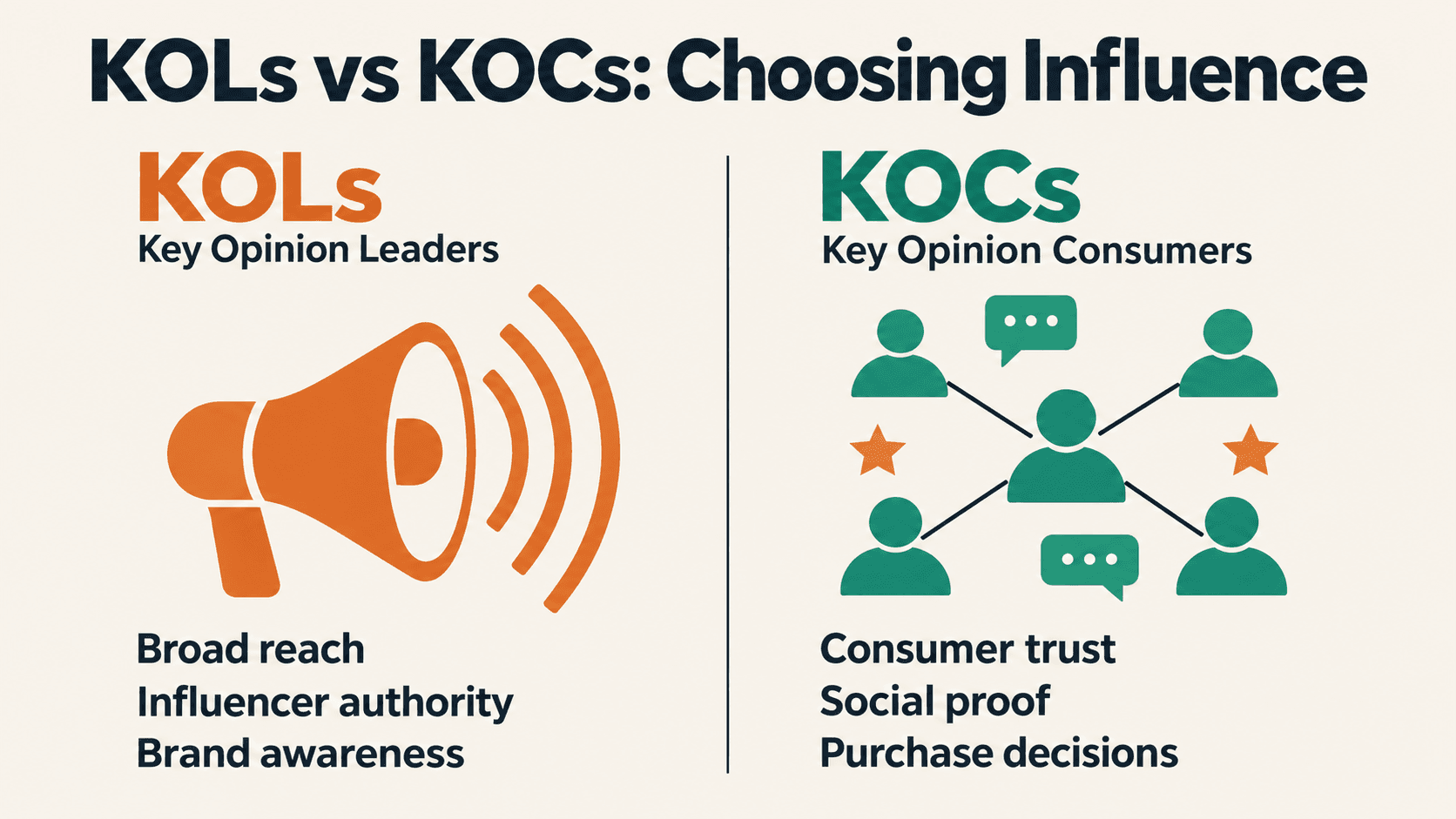
Measuring Influencer Marketing Effectiveness: Real Metrics vs. Vanity Metrics
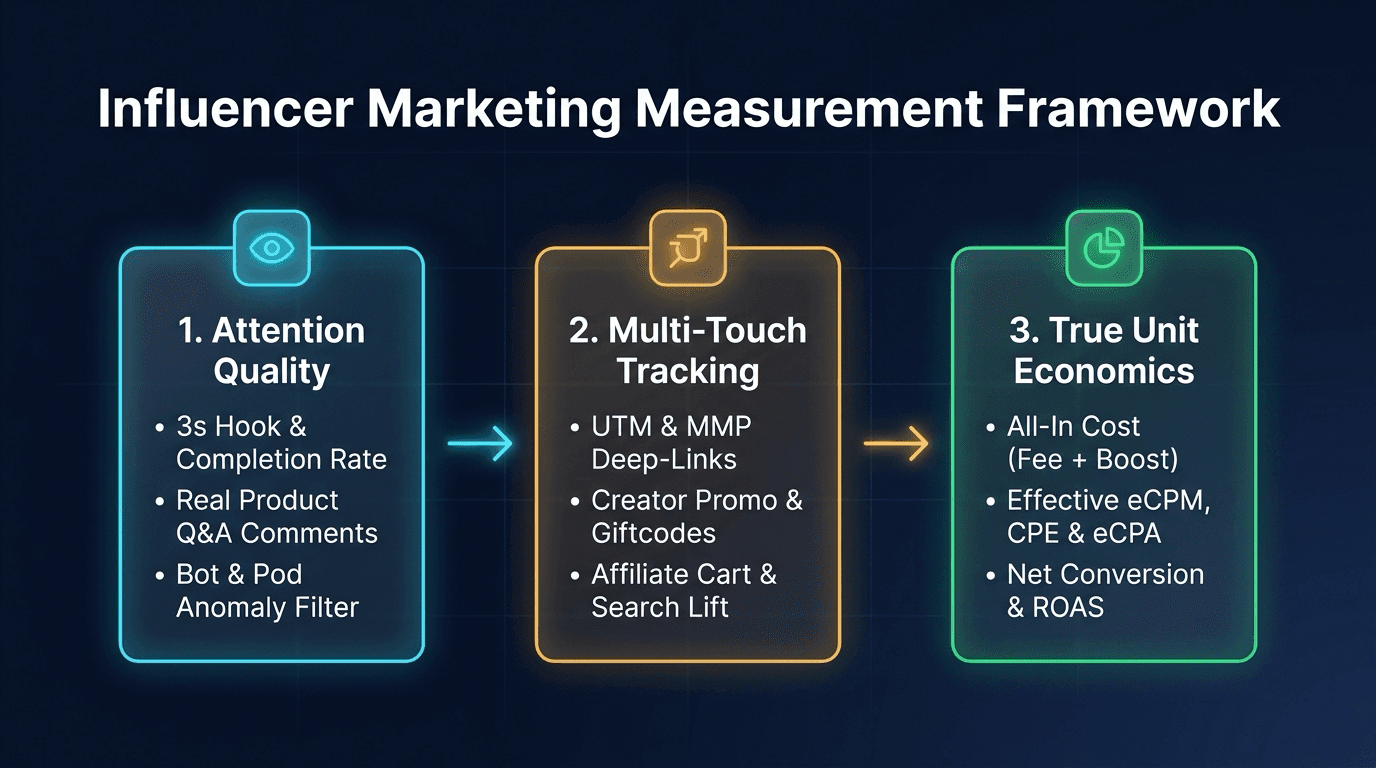
Measuring influencer marketing effectiveness means verifying the real impact of KOLs and KOCs across three layers: audience retention, tracked traffic, and net completed orders or installs. Relying on raw view and like totals easily wastes budget on fake engagement. This guide covers a three-stage KPI framework, four tracking methods, and eCPM, CPE, and eCPA formulas.
Key takeaways
- Raw views and likes are easily inflated by untargeted ad boosting or engagement pods. Campaign managers should check 3-second hook rates, average watch time, and product-related comment ratios instead.
- Evaluation KPIs must match each creator group's role: Awareness KOLs are measured by unique reach and Brand Search Lift; Consideration creators by watch time and engaged sessions; Conversion KOCs by net orders or tutorial completions.
- Because mobile viewers frequently watch videos in one app and buy in another, teams should combine four tracking methods: UTM/MMP deep-links, creator-specific promo or giftcodes, native affiliate carts, and organic search lift.
- Avoid forcing pure CPA/CPS payouts on new launches or complex products. Commission-only pressure often leads creators to exaggerate product claims—violating Article 15a of Vietnam's Law on Advertising No. 75/2025/QH15—or generate fake return orders.
When measuring influencer marketing effectiveness, the hardest job for a marketing team is separating real business results from flattering surface numbers (vanity metrics). Many brands in Vietnam spend hundreds of millions of VND booking Key Opinion Leaders (KOLs) and Key Opinion Consumers (KOCs), receive wrap-up decks showing millions of views, yet see no movement in website visits, app installs, or actual sales.
This happens when campaign reports treat a fleeting two-second scroll-past the same as genuine buyer interest. To know which channels truly drive revenue, marketing teams need to filter out fake engagement, assign the right KPIs to each creator tier, track users across apps, and calculate costs (eCPM, CPE, eCPA) based on total campaign spend.
Which metrics in KOL and KOC post-campaign reports are most easily inflated?
Standard influencer wrap-up reports usually highlight four big numbers on the first slide: follower count, total video views, total likes, and total comments. Signing off on creator payments based solely on these combined totals often means paying for traffic that never intended to buy.
According to The State of Gaming Creators in Vietnam report by Appota and OTA Network (March 2022), during COVID-19 lockdowns, 80.2% of viewers spent more time watching gaming creators (averaging 2.2 hours/day per VIRESA). However, only 43.8% of creator channels gained interaction, while 15.6% stayed flat and 40.7% saw declining interaction. A large follower base built years ago does not guarantee that a channel still holds audience attention today.
Three common ways numbers get inflated and how to spot them
Before approving campaign deliverables, marketing managers should check native platform analytics for three frequent distortions:
- Buying cheap, out-of-target ads to hit view quotas: When an organic video underperforms, some vendors run low-cost impression ads to broad audiences outside the brand's buyer age group just to meet contracted views. The clearest sign is a sudden view spike in the last 48 hours of the campaign, paired with a video completion rate below 5% and almost zero saves or shares.
- Using engagement pods and scripted comment groups: Dozens of secondary accounts flood the comment section within 15–30 minutes of posting to push the video into recommendation feeds. These comments repeat generic praise or emojis without mentioning actual product features, pricing, or details shown in the video.
- Counting 2-second auto-plays as meaningful reach: Short-form video apps count a view after just two to three seconds of automatic playback. Survey data from Appota and OTA Network (March 2022) shows 50.2% of viewers watch gaming creators for entertainment and live chat, far ahead of learning gameplay skills (29.3%). If a creator spends most of the video joking around and squeezes the brand mention into the final seconds, most viewers have already scrolled past.
Comparing surface vanity metrics against verifiable audit metrics
Instead of accepting self-reported summary spreadsheets, brand managers should request direct screenshots from platform analytics tools (TikTok Analytics, YouTube Studio, Meta Insights) across five pairs of metrics:
| Reported Surface Metric | Why It Can Mislead You | What to Check Instead | Warning Sign |
|---|---|---|---|
| 1. Total Followers | May be accumulated years ago or mismatched with your target buyers. | Median Views across the last 10–15 organic posts before booking. | Median organic views fall below 5%–10% of total followers. |
| 2. Raw Video Views | Mixes 3-second scroll-pasts with cheap untargeted ad views. | 3-Second Hook Rate and Video Completion Rate (plus watch time). | High total views paired with an average watch time under 3–4 seconds. |
| 3. Total Likes / Hearts | Easily inflated through automated click farms or mutual liking groups. | Save Rate and Share Rate as a share of unique reach. | Likes exceed 20% of views while saves and shares stay near zero. |
| 4. Gross Comment Count | Padded by giveaway tag rules or coordinated comment groups. | Product-Relevant Comment Ratio (questions on price, features, where to buy). | Over 70% of comments are just friend tags, emojis, or generic praise. |
| 5. Raw Link Clicks | Includes accidental mobile taps and automated link-preview bots. | Engaged Sessions in GA4 or verified app opens in an MMP. | Platform link clicks exceed loaded landing-page sessions by 3x–5x. |
A 3-stage KPI framework for measuring influencer marketing effectiveness: Awareness, Consideration, and Conversion
After filtering out fake engagement, the next step in measuring influencer marketing effectiveness is matching KPIs to each creator group's role in the marketing funnel. A common mistake is judging top-of-funnel KOLs by direct orders or paying conversion KOCs for raw views, as explained in our framework for choosing and combining KOLs and KOCs by budget.
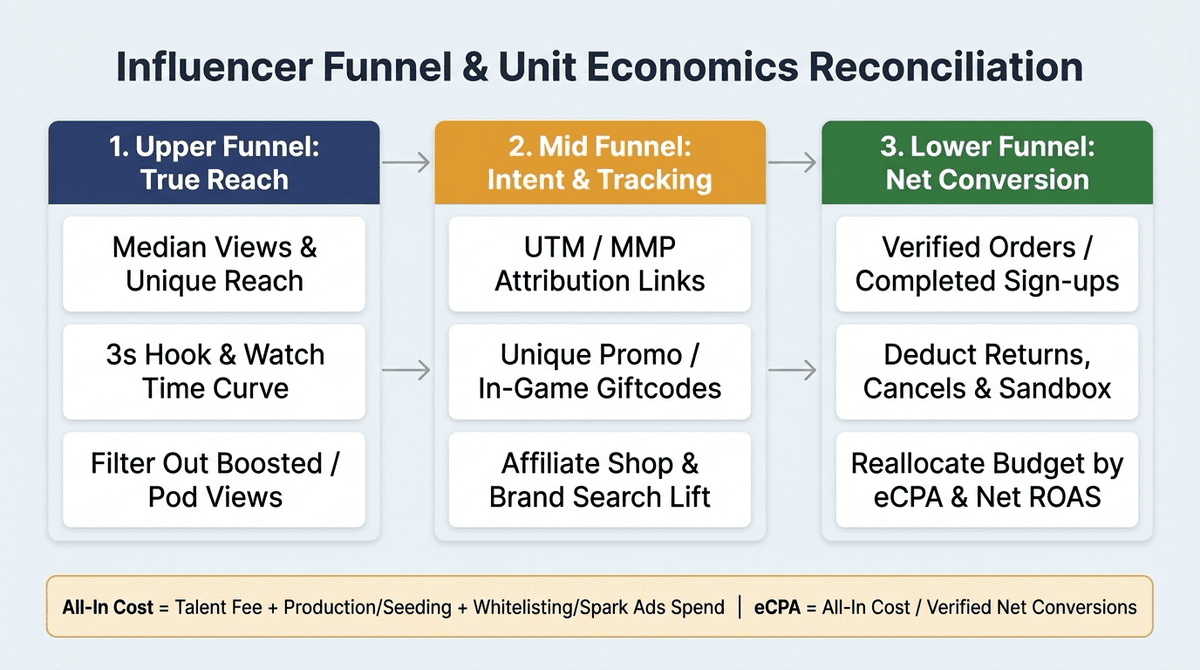
As the diagram above shows, a practical measurement workflow checks three stages in order: verifying how many real people watched at the top of the funnel, tracking how many actively searched or clicked in the middle, and counting completed orders or installs at the bottom.
Why audience age and channel size determine your KPIs
Survey data from Appota and OTA Network (March 2022) shows that 75.8% of gaming livestream viewers are aged 13–22 (40.8% aged 18–22 and 35% aged 13–17). Looking at channel size across the Vietnam creator ecosystem map, 89% of creators belong to the Micro (48%, 10,000–100,000 followers) and Medium (41%, 100,000–1 million followers) tiers. Macro (6%) and Celebrity (5%) creators make up just 11%.
This market structure requires splitting KPIs across three distinct campaign goals:
- Awareness (Upper Funnel): The top 11% Macro and Celebrity KOLs—or major streamers with a young (13–22) audience—excel at broad reach and sparking brand searches. Judging these channels on immediate high-ticket purchases misreads their role.
- Consideration (Mid Funnel): The 89% Micro and Medium creators, along with niche reviewers, show viewers how a product actually works in daily life. Their main KPIs should be average watch time, product questions in the comments, and engaged visits to your website or store page.
- Conversion (Lower Funnel): Built for KOC seeding waves, affiliate creators, and shoppable livestreams. Performance is measured by net completed orders (after deducting cancellations and returns) or new app users who finish registration and the initial tutorial.
Three-stage influencer KPI and measurement tool matrix
The table below maps primary KPIs, cross-check metrics, and tracking tools to each campaign goal:
| Campaign Goal | Main Creator Group | Primary KPIs | Cross-Check Metrics | Tracking Tools |
|---|---|---|---|---|
| 1. Awareness | Celebrity, Macro KOLs, Major Streamers. | Unique Reach, Completed Views, Effective CPM (eCPM). | 3-Second Hook Rate, Brand Search Lift within 48–72 hours. | Native Platform Analytics, Google Search Console. |
| 2. Consideration | Vertical KOLs, Medium Creators, Reviewers. | Average Watch Time, Saves & Shares, Engaged Sessions, CPE. | Product Comment Ratio, Landing Page Bounce Rate. | Google Analytics 4 (GA4), Social Listening tools. |
| 3. Conversion | Micro/Nano KOCs, Affiliate Creators. | Net Conversions (orders / tutorial completions), eCPA / CPI, Net ROAS. | Refund & Cancel Rate, Click-to-Install Time (CTIT), D1/D7 Retention. | MMP (AppsFlyer, Adjust, Singular), CRM/POS, TikTok Shop / Shopee. |
Four methods to track conversions from creators to websites and mobile apps
The biggest blind spot when evaluating KOL and KOC campaigns is that mobile viewers rarely buy in a single click. According to Adsota's Vietnam Digital Advertising Report 2019 (published February 2020, citing Q&Me 2019), only 11% of Vietnamese social media users follow brand pages and 9% follow celebrities, yet 51% have bought a product after seeing social media ads.
At the same time, mobile clicks are noisy: 28% of mobile ad clicks happen because a prompt forces a click to unlock content, and 24% come from accidental screen taps (Q&Me, 2019). Moreover, 53% of mobile users leave a page that takes over 3 seconds to load, and each extra second of delay cuts conversions by 20% (Google & Kantar, 2018). Counting raw link clicks without tracking through to final checkout will severely distort your numbers.
Combining 4 tracking methods so you don't lose conversions
To capture both direct clickers and viewers who switch apps to search and buy later, operations teams should combine four tracking methods:
- UTM Links (Websites) and MMP Deep-links (Mobile Apps/Games): Per Google Analytics 4 (GA4) documentation, every link in a creator's bio, description, or pinned comment should carry five parameters:
utm_source,utm_medium,utm_campaign,utm_content(creator ID), andutm_term. For mobile apps and games, links should run through a Mobile Measurement Partner (AppsFlyer, Adjust, Singular) with Deferred Deep-linking so the creator still gets credit after the user installs the app from the App Store or Google Play. - Creator-Specific Promo Codes and In-Game Giftcodes: On short-video apps like TikTok or Reels, viewers rarely tap profile links; instead, they open a shopping app or launch the game directly. Giving each creator a unique code (such as
GAMOTA_DUYorADSOTA50) lets your server count exact redemptions across devices. - In-App Affiliate Carts (TikTok Shop, Shopee Affiliate, YouTube Shopping): For retail and consumer goods, native shopping carts let viewers check out without leaving the video app. Finance teams must separate Placed Order Value (Gross GMV) from Net Settled Revenue (Net GMV) after deducting canceled orders, failed deliveries, and returns over 7–14 days.
- Brand Search Lift and Organic Uplift: Large KOL streams often prompt viewers to search the brand name on Google, the App Store, Google Play, or Shopee. Data teams should compare the 7-day pre-campaign average against the jump in branded searches and organic installs during the 24–72 hours after a broadcast, aligning with multi-channel rules in marketing attribution models for performance marketing.
| Tracking Method | How It Logs Data | Main Strength | Key Limitation | Best Fit For |
|---|---|---|---|---|
| 1. UTM / MMP Deep-links | URL parameters in GA4 or MMP SDK attribution. | Tracks session length, drop-off steps, and post-install behavior. | Loses users if in-app browsers take over 3 seconds to load the page. | Brand websites, lead-gen pages, fintech apps, mobile games. |
| 2. Promo / Giftcodes | Server redemption logs at checkout or inside the game. | Unaffected by cookie blocking or users switching devices. | Codes can leak onto coupon groups if not capped by time or quantity. | Mobile game launches, subscription apps, marketplace promos. |
| 3. Affiliate Carts | Platform order tracking tied directly to creator IDs. | Smooth in-app checkout; shows exact sales per video or stream. | Brands get limited CRM customer data; gap between Gross and Net GMV. | Fast-moving consumer goods (FMCG), fashion, beauty, home goods. |
| 4. Brand Search Lift | Compares branded searches and organic installs before vs. after. | Captures the halo effect of big KOLs when viewers don't click links. | Hard to separate individual impact if several KOLs post at the same hour. | New brand or game launches, celebrity ambassadors, major events. |
How do you calculate effective CPM (eCPM), CPE, and CPA per creator tier to reallocate budget?
A common budgeting error when comparing creators is dividing results only by the contracted booking fee. In reality, hiring 30 KOCs comes with low individual fees, but adds significant costs for product samples, shipping, staff coordination, and paid ad boosting.
According to Appota and OTA Network's survey (March 2022), 40.6% of surveyed creators earn income from brand sponsorships and bookings. Reference rates for a single livestream start at USD 250+ for Micro creators (10,000–100,000 followers) and USD 320–420+ for Medium creators (100,000–1M followers), rising to USD 850+ for Macro (1–3M followers) and USD 2,000+ for Celebrity talent (over 3M followers). To compare one USD 2,000 Celebrity stream fairly against eight USD 250 Micro streams, teams must calculate based on All-In Cost (C_all_in).
Calculating All-In Cost and 4 cost-efficiency formulas
Before comparing channels, add up all four cost items tied to each creator group (C_all_in):
$$C_{\text{all-in}} = \text{Booking Fee} + \text{Affiliate Commission} + \text{Sample & Production Cost} + \text{Paid Ad Boost Spend}$$
Using C_all_in as total spend, evaluate each creator group across four practical cost metrics:
| Cost Metric | Formula | Counted Only on Verified Results | What Decision It Guides |
|---|---|---|---|
| 1. Effective CPM (eCPM) | (C_all_in / Verified Views) × 1,000 |
Views lasting ≥3 seconds within your target age and market. | Compares KOL reach cost against standard paid social video ads. |
| 2. Cost Per Completed View (CPV) | C_all_in / Completed Views (or ≥15s views) |
Viewers who watched through the full product introduction. | Spots the best-retaining creator videos to boost with paid ads. |
| 3. Cost Per Engagement (CPE) | C_all_in / (Saves + Shares + Real Comments + Clicks) |
Intentional interactions after removing bot and pod comments. | Shows how well a creator sparks genuine product interest. |
| 4. Effective CPA (eCPA) | C_all_in / Verified Net Conversions |
Completed orders (minus returns) or users finishing the game tutorial. | Decides which channels to scale, renew, or drop in the next wave. |
How Adsota and OTA Network filter anomalies and reallocate campaign budget
Across brand and game publishing campaigns run by Adsota and creator network OTA Network, operations teams apply two practical checks after videos go live:
- Cross-checking numbers in the first 24–48 hours: Right after publication, analysts compare the 3-second hook rate against the pace of UTM/MMP link clicks. If a video gets a sudden midnight view spike while click-through rate (CTR) drops near 0% and comments repeat identical one-word praise, the channel is flagged for review instead of receiving paid ad budget.
- Splitting budget 70/30 to amplify winning videos: Rather than spending 100% of the budget upfront on booking fees, campaigns put roughly 70% into creator production and hold 30% for paid amplification. After 48 hours of organic reach, media buyers pick the top 10%–15% of videos with the best
CPVandeCPAto run as TikTok Spark Ads or Meta Partnership Ads—while keeping landing page load times under 3 seconds. (Note: Appota's Marketing specialist will confirm additional operational details prior to publication.)
When should brands avoid forcing pure CPA or CPS KPIs onto KOLs and KOCs?
Under pressure to guarantee sales, many businesses try to move all KOL and KOC contracts onto pure Cost Per Sale (CPS) or Cost Per Install (CPA/CPI) commission terms. While paying only per order lowers fixed upfront costs, forcing pure CPA/CPS deals into the wrong situations can damage both brand trust and legal compliance.
Four situations where pure CPA/CPS deals backfire
Budget managers should avoid pure CPA/CPS contracts in four cases:
- Brand-new products with zero market awareness: KOCs and affiliate sellers close sales best when buyers already recognize the brand. For an unknown product, natural conversion rates are low; offering commission-only terms causes skilled creators to turn down the job, leaving only low-quality link spammers.
- Products that require a longer decision process: For fintech apps requiring identity verification (eKYC), B2B software, or strategy games with large downloads, customers usually need 3–5 touchpoints before committing. Paying only the last-click channel penalizes the creators who did the hard work of explaining the product first.
- In-depth reviews that rely on objective trust: Viewers follow tech reviewers, finance educators, and veteran streamers for honest opinions. When a creator's pay depends entirely on immediate link clicks below the video, the review quickly turns into a pushy sales pitch that turns audiences away.
- Categories requiring strict claims control: When KOCs receive no base fee to cover production time and must chase order volume to break even, some make exaggerated product claims or arrange fake cash-on-delivery (COD) orders that get returned after commission payout.
Legal risks under Vietnam's amended Law on Advertising No. 75/2025/QH15
Starting in 2026, when a creator exaggerates product benefits or hides sponsorship labels to hit sales targets, both the creator and the brand face direct legal liability.
Under Article 15a of the Law Amending and Supplementing a Number of Articles of the Law on Advertising No. 75/2025/QH15 (passed June 16, 2025, effective January 1, 2026), together with Decree 342/2025/ND-CP (effective February 15, 2026) and Decree 87/2026/ND-CP (effective May 15, 2026), Vietnamese law sets clear legal duties for influencers:
- No endorsing products without actual use or clear understanding (Clause 3a, Article 15a): Influencers must verify advertiser credibility and check legal product documents. If they have not used or do not clearly understand the product or service, they are prohibited from introducing it.
- Clear advertising disclosure before and during content (Clause 3b, Article 15a): Influencers must clearly inform viewers about advertising right before and throughout the promotional activity, while turning on commercial disclosure labels on TikTok, Meta, and YouTube.
- Legal responsibility for truthful claims (Clause 2, Article 15a): Anyone conveying advertising must provide truthful, accurate information on product features and quality and bears legal responsibility if the content is misleading. (Editorial note: Legal counsel must verify statutory citations against primary Gazette texts prior to publication.)
Instead of pure CPA/CPS demands, a more sustainable approach is a Hybrid Compensation Model: brands pay a reasonable base fee to cover genuine product testing and legal script compliance, paired with tiered commission bonuses once verified net orders pass target thresholds.
Before launching your next campaign, update your evaluation checklist: replace raw view totals with 3-second hook and completion rates, issue unique UTM/MMP deep-links and promo codes per creator, and calculate eCPM, CPE, and eCPA on total all-in spend. Read more practical guides in the Marketing and Creator topic hub on Appota Insights.
If your team needs an experienced partner to build creator KPI frameworks, screen KOL and KOC rosters against fake engagement, and set up multi-channel conversion tracking for brands, apps, or mobile games in Vietnam, reach out to Adsota's influencer and digital marketing team for a consultation.
Sources
- E-Magazine: Tổng quan Gaming Creators Việt Nam (The State of Gaming Creators in Vietnam), Appota & OTA Network, 2022-03-15, accessed 2026-11-02
- Báo cáo thị trường quảng cáo số Việt Nam 2019 (Vietnam Digital Advertising Report 2019), Adsota (Appota Group), 2020-02-20, accessed 2026-11-02
- Luật sửa đổi, bổ sung một số điều của Luật Quảng cáo số 75/2025/QH15, Quốc hội Việt Nam (dẫn qua Thư viện Pháp luật), 2025-06-16, accessed 2026-11-02
- Nghị định 342/2025/NĐ-CP quy định chi tiết một số điều của Luật Quảng cáo và Nghị định 87/2026/NĐ-CP về xử phạt vi phạm hành chính trong văn hóa và quảng cáo, Chính phủ Việt Nam (dẫn qua Thư viện Pháp luật), 2025-12-26, accessed 2026-11-02
- Google Analytics 4 Help — Collect campaign data with custom URLs (UTM parameters), Google, accessed 2026-11-02
- TikTok Branded Content Policy, TikTok, accessed 2026-11-02