Comparing Mobile Game Monetization Models: IAP, IAA, Hybrid, and Subscriptions

The four core mobile game monetization models are In-App Purchases (IAP), In-App Advertising (IAA), Hybrid Monetization, and Subscriptions or Battle Passes. Mid-core and hardcore RPG or strategy titles rely on IAP and Battle Passes, casual games lean on IAA, and Hybrid models combine both streams. In Vietnam, VND 20,000–50,000 starter packs and domestic payment rails improve first-purchase conversion.
Key takeaways
- No single revenue model fits every genre: RPG and strategy titles rely on IAP and Battle Passes, casual titles depend on IAA, and fast-growing Idle RPG and Roguelike sub-genres perform best with Hybrid Monetization.
- According to AdColony (cited in Adsota's August 2017 report) and Appota (May 2021), 87% of mobile games in Vietnam integrate IAA and 40% integrate IAP; 75% of publishers rate Rewarded Video as the most effective format and 87% rate it highest for user experience.
- IAP funnels in Vietnam require localized VND 20,000–50,000 Starter Packs aligned with e-wallets and VietQR, alongside strict compliance with Article 57 of Decree 147/2024/ND-CP and Decree 174/2026/ND-CP prohibiting virtual item cash-out or trading.
- All payback and co-publishing calculations must use Net Revenue after deducting 15%–30% Apple/Google storefront fees or domestic payment gateway MDR fees, refunds, and taxes.
Selecting the right mobile game monetization models during early economy design determines whether a studio can recover User Acquisition (UA) spend after launch. According to the Vietnam Mobile Game Market Report 2024 by Gamota R&D (February 2025), Vietnam's mobile game revenue surpassed USD 800 million in 2024 (up 2%), even as total downloads declined 10% to over 1.6 billion. With 127 new titles from domestic publishers seeing a 22% drop in new-release revenue to over USD 70 million, copying overseas USD price tiers or overloading sessions with forced ads quickly erodes retention.
How do the four mobile game monetization models (IAP, IAA, Hybrid, and Subscription/Battle Pass) work?
Commercial studios structure player revenue around four primary mobile game monetization models: In-App Purchases (IAP), In-App Advertising (IAA), Hybrid Monetization, and recurring Subscriptions or seasonal Battle Passes.
According to Appota's Vietnam Mobile Application Report 2021 (May 2021), 87% of mobile games in Vietnam integrate IAA (compared to 73% globally), 40% integrate IAP (versus 21% globally), and only 2% charge paid download fees. Globally in 2024, Newzoo recorded USD 92.6 billion in mobile game spending (49% of the USD 187.7 billion global games market). Meanwhile, Sensor Tower reported USD 80.9 billion in global App Store and Google Play IAP revenue (up 4% year-on-year despite a 6% drop in downloads to 49.6 billion).
The table below compares mechanics, genre fit, core metrics, and player experience risks across all four models:
| Monetization Model | Revenue Mechanism | Best-Fit Game Genres | Primary KPIs Tracked | Player Experience Risks |
|---|---|---|---|---|
| 1. In-App Purchase (IAP) | Direct sale of hard currency, gacha summons, equipment, and speed-ups | MMORPG, ARPG, Strategy (SLG / 4X), Team Battle | Paying Rate, ARPPU, Cohort Net LTV |
Pay-to-win friction between high-spending VIPs and free-to-play (F2P) players |
| 2. In-App Ads (IAA) | Serving Rewarded Video, Interstitial, Playable, and Banner ad placements | Hyper-casual, mass-market Puzzle, short-session Arcade | eCPM, Impressions/DAU, Ad ARPDAU, Fill Rate |
Early D1/D3 churn if forced interstitials interrupt core gameplay loops |
| 3. Hybrid Monetization | Combining deep IAP for payers with opted-in IAA for non-payers | Idle RPG, Roguelike, Tower Defense, Hybrid-casual | Blended ARPDAU, IAP/IAA Split, Net ROAS |
Overly generous ad rewards cannibalizing entry-level IAP starter packs |
| 4. Subscription & Battle Pass | Weekly, monthly, or seasonal pass tied to daily progression milestones | MOBA, Battle Royale, RPG, SLG, core Casual | Pass Attach Rate, Renewal Rate, Retention D30 |
Mid-season buyer fatigue if daily quest requirements demand excessive grinding |
Why applying a rigid single-stream formula across genres fails
A common misconception is treating IAP as exclusive to hardcore RPGs and IAA as exclusive to casual games. Global store data from Sensor Tower (cited in Gamota R&D's February 2025 report) shows a structural shift. In 2024, global RPG IAP revenue declined 17.3% to USD 16.8 billion. Conversely, Strategy rose 16.2% to USD 17.5 billion and Puzzle climbed 14.0% to USD 12.2 billion through deep LiveOps events and seasonal passes.
Within Vietnam during 2024, Gamota R&D recorded a 42% drop in traditional MMORPG downloads, while Roguelike installs jumped 91% and Idle RPG installs grew 66%. Both breakout sub-genres rely on Hybrid Monetization paired with monthly passes. For a broader look at how genres and licensing interact across the industry, see our Vietnam mobile game market overview.
How should studios design the IAP funnel and first-purchase Starter Pack for Vietnam?
Vietnamese publishers generated USD 292 million in 2024 (roughly 36.5% of total market revenue) despite accounting for just over 130 million downloads (around 8.1% of total installs), according to Gamota R&D (February 2025). This monetization efficiency stems from localizing the IAP funnel to match domestic purchasing power and payment habits.
AdColony's Summer 2017 Mobile Publishing Survey (cited in Adsota's August 2017 report) identified the three strongest predictors of Lifetime Value (LTV): user retention (Retention, selected by over 80% of publishers), early purchases (Early IAP, nearly 70%), and average session duration (around 45%). Consequently, the primary job of an IAP funnel during the first 48 hours is removing friction from the player's first transaction.
Four-tier IAP pricing architecture from icebreaker packs to VIP events
Operational experience from publisher Gamota shows that keeping unadjusted international Starter Packs at USD 4.99–9.99 (roughly VND 125,000–250,000) suppresses first-time payer conversion in Vietnam. A localized IAP architecture divides offerings into four tiers:
| IAP Funnel Tier | Reference Price Band (VND) | Representative Offerings | Behavioral Objective | Trigger Timing |
|---|---|---|---|---|
| 1. Icebreaker (Starter Pack) | VND 20,000 – 50,000 |
First-top-up SSR hero/weapon bundle, Remove Ads pack | Convert a Non-payer into a verified First-time Payer |
Immediately after tutorial completion (D0–D1) |
| 2. Habit & Retention Pass | VND 99,000 – 249,000 |
30-day Monthly Card, Growth Fund, Seasonal Battle Pass | Anchor daily logins to claim recurring hard currency | Days D2–D7 once the core loop habit is formed |
| 3. Mid-Tier Progression | VND 299,000 – 999,000 |
Level breakthrough bundles, limited gacha summon packs | Relieve resource bottlenecks during squad upgrades | Triggered at level milestones (2-hour timed popup) |
| 4. Competitive VIP / Whale | VND 1,000,000 – 2,000,000+ |
Guild siege bundles, cross-server auction packages | Support leaderboard competition and social status | Synced with weekend LiveOps and holiday events |
Statutory compliance for virtual items and under-18 playtime limits in Vietnam
When designing virtual currencies, gacha mechanics, and Battle Passes for Vietnam, product directors must enforce strict statutory rules:
- Prohibition on virtual item cash-out and player trading: Under Article 57 of Decree 147/2024/ND-CP (signed November 9, 2024, effective December 25, 2024), virtual items, virtual units, and reward points may only be used within the game and strictly for the purpose declared by the enterprise. Converting virtual items, virtual units, or reward points into cash, payment cards, vouchers, or tradable real-world goods—or enabling virtual item trading between players—is strictly prohibited.
- Administrative penalties for violations: Under Decree 174/2026/ND-CP (signed May 15, 2026, effective July 1, 2026), enterprises that violate virtual item management rules or fail to verify player accounts via Vietnamese mobile phone numbers (across G1–G4 categories) face administrative fines. (Editorial note: Legal counsel should verify specific penalty tiers against primary Official Gazette texts before publication.)
- Sizing Battle Pass daily quests within the 60 / 180-minute under-18 cap: Under Articles 39 and 48 of Decree 147/2024/ND-CP, technical systems must cap players under 18 at no more than 60 minutes per day for each game and 180 minutes per day across all games for under-18 players operated by the same enterprise. Daily Battle Pass tasks must therefore be completable within 30–45 minutes.
How can you optimize in-app advertising (IAA) without driving player churn?
In most free-to-play titles, over 90% of installs never make an IAP transaction. According to AdColony's global survey (cited in Adsota's August 2017 report), in-app advertising (IAA) generated 52% of total gaming app revenue (31% video, 19% display, 2% native), exceeding the 43% share from IAP and mobile commerce.
Among ad formats, Rewarded Video is the clear performance leader. AdColony found that 75% of publishers rated Rewarded Video as the most effective monetization tool (ahead of IAP at 63% and interstitial video at 44%), while 87% rated it best for user experience (far above interstitial display at 32% and banners at 24%).
In Vietnam, survey data from POKKT and Decision Lab (cited in Appota's Vietnam Mobile Marketing and Game Report 2019, June 2019) confirmed that 51% of Vietnamese gamers prefer Rewarded Video for in-game rewards. That rate is more than double the 23% preference for non-rewarded video, with an average acceptable ad duration of 19 seconds.
eCPM hierarchy by ad format, device tier, and Lunar New Year seasonality
Data from Adsota across its Q2 2017 Mobile App Advertising Report (August 2017) and 2018 Holiday Season App Monetization Report (January 2019)—synthesizing AppotaX, Appodeal, Google, Smaato, and InMobi benchmarks—demonstrates how effective revenue per thousand impressions (eCPM) varies by format, OS, and season:
| Dimension | Performance Tier & Vietnam / APAC Benchmarks | Source & Period | Ad Mediation Configuration Rule |
|---|---|---|---|
| 1. Rewarded Video | Highest eCPM tier; in Vietnam H1 2017, reached USD 1.00–2.90 on iOS and USD 0.58–0.66 on Android in Q2 |
Adsota, Appodeal (H1 2017) | Tie placements to revives, 2x stage clear rewards, and bonus spins; cap at 3–5 views/day per placement |
| 2. Interstitial Ads | 2nd in eCPM (3x Native and 5–6x Banner); in Vietnam H1 2017, reached USD 1.25–2.35 on iOS and USD 0.80–0.96 on Android |
Adsota, AppotaX, Appodeal, Smaato (2017–2018) | Trigger only at natural post-match breaks; enforce a minimum 180–240 second cooldown timer |
| 3. Native & Banner | Native delivers nearly 2x Banner eCPM; Banner is lowest (USD 0.04–0.35 in Vietnam H1 2017) |
Adsota, AppotaX, Appodeal, Smaato (2017–2018) | Avoid persistent banners that crowd combat controls or trigger accidental clicks in landscape games |
| 4. Device OS Tiers | Low-to-mid Android drives 49% of impressions (100X eCPM), high-end Android 29% (134X), and iOS 22% of impressions at 153X eCPM (+30% over Android) |
Adsota, Smaato, InMobi (2017–2018) | Separate bidding waterfalls and floor prices for iOS and high-end Android devices |
| 5. Tet Holiday Peak | Daily in-app ad requests in Vietnam jump +32% across the 7-day Tet holiday, lifting Indexed eCPM to 222X (Japan = 100X, South Korea = 133X) |
Adsota, Appodeal, Smaato (2017–2018) | Lock mediation SDK updates at least 2 weeks before Lunar New Year to capture peak brand ad spend |
Three operational guardrails to protect retention when deploying IAA
To capture ad revenue without damaging Day-1 (D1) retention, product and monetization teams at Gamota and Adsota enforce three rules:
- Zero forced interstitials during the First-Time User Experience (
FTUE): Players must finish onboarding and experience the core loop before encountering forced ads. Showing interstitials during the first 10 minutes spikes immediate uninstalls. - Automatic removal of forced interstitials after the first IAP: Any player who purchases a VND 20,000 Starter Pack—or any real-money bundle—should immediately have forced interstitials disabled while retaining optional Rewarded Video buttons.
- Strict sink-and-source caps on ad rewards: Rewarded Video payouts should grant consumable resources (gold, stamina, retry tokens) capped at 10%–15% of daily progression needs, preventing ad rewards from cannibalizing Starter Pack sales.
When should a studio transition from pure IAP or pure IAA to Hybrid Monetization?
The shift toward Hybrid Monetization works in both directions: casual studios add IAP and Battle Passes to deepen LTV, while mid-core studios add Rewarded Video to monetize non-paying cohorts (Non-payers).
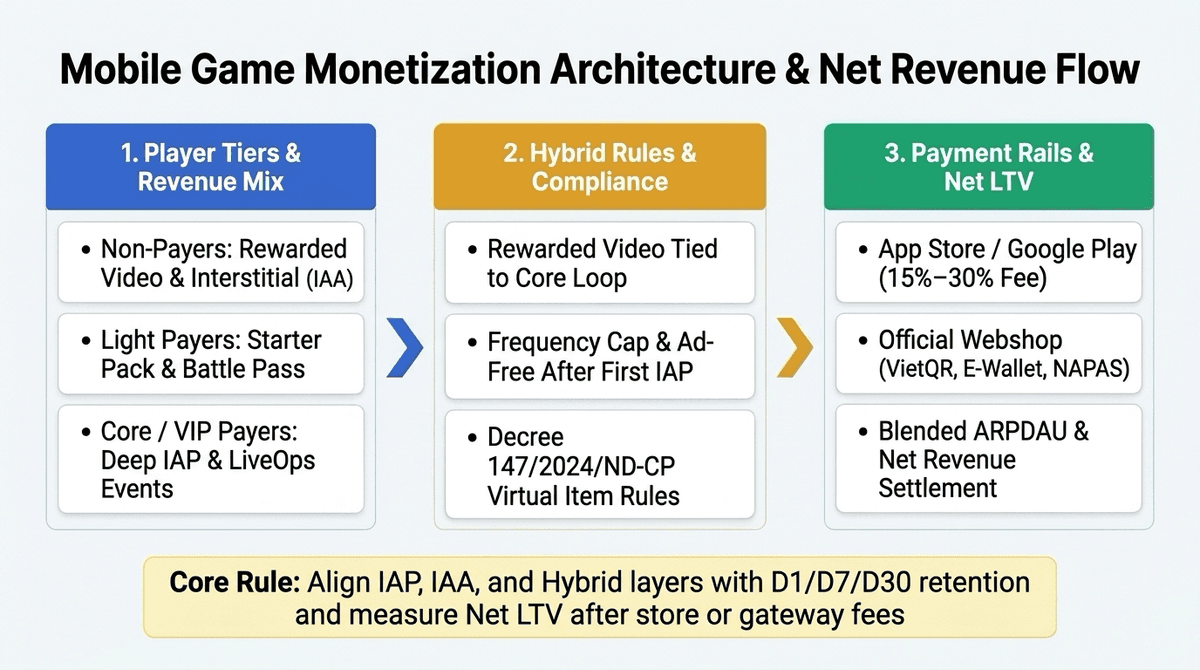
As the architecture diagram above illustrates, a balanced Hybrid system segments users into three tiers (non-payers viewing IAA, light payers purchasing Starter Packs and Battle Passes, and VIPs engaging in LiveOps events), applies strict experience guardrails, and reconciles all cash flows on Net LTV.
Four-step cohort workflow to introduce a secondary monetization layer
Studios can execute a four-step workflow during soft-launch testing to validate a Hybrid transition (see our mobile game soft-launch checklist for cohort gate benchmarks):
- Step 1 — Diagnose the gap between Retention and Paying Rate: According to AppsFlyer and Sensor Tower data cited in Appota's report (May 2021), average
D1retention for mobile games in Vietnam exceeds 30% on iOS and reaches roughly 24% on Android. If a mid-core game achieves healthyD1retention but converts fewer than 2%–3% of players into payers, adding Rewarded Video captures incremental value. Conversely, if an IAA casual title retains players throughD7/D14with long sessions, adding a Remove Ads bundle, Starter Pack, and Battle Pass lifts the LTV ceiling. - Step 2 — Segment ad and store prompts by predicted payer probability: Use first-24-hour behavioral signals (device model, stage progression speed, store visits) to segment cohorts. High-probability payers see targeted Starter Pack offers, while predicted non-payers unlock early Rewarded Video placements to assist stage progression.
- Step 3 — Isolate Soft Currency from Hard Currency: Keep soft currency (earned via gameplay and Rewarded Video) separate from premium hard currency (purchased via IAP or monthly cards) to prevent economy inflation.
- Step 4 — Run 14-day A/B tests on
Blended ARPDAU: Split cohorts 50/50 between control and Hybrid variants for at least 14 days. Roll out the Hybrid build only ifBlended ARPDAU(IAP ARPDAU + IAA ARPDAU) increases without degradingD7retention or cannibalizingIAP ARPDAU.
When should a studio NOT implement Hybrid Monetization?
Despite its success in Idle RPG and Roguelike titles, studios should not combine IAP and IAA in three scenarios:
- Hardcore MMORPGs or 4X Strategy titles with high-ARPPU VIP cohorts: In heavy guild-driven RPG or SLG titles where revenue concentrates among high-spending VIPs, a few cents of ad
ARPDAUwill never offset brand dilution or the risk of an in-game video ad serving a rival SLG title's creative to your top spenders. - Ultra-short-session Hyper-casual games with weak
D7retention: When players churn within 2–3 days, the engineering overhead of account registration, Vietnamese phone verification, storefront SKU management, and payment support exceeds potential IAP returns. - Before securing Vietnamese regulatory approval and payment reconciliation: Studios must never enable real-money monetization for players in Vietnam before obtaining a G1 Release Decision or G2–G4 Notification Confirmation under Decree 147/2024/ND-CP.
How do app store fees and domestic payment gateways affect Net Revenue?
A costly financial error among studios is evaluating UA payback against Gross Bookings reported on MMP dashboards. In practice, the cash a studio actually collects (Net Revenue) depends heavily on storefront commissions and domestic payment channel fees.
According to OTA Network's 2023 payment survey in the Vietnam Esports Whitebook 2022–2023 (August 2024), Vietnamese players strongly favor domestic payment rails: 71% pay via bank accounts (VietQR transfers, domestic NAPAS cards), 58.1% use MoMo, 30.6% use ZaloPay, 21% use credit cards, 17.7% use ShopeePay, 9.7% use debit cards, and only 1.6% do not spend.
Comparing Net Revenue margins across App Store IAP, domestic Webshops, and IAA
In Vietnam, commercial publishers operate dual payment rails: native In-App Purchases (governed by Section 3.1 of Apple's App Store Review Guidelines and Google Play Payments Policy) alongside official browser-based Webshops powered by payment intermediaries licensed by the State Bank of Vietnam under Decree 52/2024/ND-CP (effective July 1, 2024) and Circular 40/2024/TT-NHNN (effective July 17, 2024, as amended by Circular 41/2025/TT-NHNN and Circular 22/2026/TT-NHNN effective May 19, 2026).
The table below compares fee structures and operational characteristics across all three revenue rails:
| Financial & Operational Dimension | Native Storefront IAP (App Store / Google Play) | Official Domestic Webshop (Licensed Payment Gateway) | In-App Advertising (IAA via Ad Networks) |
|---|---|---|---|
| 1. Commission / Fee Structure | 30% standard fee; 15% for auto-renewing subscriptions after 12 months or small businesses (<USD 1M/year) |
Lower Merchant Discount Rate (MDR) varying by rail (VietQR, e-wallets, NAPAS cards, credit cards) |
Ad networks deduct revenue share before reporting net publisher eCPM |
| 2. Supported Payment Methods | International cards (Visa/Master/JCB) and selected store-linked local e-wallets | Full coverage of bank accounts (71% usage), MoMo (58.1%), ZaloPay (30.6%), ShopeePay (17.7%), ATM/credit cards |
Settled by demand partners via ad networks (AdMob, AppLovin, Unity, AppotaX) |
| 3. Checkout UX & Ticket Size | Seamless 1-click in-app prompt; ideal for VND 20,000–200,000 impulse packs |
Browser login via character ID; ideal for high-value bundles, monthly passes, and bonus tiers | Players watch 15–30s videos (average acceptable length 19s) for in-game rewards |
| 4. Settlement Cycle | Monthly payout schedule per Apple and Google settlement calendars | Automated daily reconciliation (T+1 or per contract) via gateways such as AppotaPay |
Net 30 to Net 60 days depending on each ad network's payout terms |
| 5. Refund & Technical Risk | Refund abuse when users consume items and file storefront refund claims | Requires HMAC-SHA256 IPN webhook verification and strict database idempotency |
Invalid traffic (IVT) deductions if bots or misconfigured placements trigger fake clicks |
Net Revenue formula and technical payment synchronization
Both in co-publishing agreements and internal Net LTV versus CPI models, finance and product teams must standardize on:
$$\text{Net Revenue} = \text{Gross Revenue} - (\text{Store Fee / Gateway MDR} + \text{Refunds & Chargebacks} + \text{VAT & FWT})$$
To run native IAP and a domestic Webshop simultaneously without revenue leakage, backend teams must enforce three engineering controls detailed in our guide to direct-to-consumer mobile game webshops:
- Grant virtual items strictly upon verified server-to-server IPN or receipt validation: Game servers must never fulfill orders based on client-side browser redirect parameters. Grant items only after verifying the
HMAC-SHA256signature on the gateway's Instant Payment Notification (IPN) webhook or validating store receipts directly with Apple and Google servers. - Enforce database idempotency and automated refund clawbacks: Process each unique
transaction_idexactly once at the database level to prevent duplicate item grants during webhook retries. Integrate Apple's App Store Server Notifications and Google Play's Voided Purchases API to automatically revoke items or flag accounts engaging in refund abuse. - Synchronize VIP points and first-purchase perks across in-app and Webshop orders: When a player purchases via VietQR or an e-wallet on the Webshop, the game server should push the reward to the active client within seconds, unlock First-Purchase Starter Pack milestones, and disable forced interstitials identically to an in-app purchase.
You can explore additional guides on game licensing, user acquisition, and live operations in the Gaming topic hub on Appota Insights.
If your studio is designing the in-game economy for an upcoming release or needs a local co-publishing partner in Vietnam to optimize IAP pricing, Ad Mediation, and licensed domestic payment rails, connect with Gamota's game publishing team to build a monetization roadmap tailored to your genre.
Sources
- Báo cáo thị trường game mobile Việt Nam 2024 (Vietnam Mobile Game Market Report 2024), Gamota R&D (Appota Group), 2025-02-15, accessed 2026-11-03
- Báo cáo quảng cáo ứng dụng di động và doanh thu app Việt Nam quý 2/2017 (Vietnam Mobile App Advertising & Monetization Report Q2 2017), Adsota (Appota Group), 2017-08-17, accessed 2026-11-03
- Báo cáo quảng cáo di động mùa Tết và doanh thu ứng dụng mùa lễ hội 2018 (Vietnam Mobile Ads & App Monetization Report Holiday Season 2018), Adsota (Appota Group), 2019-01-22, accessed 2026-11-03
- Báo cáo ứng dụng di động Việt Nam 2021 (Vietnam Mobile Application Report 2021), Appota Group, 2021-05-01, accessed 2026-11-03
- Báo cáo Mobile Marketing và Game Việt Nam 2019 (Vietnam Mobile Marketing and Game Report 2019), Appota Group, 2019-06-15, accessed 2026-11-03
- Sách trắng Thể thao điện tử Việt Nam 2022–2023 (Vietnam Esports Whitebook 2022–2023), Hội Thể thao điện tử giải trí Việt Nam (VIRESA) & OTA Network (Appota Group), 2024-08-15, accessed 2026-11-03
- Nghị định 147/2024/NĐ-CP về quản lý, cung cấp, sử dụng dịch vụ Internet và thông tin trên mạng, Chính phủ Việt Nam (dẫn qua Cổng TTĐT Bộ Khoa học và Công nghệ), 2024-11-09, accessed 2026-11-03
- Nghị định 174/2026/NĐ-CP quy định xử phạt vi phạm hành chính trong lĩnh vực bưu chính, viễn thông, tần số vô tuyến điện, giao dịch điện tử và công nghệ thông tin, Chính phủ Việt Nam (dẫn qua LuatVietnam), 2026-05-15, accessed 2026-11-03
- App Store Review Guidelines (Section 3.1 Payments) & Google Play Payments Policy / Service Fees, Apple & Google, accessed 2026-11-03
- Nghị định 52/2024/NĐ-CP về thanh toán không dùng tiền mặt và Văn bản hợp nhất 76/VBHN-NHNN hợp nhất Thông tư 40/2024/TT-NHNN, Chính phủ & Ngân hàng Nhà nước Việt Nam, 2026-07-15, accessed 2026-11-03