
Vietnam Esports Market Report 2018
Co-produced by Appota and VTVplay (VTVcab), this 36-page Vietnam esports market report traces the domestic sector from late-1990s LAN tournaments to professional leagues. The study documents 4.5 million Vietnamese esports fans in 2018, VND 38.67 billion in cumulative 2005–2018 prize money (30% on mobile), and full-time streamer incomes of VND 30–100 million monthly.
Appota and VTVplay's 36-page benchmark report analyzing Vietnam's 4.5 million esports fans, VND 38.67 billion cumulative prize pools, pro player and streamer earnings, and mobile esports trends for 2018–2021.
Key findings
- 4.5M esports fansSize of Vietnam's esports fan base in 2018 (up from 2.8 million in 2016 and 3.5 million in 2017), projected to expand 3.25x to 9.1 million fans by 2021 (Newzoo).
- VND 38.67B prizesCumulative tournament prize money across 18 competitive titles in Vietnam from 2005 to 2018, split between PC and Console at VND 27.18 billion (70%) and Mobile since 2015 at VND 11.49 billion (30%).
- VND 15.041B in 2017Annual domestic prize pool in 2017—rising more than fiftyfold from VND 299 million in 2012 (VND 8.060B PC/Console; VND 6.981B Mobile)—followed by VND 7.32 billion in the first half of 2018.
- 54% and 29%Share of cumulative 2005–2018 Vietnamese tournament prize pools captured by MOBA (54%) and FPS (29%) titles, far ahead of real-time strategy RTS (8%) and Sports games (7%).
- VND 30–100M/monthAverage monthly earnings of full-time Vietnamese gaming streamers with 500,000 to 1,000,000 followers in 2018 (exemplified by PewPew and ViruSs) across five commercial and fan-supported income streams.
- 6 ASIAD 2018 titlesNumber of esports titles included at the 18th Asian Games in Jakarta–Palembang in 2018, comprising four PC/Console titles and two mobile titles (Arena of Valor and Clash Royale).
- USD 906M globalGlobal esports revenue (+38% YoY, projected to reach USD 1.6 billion by 2021) alongside 380 million viewers in 2018, 1.4 billion Twitch hours watched, and 42% of viewers not playing the titles they watch (Newzoo).
How does the USD 906 million global boom frame the Vietnam esports market report?
Co-produced in mid-2018 by Appota and VTVplay (VTVcab), this 36-page Vietnam esports market report established the first comprehensive statistical baseline for competitive gaming in Vietnam ahead of the 2018 Asian Games. The study documents 4.5 million domestic esports fans in 2018 and VND 38,665,650,000 in cumulative tournament prize pools from 2005 through May 2018. Readers tracking subsequent industry expansion can compare our Vietnam Esports Whitebook 2021 and Vietnam Esports Whitebook 2022–2023.
Chapter 1 anchors the publication in the academic framework of Professor Juho Hamari (Tampere University of Technology, Finland). Rather than casual play, esports is defined as organized, rule-bound competition between semi-professional or professional players overseen by certified referees.
The report classifies competitive play across six primary game genres, supplemented by strategic digital card games:
- Multiplayer Online Battle Arena (MOBA/ARTS): Team-based tactical arena titles leading viewership, including Dota 2, League of Legends, Vainglory, and Arena of Valor (Liên Quân Mobile).
- Real-Time Strategy (RTS): Foundational LAN-era strategy titles led by Age of Empires and StarCraft—the latter cited for its status as a national cultural pastime in South Korea since the late 1990s.
- First-Person Shooter (FPS): Precision tactical shooters anchored in Vietnam by Counter-Strike: Global Offensive (CS:GO) and CrossFire (Đột Kích).
- Fighting and Sports simulations: Head-to-head combat franchises (Street Fighter, Tekken) alongside football leagues in Pro Evolution Soccer (PES 2018) and FIFA Online 3.
- Battle Royale and Card games: Survival shooters (PlayerUnknown's Battlegrounds — PUBG and Rules of Survival) that surged from late 2017, alongside card competition in Hearthstone.
Global milestones from 1972 to ASIAD 2018 and worldwide audience scale
Organized video game competition began on October 19, 1972 at Stanford University with the Intergalactic Spacewar tournament, where the prize was a one-year subscription to Rolling Stone. In 1980, the Space Invaders Championship drew over 10,000 participants in the United States. Three years later, the U.S. National Video Game Team was founded in 1983 and staged a tour recorded by the Guinness Book of World Records.
During the 1990s, Internet connectivity enabled online tournaments. Between 2000 and 2018, growth shifted decisively toward Asia. Dota 2's The International 2017 set a single-tournament prize record of USD 25 million (approximately VND 540 billion).
Institutional recognition followed rapidly. In 2017, the International Olympic Committee (IOC) acknowledged competitive esports as a sporting activity. In 2018, the 18th Asian Games (ASIAD 2018) in Jakarta–Palembang featured six esports titles: League of Legends, Hearthstone, StarCraft II, Pro Evolution Soccer, Clash Royale, and Arena of Valor.
According to Newzoo benchmarks cited in the report, global esports revenue reached USD 906 million (+38% YoY) on a path toward USD 1.6 billion by 2021. Twitch logged 1.4 billion hours watched. Among individual pros, German Dota 2 captain KuroKy (Kuro Salehi Takhasomi, age 25) topped the global career prize leaderboard with USD 3,626,277 (roughly VND 83 billion).
| Market Benchmark (Newzoo) | 2016 | 2017 | 2018 | 2021 Forecast | Growth / Structural Note |
|---|---|---|---|---|---|
| Global esports audience (millions) | 281 | 335 | 380 | 557 | +14.4% CAGR (2016–2021) |
| Occasional viewers (millions) | 160 | 192 | 215 | 307 | Tune in for flagship seasonal finals |
| Esports enthusiasts (millions) | 121 | 143 | 165 | 250 | Follow regular-season leagues weekly |
| Vietnam esports fans (millions) | 2.8 | 3.5 | 4.5 | 9.1 | Reaches 5.7M (2019F) and 7.2M (2020F) |
| Global esports revenue (USD millions) | — | — | 906 | 1,600 | +38% YoY expansion in benchmark period |
Newzoo's time series highlights how Vietnam outpaced global audience growth. While worldwide viewership compounded at 14.4% annually toward 557 million viewers by 2021, Vietnam's domestic fan base was projected to grow 3.25x over five years—rising from 2.8 million in 2016 to 9.1 million by 2021.
Five structural drivers propelling mainstream spectator adoption
Synthesizing data from Newzoo, Emerald Insight, Statista, and Polygon, Chapter 2 identifies five catalysts behind the spectator boom:
- Over 2.5 billion video game players worldwide: Active gamers form a natural funnel for tournament broadcasts. Monthly active player benchmarks cited include League of Legends (100 million/month), Fortnite (2 million), PUBG (1.2 million), CS:GO (~900,000), and Dota 2 (~500,000).
- Spectator appeal beyond active players: Newzoo data shows 42% of esports viewers do not play the specific game they watch. Spectators follow leagues for team drama and arena atmosphere, much like football or basketball fans.
- Two-way interactive live streaming: Twitch, YouTube, and VTVplay let viewers chat in real time and interact directly with pro players. Fueled by creator streams, PUBG reached an all-time Steam peak of 3,236,027 concurrent players (Peak CCU) in January 2018.
- Smartphone accessibility: Mobile devices removed PC hardware barriers, bringing competitive titles such as Vainglory, Arena of Valor, and Rules of Survival to mass audiences.
- Continuous meta updates from publishers: Frequent balance patches, new heroes, and map reworks force professional rosters to innovate constantly across multi-year league lifecycles.
How did Vietnam's 20-year history and VND 38.67 billion in prize pools evolve?
Chapter 3 divides Vietnam's twenty-year competitive gaming evolution into four historical eras:
- 1996–1999 (LAN party origins): Grassroots tournaments emerged inside neighborhood computer rooms around Age of Empires, StarCraft, and Counter-Strike.
- 2000–2004 (Internet cafe boom and international debut): Expanding urban Internet cafes scaled local clans, culminating in Vietnam's first international Age of Empires II appearance in 2004.
- 2004–2010 (Online games and institutional foundation): Online publishing took shape under VTC and Garena. In 2009, the Vietnam Recreational and Electronic Sports Association (VIRESA) was established, partnering with the University of Physical Education and Sports to train state-certified referees.
- 2010–2018 (Professionalization and mobile expansion): Salaried pro rosters, full-time streamers, and circuits such as the Vietnam Pro League (VPL) (offering up to VND 2 billion in prizes) matured the sector, while mobile tournaments launched starting in 2015.
Broadcast metrics from 2017–2018 confirm strong online engagement. Streams for the VPGL / GPL / CF Mobile Invitational generated 5,003,660 minutes watched, 1,585,058 social reach, and 21,145 peak concurrent viewers (Peak CCV). Meanwhile, the Vietnam Vainglory Championship logged 46 broadcasts (15 per season), over 3,063,333 minutes watched (295,625+ per season), and more than 13,600,000 total views (3,600,000+ per season).
On the sponsorship front, international brands—Logitech, Gigabyte, and Coca-Cola—led early funding. Domestic corporations initially remained cautious due to social misconceptions, but early Vietnamese movers stepped in from retail, IT hardware, and telecom, led by Nguyen Kim, Hanoi Computer, Viettel, An Phat, and MobiFone. Media coverage scaled across GameK.vn, GameSao, GameHub, GameTV, ICTnews, and Thanh Nien.
Fiftyfold annual prize pool expansion and the post-2015 mobile surge
Aggregating semi-professional and professional leagues across 18 titles in Vietnam from 2005 through May 2018 (League of Legends, Dota 2, CS:GO, AoE, StarCraft I & II, Vainglory, CrossFire Legends, CrossFire, PES, FIFA, FIFA Online 3, Blade & Soul, Arena of Valor, Crisis Action / Tập Kích, 3Q, Huyền Thoại MOBA, PUBG, and Rules of Survival), cumulative prize pools reached VND 38,665,650,000 (over VND 38 billion).
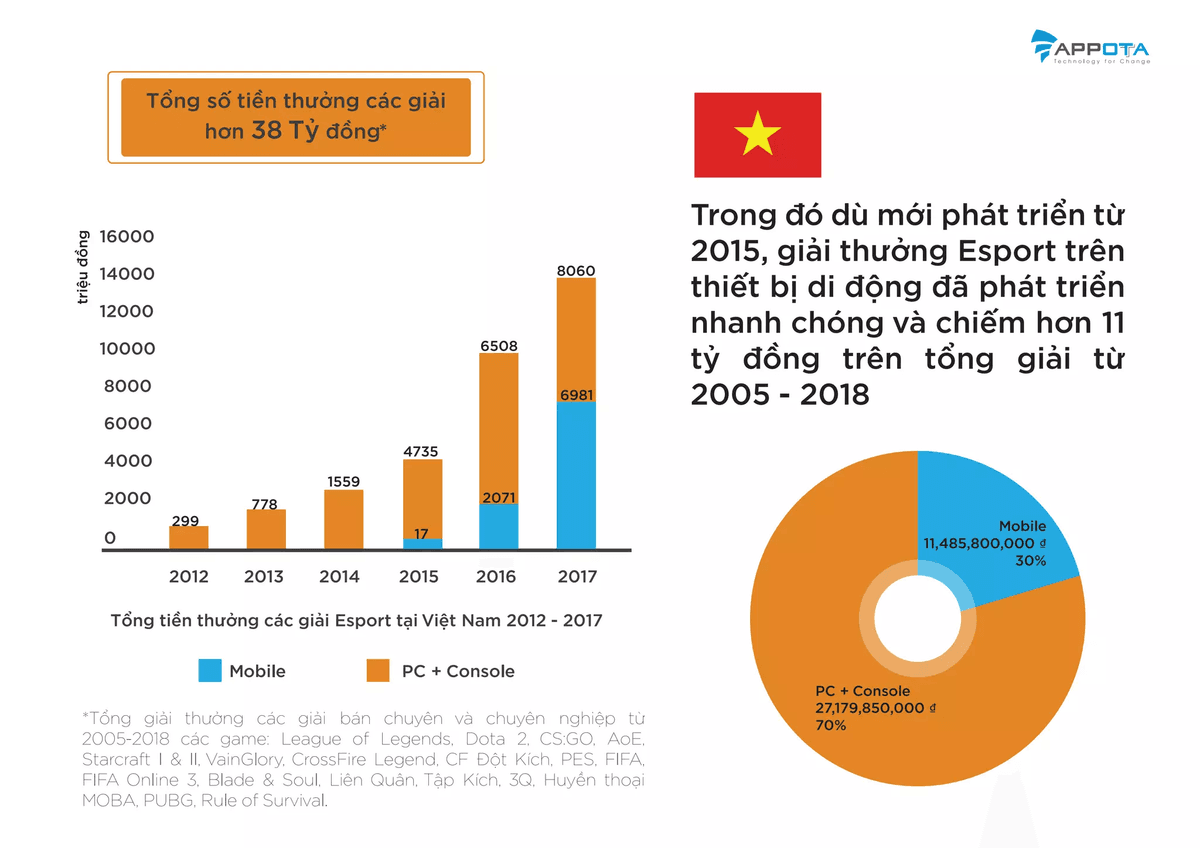
The chart highlights two structural shifts in tournament financing. First, across 2005–2018, PC and Console tournaments accounted for VND 27,179,850,000 (70%), while Mobile tournaments—despite starting only in 2015—captured VND 11,485,800,000 (30%). Second, annual prize pools between 2012 and 2017 expanded more than fiftyfold in five years:
- 2012–2014 (PC and Console exclusivity): Annual prize money rose from VND 299 million (2012) to VND 778 million (2013) and VND 1.559 billion (2014), with 100% allocated to PC and Console.
- 2015–2016 (Mobile tournament takeoff): Total prizes jumped to VND 4.752 billion in 2015 (VND 4.735B PC/Console; VND 17M Mobile). In 2016, prize pools reached VND 8.579 billion as Mobile surged to VND 2.071 billion alongside VND 6.508 billion on PC/Console.
- 2017 and H1 2018 (Platform convergence): Full-year 2017 prize money hit a record VND 15.041 billion, with Mobile contributing VND 6.981 billion (46.4%) and PC/Console contributing VND 8.060 billion (53.6%). In the first half of 2018 alone, domestic tournaments awarded VND 7.32 billion.
Genre realignment from early RTS dominance to MOBA and FPS leadership
Surging publisher investments reshaped how prize money was distributed across genres between 2011 and 2018.
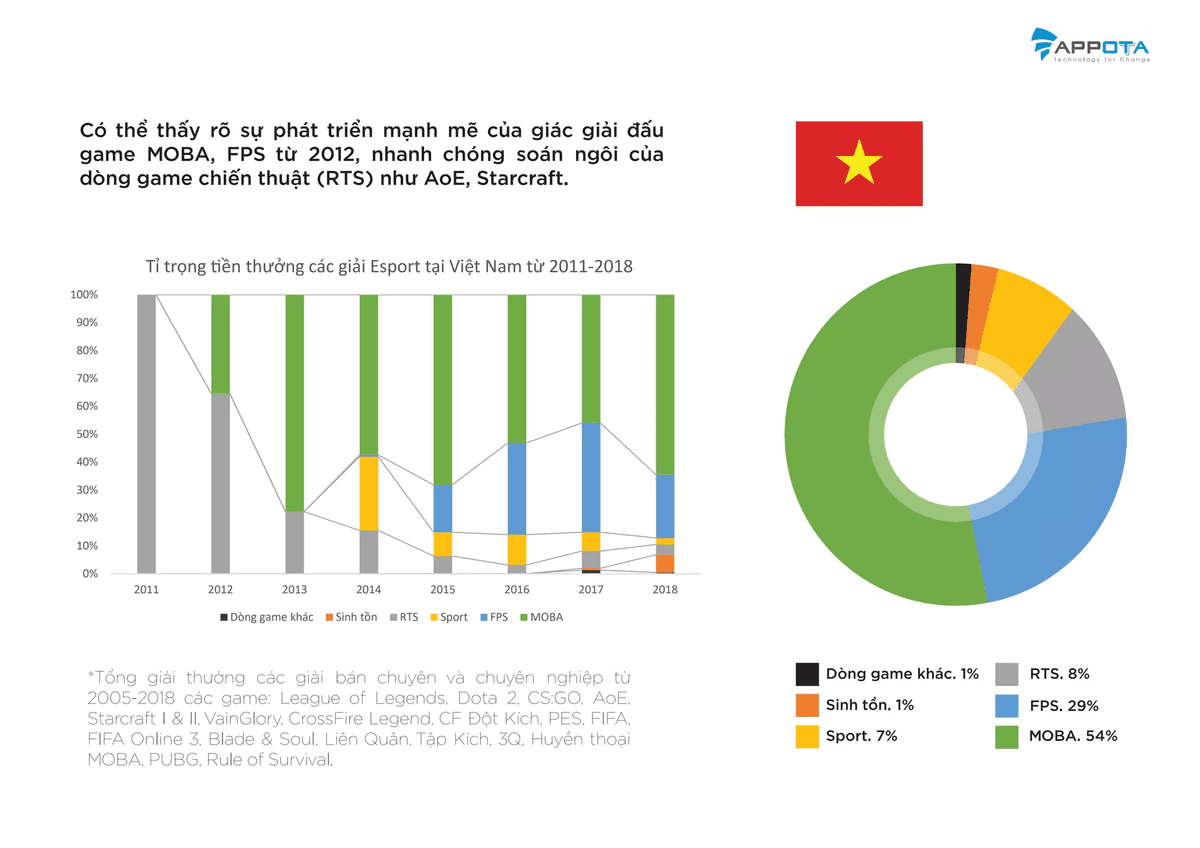
In 2011, real-time strategy (RTS) tournaments (AoE and StarCraft) accounted for nearly 100% of tracked Vietnamese prize pools. Starting in 2012, major publisher circuits for League of Legends and CrossFire—followed after 2015 by Arena of Valor and CrossFire Legends—shifted capital decisively toward MOBA and FPS titles.
Across cumulative 2005–2018 prize pools, MOBA captured 54% of all tournament payouts in Vietnam, while FPS secured 29%. Together, those two genres represented 83% of historical prize money, ahead of RTS (8%), Sports simulations (7%), Battle Royale (1%), and other genres (1%).
How do ecosystem cash flows, pro and streamer incomes, and venues operate?
Chapter 4 maps the commercial architecture that transformed Vietnamese competitive gaming into a self-sustaining entertainment economy.
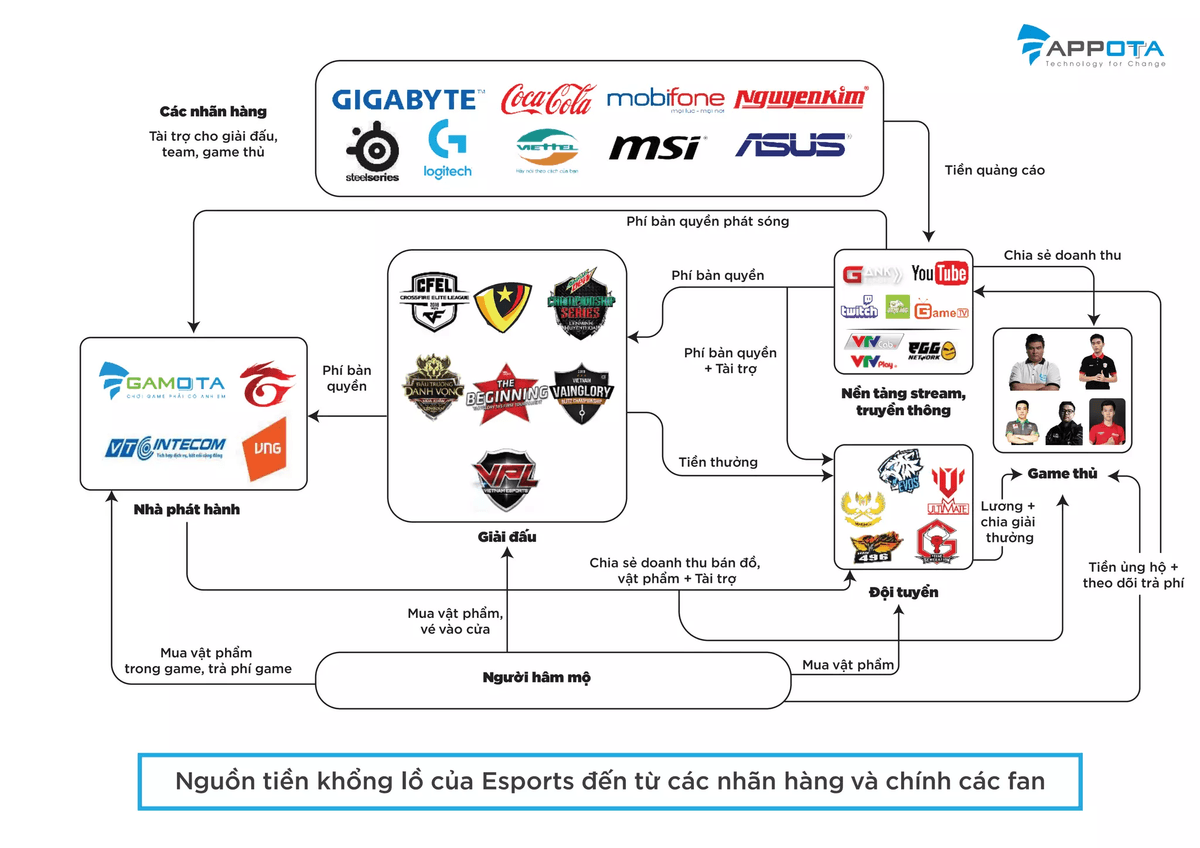
As the diagram illustrates, capital enters the value chain from two primary sources—corporate brands and fans:
- Brand capital inflows: Brands inject sponsorship budgets into tournaments, pro clubs, and individual players, while paying advertising fees to streaming platforms and media networks (YouTube, Twitch, VTVcab, VTVplay, Gank Esport, GameTV, and PGG Network).
- Fan spending inflows: Viewers buy in-game items from publishers (Gamota, Garena, VTC Intecom, VNG), event tickets, and team merchandise, while sending direct fan donations or paid subscriptions to pros and streamers.
- Value-chain redistribution: Publishers and broadcasters fund tournaments through licensing and sponsorship fees. Tournaments distribute prizes and item revenue shares to teams, which pay monthly salaries and prize splits to players.
Benchmark earnings of Vietnamese pro players and full-time gaming streamers
Backed by these inflows, top Vietnamese athletes and full-time creators achieved competitive earnings by mid-2018. Readers examining creator monetization in later years can consult our State of Gaming Creators in Vietnam report.
| Featured Profile (as of May 2018) | Role / Primary Title | Audience / Competitive Rank | Estimated Monthly Salary / Income | Career Tournament Prize Earnings |
|---|---|---|---|---|
| Archie (Trần Minh Nhựt, b. 1992) | Pro player — LoL (GAM) | #1 Vietnam prize earner (2018) | ~VND 30 million/month | USD 72,156.78 (~VND 1.7B) |
| Optimus (Trần Văn Cường, b. 1996) | Pro player — LoL | #2 Vietnam prize earner (2018) | Club salary + streaming | USD 59,431.94 (~VND 1.4B) |
| MAXIM (Nguyễn Hồng Thái, b. 1993) | Pro player — CrossFire | #3 Vietnam prize earner (2018) | Club salary + league prizes | USD 47,468.04 (~VND 1.07B) |
| SofM (Lê Quang Duy, b. 1997) | Pro player — LoL (LPL) | Competing in China's LPL | ~USD 5,000/month | USD 36,273.89 (~VND 825M) |
| Chim Sẻ Đi Nắng (Nguyễn Đức Bình, b. 1996) | Pro player — AoE | Vietnam's flagship RTS icon | ~VND 5 million/month (base) | USD 18,176.50 (~VND 413M) |
| PewPew (Hoàng Văn Khoa, b. 1991) | Streamer / Caster | 1.3M YouTube; 970K Facebook | VND 30–100 million/month | Brand deals, platform & fan support |
| ViruSs (Đặng Tiến Hoàng) | Streamer / Caster | 1.4M YouTube subscribers | VND 30–100 million/month | Brand deals, platform & fan support |
| Linh Ngọc Đàm (Đàm Ngọc Linh, b. 1996) | Female Streamer | 560K YouTube; 655K Facebook | Over VND 20 million/month | Brand deals, platform & fan support |
Media benchmarks cited in the report (Kenh14.vn and Thanh Nien) show full-time streamers with 500,000 to 1,000,000 followers earning VND 30–100 million monthly across five streams: (1) Fan donations and paid subscriptions; (2) Platform ad revenue shares; (3) Brand endorsements and events; (4) Tournament casting and video production fees; and (5) Personal retail ventures in food, apparel, or PC peripherals.
High-spec cybercafe centers and multi-tier tournament arenas
Alongside digital platforms, Vietnam's physical esports infrastructure by 2018 operated across two venue tiers:
- High-spec cybercafe centers (Cyber Games): Upgraded into tournament-grade training centers with soundproofed booths, led by Cyzone E-Sports Centre in Hanoi (530 client PCs), Virus E-sports Stadium in Vinh City, Nghe An (233 client PCs), and CyberCore Gaming iSpace in Ho Chi Minh City (150 member cybercafes/stations).
- Dedicated studios and arenas: Supporting live audiences across GG Stadium in Ho Chi Minh City (180 seats for studio splits), Hanoi National University of Education Gymnasium (1,000 seats), Quan Ngua Sports Palace in Hanoi (3,500 seats), and the National Convention Center in Hanoi (5,000 seats for major finals).
What do 2018–2021 trends and South Korea's KeSPA model signal for Vietnam?
Chapter 5 outlines five structural trends shaping Vietnam's esports trajectory between 2018 and 2021:
- Club professionalization: Teams are transitioning from informal collectives into corporate clubs backed by sponsors, coaches, analysts, and gaming houses.
- Accelerating prize pools: Following 2017's record VND 15.041 billion, domestic prizes reached VND 7.32 billion in H1 2018 alone. Summer 2018 majors included Green Rift Rivals 2018 (July 4–7), AoE Vietnam–China 2018 (July), Vietnam Vainglory Championship 2018 Season 1 (June–July), and CrossFire Semi-Pro League 2018 Season 1 (May 30–July 22).
- Sporting legitimacy at ASIAD 2018: Six esports titles at the 2018 Asian Games began shifting parental and regulatory perceptions ahead of future SEA Games medal events.
- Mobile esports across 42 million+ smartphone owners: With over 42 million Vietnamese smartphone owners in 2018 and two mobile titles at ASIAD 2018 (Arena of Valor and Clash Royale), mobile became the fastest user acquisition engine.
- Rise of Battle Royale competition: Entering Vietnam in late 2017, survival shooters (PUBG and Rules of Survival) generated VND 565 million in domestic prizes through May 2018.
Institutional governance lessons from South Korea's KeSPA model
To illustrate how policy alignment unlocks economic value, the report benchmarks South Korea—the pioneer in institutionalizing esports after the late-1990s Asian financial crisis.
Founded in 2000 under the Ministry of Culture, Sports and Tourism, the Korea e-Sports Association (KeSPA) standardized player contracts, licensed dedicated broadcast channels, and coordinated conglomerate team ownership (Samsung, SK Telecom, KT Rolster). Backed by this framework, South Korea's gaming and esports sector contributes over USD 5 billion annually to national GDP—offering a clear institutional roadmap for Vietnam.
What execution priorities should publishers and brands take from this 2018 baseline?
Connecting Appota and VTVplay's 2018 baseline to current Vietnamese operations, publishers and brands should prioritize four actions:
- Secure domestic game licenses and tournament permits early: Data from 2012–2018 confirms that sustainable multi-billion-VND leagues depend on locally licensed publishers such as Gamota, Garena, VNG, and VTC. Today, operators must comply with Decree 147/2024/ND-CP (effective December 25, 2024) governing G1–G4 game licensing, player verification, and virtual items under the Ministry of Culture, Sports and Tourism via our six-stage guide to mobile game publishing in Vietnam.
- Pair mobile-first open qualifiers with offline cybercafe and arena finals: The jump in mobile prizes from VND 17 million (2015) to VND 6.981 billion (2017) across 42 million+ smartphone owners confirms mobile as Vietnam's primary funnel. Publishers should combine smartphone qualifiers with regional cybercafe brackets and arena finals.
- Balance sponsorship budgets between leagues and creator co-streaming: Ecosystem cash flows and VND 30–100 million monthly streamer earnings show how strongly fans bond with creators. Because 42% of spectators watch for entertainment without playing the title, non-endemic brands maximize conversion by pairing league sponsorships with creator activations.
- Diversify portfolios beyond MOBA and FPS into emerging genres: While MOBA (54%) and FPS (29%) anchored 83% of 2005–2018 prize money, Battle Royale's VND 565 million prize ramp-up in under six months shows rapid player adoption of new formats. Teams can track sector updates in our Gaming industry insights hub.
Complete the download form on this page to receive the full 36-page Vietnam Esports Market Report 2018 PDF from Appota and VTVplay, including historical tournament tables across 18 titles, pro player and streamer profiles, and the ecosystem cash-flow model.
Sources
- Báo cáo thể thao điện tử Việt Nam 2018 (Vietnam Esport Market Report 2018 — Bản tiếng Việt), Appota & VTVplay (VTVcab), 2018-06-04, accessed 2026-11-02
- Vietnam Esport Market Report 2018 (English Edition), Appota & VTVplay (VTVcab), 2018-06-05, accessed 2026-11-02
- 2018 Global Esports Market Report, Newzoo, 2018-02-21, accessed 2026-11-02
- What is eSports and why do people watch it?, Juho Hamari & Max Sjöblom — Internet Research (Emerald Insight), 2017-04-03, accessed 2026-11-02
- Vietnam Esports Player Prize Earnings & Global Top Players (as of May 2018), Esports Earnings, 2018-05-31, accessed 2026-11-02
- PUBG hits 3 million concurrent players on Steam, Polygon & Steam Charts, 2018-01-08, accessed 2026-11-02
- Nghị định 147/2024/NĐ-CP về quản lý, cung cấp, sử dụng dịch vụ Internet và thông tin trên mạng, Chính phủ, 2024-11-09, accessed 2026-11-02