Enterprise AI Implementation Framework: From Use-Case Selection to ROI Measurement
An enterprise AI implementation framework is a four-layer methodology for moving artificial intelligence from proof of concept (PoC) into daily production workflows while controlling data risk and unit cost. Rather than starting with model selection, organizations prioritize operational bottlenecks, match workloads to commercial APIs, RAG, or self-hosted models, enforce human-in-the-loop guardrails, and measure net ROI within 30 to 90 days.
Key takeaways
- Sustainable enterprise AI programs begin with high-frequency operational bottlenecks—such as customer support retrieval, content localization, and document reconciliation—rather than Large Language Model (LLM) selection.
- According to GDC's 2024 survey (N = 3,000) cited in Gamota's February 2025 report, 49% of workplaces already use Generative AI (GenAI), led by Business & Finance (44%) and Community, Marketing & PR (41%).
- Technical architecture must match data sensitivity and query volume: commercial APIs fit rapid validation, Retrieval-Augmented Generation (RAG) grounds answers in internal documents, and self-hosted models optimize high-volume or restricted workloads.
- Compliance with Vietnam's Law on Artificial Intelligence No. 134/2025/QH15, Law on Data No. 60/2024/QH15, and Personal Data Protection Law No. 91/2025/QH15 requires automated PII masking and tiered human-in-the-loop oversight.
- Production ROI after 30 to 90 days should be measured via fully loaded Cost per Resolved Task—combining token fees, infrastructure, data prep, and human review—against the manual baseline.
Establishing a disciplined enterprise AI implementation framework helps executive teams turn promising Proofs of Concept (PoCs) into reliable daily operations. Many organizations launch AI initiatives by purchasing scattered SaaS seats or chasing the newest Large Language Model (LLM). Once connected to live business data, those projects frequently stall due to policy hallucinations, compliance gaps, or runaway inference bills.
Moving from experimental demos to production requires reversing that sequence. Leadership teams must govern deployment across four layers: operational bottleneck triage, workload-matched architecture, data privacy guardrails, and unit cost tracking per completed task. This structured execution complements our pillar analysis of the Vietnam enterprise AI adoption landscape.
AI use-case prioritization matrix: Which operational problems should you solve first?
A common pitfall for digital transformation teams is selecting an overly broad initiative or a zero-tolerance workflow for their first deployment. These scoping mistakes explain why many enterprise AI pilots stall at the PoC stage.
A two-axis evaluation grid inside an enterprise AI implementation framework
Within an enterprise AI implementation framework, steering committees should score every proposed initiative across two axes before allocating engineering budget:
- Axis 1 — Measurable Business Impact: The workflow repeats hundreds or thousands of times daily. Outputs translate directly into labor hours saved, faster customer response times, or lower manual error rates.
- Axis 2 — Data Readiness and Technical Feasibility: Source procedures are digitized and structured, and the operational workflow allows human verification before final transaction execution.
Empirical adoption data confirms that commercial and operational workflows deliver production value faster than complex core engineering tasks. According to Gamota's Vietnam Mobile Game Market Report 2024 (published February 2025, citing Statista), the global AI market reached USD 184.05 billion in 2024 (+35.38% YoY). Generative AI (GenAI) accounted for USD 36.06 billion (19.5% share) and is projected to grow at a 32.2% compound annual rate to reach USD 356.1 billion by 2030.
Similarly, GDC's 2024 State of the Game Industry survey (N = 3,000 global professionals) cited in Gamota's report found that 49% of workplaces already use GenAI tools (31% personally using, 18% used by colleagues). Adoption is highest in Business and Finance (44%), Community, Marketing, and PR (41%), and Production Management (33%). Those operational functions outpace Programming (25%), Game Design (21%), Visual Arts (16%), Audio (14%), Narrative Writing (13%), and Quality Assurance — QA (6%).
Four operational use-case clusters delivering the fastest production value
Drawing on practical implementations across Appota's digital technology ecosystem—spanning game publishing at Gamota, digital marketing at Adsota, payment processing at AppotaPay, and cloud infrastructure at Kdata—organizations should prioritize four operational clusters:
| Operational Cluster | Manual Bottleneck | Data Readiness | Error Tolerance & Control Mode | Primary Target KPIs |
|---|---|---|---|---|
| 1. Customer Support & Internal Knowledge | Agents spend minutes searching hundreds of policy PDFs and SOPs. | High (Wikis, support scripts, historical tickets). | Moderate; deploy as an Agent Copilot drafting cited replies for agent sign-off. | Average Handle Time (AHT), First Contact Resolution (FCR). |
| 2. Content Production & Localization | Multi-language translation, ad script variations, and test visuals bottleneck launches. | High (Terminology glossaries, approved asset libraries). | High during drafting; human editors approve final assets before publishing. | Asset Time-to-market, production cost per creative variant. |
| 3. Finance Operations & Reconciliation | Parsing invoices, extracting fields, and categorizing transaction discrepancies. | Very high (Standardized ledgers, gateway error codes). | Very low; AI tags anomalies while accountants approve ledger postings. | Reconciliation hours per settlement cycle, anomaly detection speed. |
| 4. Data Analysis & Anomaly Alerting | Compiling recurring reports and spotting traffic spikes or fraud patterns early. | High (System logs, CRM and MMP telemetry). | Moderate; alerts route to operational dashboards for engineer triage. | Mean Time to Detect (MTTD), false-positive alert ratio. |
Selecting technical architecture: Commercial APIs, Retrieval-Augmented Generation (RAG), or self-hosted models?
Once a high-value bottleneck is selected, engineering leaders must choose the right technical pattern. Very few enterprise workflows require expensive model pre-training or full-parameter fine-tuning from day one.
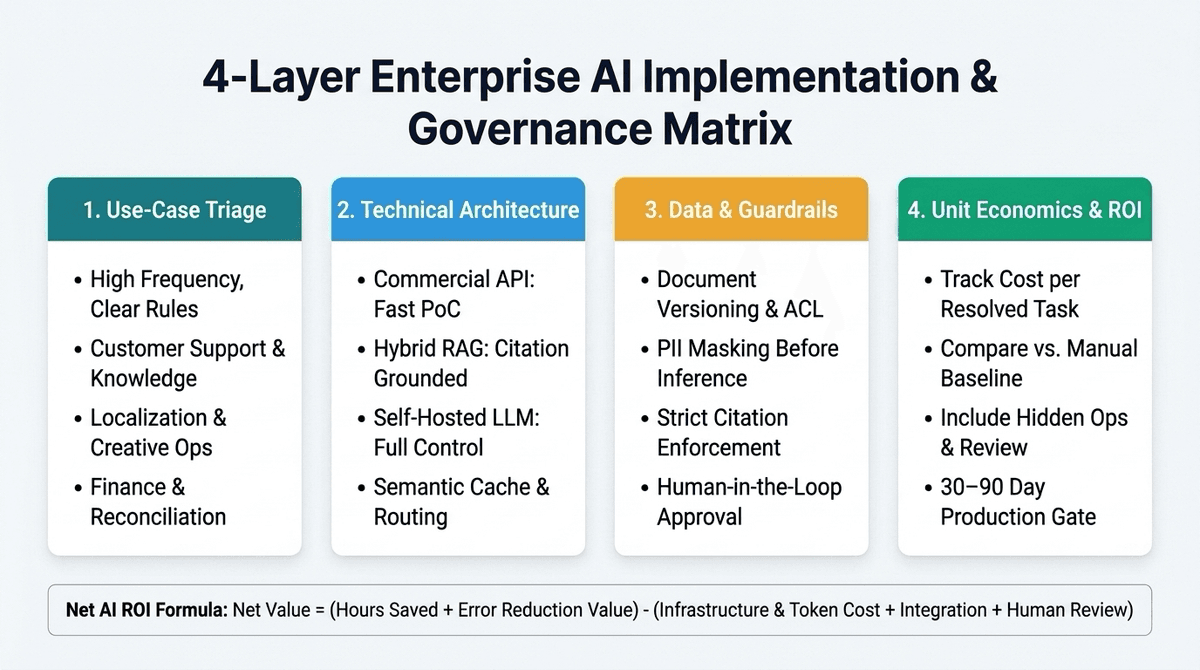
As the four-layer governance matrix above illustrates, architecture choices bridge initial use-case triage with downstream data security guardrails and 30-to-90-day unit economics.
Comparing 3 deployment architectures across cost, latency, and data sovereignty
Chief Technology Officers (CTOs) should evaluate three architectural patterns across setup cost, variable volume cost (API token fees versus dedicated GPU hosting), latency, and data residency:
| Evaluation Criterion | 1. Commercial LLM API | 2. Retrieval-Augmented Generation (RAG) | 3. Fine-Tuned / Self-Hosted Open-Weight LLM |
|---|---|---|---|
| Setup Cost (CapEx / Engineering) | Low; integrates within days via standard REST SDKs. | Moderate; requires document ingestion pipelines and a vector database. | High; requires dedicated GPU clusters and specialized MLOps engineers. |
| Operating Cost (OpEx) | Billed per input/output token; scales linearly with query volume. | Vector storage fees plus inference tokens on retrieved context chunks. | Fixed per GPU node; becomes cost-efficient at high, predictable daily volumes. |
| Hallucination Control & Freshness | Prone to guessing on newly updated internal company policies. | High; responses are strictly grounded in retrieved document chunks with citations. | Locked to training cutoffs; requires retraining when business rules change. |
| Response Latency | Depends on cross-border routing and prompt context length. | Adds 100–300ms for vector retrieval and semantic reranking. | Low and predictable when hosted on domestic cloud infrastructure near core apps. |
| Data Control & Residency | Prompts traverse external provider servers; requires strict PII scrubbing. | Source files stay internal; only masked excerpts pass to the generation layer. | Full sovereignty; raw data never leaves the enterprise's private infrastructure. |
| Best-Fit Scenarios | Rapid PoCs, public text summarization, translation, and creative ideation. | Internal SOP lookup, customer support copilots, and dynamic policy Q&A. | High-volume classification, specialized domain syntax, or restricted datasets. |
Hybrid routing and semantic caching in production
In live operations, relying on a single frontier model for every request quickly erodes unit economics. Infrastructure deployments across Kdata and Appota's engineering teams show that hybrid model routing substantially lowers inference spend:
- Semantic Caching Layer: Recurring customer questions regarding top-up instructions, event rules, or common error codes are served directly from a verified semantic cache without triggering new LLM calls.
- Specialized Small Language Models (SLMs): High-frequency tasks such as intent classification, entity extraction, and profanity filtering run on compact models hosted on domestic cloud nodes, keeping latency under 200ms.
- RAG + Frontier LLM Escalation: Only complex multi-document queries pass through the full hybrid retrieval and large-model generation pipeline.
Preparing enterprise data pipelines and compute infrastructure for AI
Even the most capable model will produce wrong answers if an organization's knowledge base contains conflicting policy versions or lacks access controls. In enterprise AI deployments, roughly 70% of engineering effort goes into data hygiene rather than prompt writing.
Four-step workflow for cleaning and tagging documents before RAG ingestion
Before indexing internal documents into a vector database, data engineering teams should execute a four-step preparation checklist:
- Step 1 — Audit and archive obsolete documents: Review all Standard Operating Procedures (SOPs), fee schedules, and campaign rules; move expired files out of active folders so the retrieval engine never cites revoked policies.
- Step 2 — Apply structure-aware semantic chunking: Avoid splitting documents by arbitrary character counts that sever tables or exception clauses. Each chunk must preserve its parent section heading and complete markdown table rows.
- Step 3 — Attach mandatory governance metadata: Tag every indexed chunk with at least four metadata attributes:
document_id,department,effective_date, andaccess_role. - Step 4 — Combine hybrid search with cross-encoder reranking: Pair exact keyword matching (BM25—essential for product SKUs, payment error codes, and legal statute numbers) with dense vector search, then apply a reranker to pass only the top 3–5 verified passages into the model context.
Enforcing document-level RBAC and balancing cloud compute
Internal data leaks often happen when employees query an internal AI assistant and accidentally surface documents from restricted departments (such as executive compensation tables, partner contracts, or financial audits). Production RAG pipelines must enforce Role-Based Access Control (RBAC) at the vector query layer: if a user's identity token cannot open the source file, the retrieval query must filter out that file's vector embeddings prior to generation.
On the infrastructure side, under Vietnam's Law on Data No. 60/2024/QH15 (passed by the National Assembly on November 30, 2024, effective July 1, 2025), processing, governing, and transferring core or important data across borders must satisfy strict security requirements. Keeping primary databases, vector indexes, and PII scrubbing gateways on domestic data center or cloud infrastructure reduces local network latency and simplifies statutory compliance. (Note: Appota's Technology specialist will confirm reference infrastructure specifications prior to publication.)
Safety guardrails, data privacy compliance, and human-in-the-loop workflows
Deploying AI without technical guardrails exposes enterprises to two severe operational risks: staff pasting customer personal data into external model prompts, or customer-facing bots hallucinating unauthorized refund and legal commitments.
Complying with Vietnam's Law on AI No. 134/2025/QH15 and personal data statutes
Starting in 2026, enterprise AI governance in Vietnam operates under a comprehensive statutory framework:
- Law on Artificial Intelligence No. 134/2025/QH15 (passed by the National Assembly on December 10, 2025, effective March 1, 2026, comprising 35 articles): building on the national AI strategy under Decision No. 127/QD-TTg (dated January 26, 2021), this law regulates AI systems through a risk-based classification model, mandating human-centric design, meaningful human control, transparency, and data safety across deployment lifecycles.
- Personal Data Protection Law No. 91/2025/QH15 (passed June 26, 2025, effective January 1, 2026) and Decree No. 356/2025/ND-CP (issued December 31, 2025, effective January 1, 2026, replacing Decree 13/2023/ND-CP): strictly regulate the processing of basic and sensitive personal data across AI and cloud systems, requiring impact assessments for personal data processing and cross-border transfers. Organizations should align their AI pipelines with our guide to personal data protection and Law on Data compliance for digital businesses.
- NIST AI Risk Management Framework (NIST AI RMF 1.0 — NIST AI 100-1, January 2023) and the Generative AI Profile (NIST AI 600-1, July 2024): structure operational governance around four continuous functions—Govern (accountability policies), Map (use-case context and risk classification), Measure (quantitative evaluation of hallucination, bias, and security), and Manage (incident response and fallback controls). (Editorial note: Legal counsel must verify statutory citations against official Gazette texts for Law 134/2025/QH15, Law 91/2025/QH15, and Decree 356/2025/ND-CP prior to publication.)
Designing a 3-layer guardrail gateway and tiered human-in-the-loop approval
To translate statutory obligations and NIST AI RMF 1.0 principles into engineering controls, teams should route all model traffic through a centralized AI Gateway paired with human-in-the-loop escalation:
- Input Guardrails & Automated PII Masking: Scan outgoing prompts to redact personal identifiers (phone numbers, national IDs, bank account numbers, transaction IDs, and API secrets) into placeholder tokens (
[REDACTED_PHONE],[REDACTED_ACCOUNT]) before inference, while blocking prompt-injection attempts. - **Output Guardrails & Citation Grounding:**Constrain generation strictly to retrieved context passages with clickable source links. Whenever retrieval confidence falls below threshold, force a deterministic fallback ("Escalate to human specialist") rather than allowing the model to guess.
- Three-Tier Human-in-the-Loop Approval Matrix:
- Tier 1 — Zero-Touch Automation: Restricted to public FAQ lookups and standard instructional guides that do not modify account state or financial balances.
- Tier 2 — Agent Copilot (Human Review & 1-Click Send): Applied to order status inquiries, complaint response drafting, content localization, and invoice reconciliation; AI prepares the draft and source citation while staff verify and click approve.
- Tier 3 — Full Human Specialist Execution: Required for payment refunds, balance adjustments, legal disputes, or security configuration changes; AI is limited to summarizing case history.
Measuring enterprise AI ROI and unit economics in production
An AI deployment only succeeds in production when it generates positive net economic value after accounting for all hidden operational costs. Finance and engineering leaders should audit performance across a 30-to-90-day window using unit economics.
Separating Total Cost of Ownership (TCO) and Cost per Resolved Task
Rather than tracking vanity metrics like total prompts sent, organizations should calculate Cost per Resolved Task and Net AI ROI across the full cost stack:
$$\text{TCO}{\text{AI}} = C{\text{infra/token}} + C_{\text{data/setup}} + C_{\text{human_review}} \quad ; \quad \text{Net ROI} = \frac{(V_{\text{time_saved}} + V_{\text{error_reduced}}) - \text{TCO}{\text{AI}}}{\text{TCO}{\text{AI}}}$$
Every cost and benefit component should be reconciled across a 30-to-90-day scorecard before scaling:
| Measurement Dimension | Manual Baseline | PoC Phase (First 30 Days) | Production Phase (At 90 Days) | Verification & Accounting Source |
|---|---|---|---|---|
1. Average Handle Time (AHT) |
100% manual lookup and drafting time per ticket/task. | Faster lookup, partially offset by prompt tweaking and review time. | Measurable reduction in net handling time via semantic caching and clean RAG. | Timestamp logs inside ticketing / ERP systems. |
| 2. First-Pass Acceptance Rate | 0% (fully manual execution). | Tested on a 10%–20% sample of standardized requests. | Scaled across Tier 1 and Tier 2 workflows under guardrails. | Share of Copilot drafts approved by staff without major rewrites. |
3. Compute & Token Cost (C_infra/token) |
VND 0. | Low (small pilot query volume). | Scales with real traffic; optimized via semantic caching and SLM routing. | Monthly API token invoices and GPU/Cloud bills divided by resolved tasks. |
4. Data Hygiene & QA Review Cost (C_review) |
Routine manual QA sampling cost. | High (engineering and domain staff cleaning documents and labeling test sets). | Ongoing scheduled maintenance aligned with product or policy updates. | Staff hours spent updating knowledge bases and reviewing Tier 2 outputs. |
| 5. Stage-Gate Governance Decision | Establish baseline manual Cost per Task. |
Verify retrieval accuracy and keep hallucination rate < target threshold. |
Cost per Resolved Task beats manual baseline; Net ROI > 0. |
Joint sign-off by CTO, COO, and CFO before expanding to new departments. |
Four scenarios where enterprises should NOT rush AI into production
Executive teams should pause AI deployment and fix foundational processes first in four situations:
- Underlying business workflows are undocumented and change ad hoc daily: If departments resolve exceptions through informal verbal overrides or conflicting rules, introducing AI will only amplify operational inconsistency.
- Internal documents are unindexed scans or lack access-control tags: Feeding blurry PDF scans, broken spreadsheets, and unlabelled confidential files into a RAG pipeline causes wrong answers and internal data exposure.
- Task frequency is too low to justify integration and maintenance overhead: For workflows occurring only a few times per month, maintaining vector pipelines and security guardrails costs more than having domain specialists handle them directly.
- Deterministic rule-based automation (RPA / SQL / Code) already solves the problem: Exact 1-to-1 payment matching, fixed threshold routing (
if-else), and structured form parsing should use deterministic code for 100% accuracy and near-zero compute cost rather than calling an LLM.
Before signing off on next quarter's AI budget, select one high-frequency operational bottleneck, clean and permission-tag its source documents, deploy an Agent Copilot with automated PII masking, and audit fully loaded Cost per Resolved Task after 30 to 90 days. Explore further technical guides in the Enterprise AI topic hub on Appota Insights.
If your organization is designing an enterprise AI roadmap, building secure internal RAG knowledge systems, or optimizing cloud and GPU infrastructure in Vietnam, connect with Appota's enterprise technology and infrastructure consulting team.
Sources
- Luật Trí tuệ nhân tạo số 134/2025/QH15, Quốc hội nước Cộng hòa xã hội chủ nghĩa Việt Nam, 2025-12-10, accessed 2026-11-03
- Luật Dữ liệu số 60/2024/QH15, Quốc hội nước Cộng hòa xã hội chủ nghĩa Việt Nam, 2024-11-30, accessed 2026-11-03
- Luật Bảo vệ dữ liệu cá nhân số 91/2025/QH15, Nghị định 356/2025/NĐ-CP và Nghị định 13/2023/NĐ-CP, Quốc hội & Chính phủ Việt Nam, 2025-12-31, accessed 2026-11-03
- Quyết định số 127/QĐ-TTg ban hành Chiến lược quốc gia về nghiên cứu, phát triển và ứng dụng Trí tuệ nhân tạo đến năm 2030, Thủ tướng Chính phủ Việt Nam, 2021-01-26, accessed 2026-11-03
- Artificial Intelligence Risk Management Framework (NIST AI RMF 1.0 — NIST AI 100-1) và Generative AI Profile (NIST AI 600-1), National Institute of Standards and Technology (NIST), 2023-01-26, accessed 2026-11-03
- Báo cáo thị trường game mobile Việt Nam 2024 (Vietnam Mobile Game Market Report 2024), Gamota R&D (Appota Group), 2025-02-15, accessed 2026-11-03