
Quang Binh and Central Vietnam Tourism Market Trends Report 2024
AppotaPay's Quang Binh and Central Vietnam Tourism Report analyzes 2024 travel demand recovery, youth spending habits, and booking payment bottlenecks. Vietnam's nine-month 2024 tourism revenue reached VND 637.7 trillion across 12.7 million international and 95.5 million domestic arrivals, with Quang Binh welcoming 4.24 million visitors. Across 700+ surveyed travelers, 70% of young tourists plan itineraries independently.
An executive analysis of Vietnam's VND 637.7 trillion tourism rebound, the Quang Binh tourism market across Central Vietnam, youth travel spending from 700+ surveyed travelers, and payment solutions from AppotaPay.
Key findings
- VND 637.7TVietnam's estimated total tourism receipts in the first 9 months of 2024, alongside 12,705,316 international arrivals (+43% YoY) and 95.5 million domestic travelers (Vietnam National Authority of Tourism, National Statistics Office).
- 4.24M arrivalsTotal visitors to Quang Binh in the first 9 months of 2024, rising 13.4% year-on-year to reach 94% of the annual plan, generating VND 4,874 billion in provincial tourism receipts (Quang Tri Dept. of Culture, Sports & Tourism; VNAT).
- 90.8%Share of surveyed travelers aware of or having visited Quang Binh's cave system (82.9% rate caves as its standout appeal), alongside 39.5% first-time prospects planning a future visit (AppotaPay survey of 700+ travelers).
- 70%Share of young Vietnamese travelers who prefer planning itineraries independently rather than buying traditional package tours, confirmed across both AppotaPay (700+ respondents) and Coc Coc travel surveys.
- 57.9%Share of young travelers budgeting VND 500,000–1,000,000 per night for accommodation (28.3% spend VND 1–3 million/night) within a typical total trip budget of VND 5–10 million over 3–5 days (AppotaPay survey).
- 88.8% & 71.1%Share of young travelers researching destinations on Facebook (88.8%) and TikTok (71.1%), well ahead of Instagram (40.8%) and YouTube (36.8%) in AppotaPay's survey of 700+ respondents.
- 45.3%Share of travelers choosing ticket agencies for convenient and flexible payment—ranking above brand reputation (40.6%), good service (35.9%), and low prices (34.4%) in Coc Coc Travel's March 2024 survey (N = 799).
How did Vietnam's VND 637.7 trillion tourism rebound shape the first nine months of 2024?
Vietnam's national travel rebound in 2024 created strong tailwinds for the Quang Binh tourism market and Central Vietnam. According to the Vietnam National Authority of Tourism (VNAT), national tourism receipts reached an estimated VND 637.7 trillion in the first nine months of 2024. These figures align with releases from the National Statistics Office under the Ministry of Finance (formerly the General Statistics Office). Nine-month receipts nearly matched full-year 2023 revenue of VND 678.3 trillion. They also far surpassed full-year totals from 2021 (VND 180 trillion) and 2022 (VND 495 trillion). Expanded visa exemptions, longer e-visa validity, and restored international air routes drove this acceleration.
International arrivals jumped 43% while domestic travel held steady
Cumulative visitor volume across the first nine months of 2024 exceeded 107 million arrivals. That total comprised 12,705,316 international arrivals and 95.5 million domestic travelers. Nine-month international arrivals rose 43% year-on-year and already beat full-year 2023 volume of 12.6 million. By comparison, foreign arrivals stood at just 3.5 million in 2021 and 3.66 million in 2022. This trajectory kept Vietnam on track toward its annual target of 17–18 million international visitors.
On the domestic side, 95.5 million nine-month trips sustained high post-pandemic participation. Domestic demand previously surged from 40 million trips in 2021 to 101.3 million in 2022 and 108.2 million in 2023. Vietnamese travelers have now shifted from post-lockdown rebound trips toward selective, budget-conscious short breaks.
Monthly weather sensitivity and top 10 inbound source markets
Monthly arrival curves in 2024 highlight strong first-half momentum alongside acute weather risks in late Q3. International arrivals stayed above 1.5 million every month from January through April. Monthly foreign volume reached 1.512 million in January, 1.531 million in February, 1.599 million in March, and 1.557 million in April. Volume moderated during the mid-year off-season to 1.384 million in May, 1.249 million in June, and 1.151 million in July. Arrivals then recovered to 1.447 million in August.
In September 2024, total visitor arrivals dropped 11.9% month-on-month. International arrivals eased to 1,274,804 during the month. Domestic volume fell from 10.0 million trips in August to 6.0 million trips, including 4.0 million overnight guests. That September trough stood far below the 14.0 million domestic peaks recorded in February and June. Super Typhoon Yagi and severe flooding disrupted transport and tourism infrastructure across Quang Ninh, Hai Phong, Hanoi, and northern provinces.
Source-market figures for the first nine months of 2024 confirm Northeast Asia's dominance in foreign visitor volume. South Korea ranked first with 3,368 thousand arrivals, accounting for 26.5% of all international visitors. China ranked second with 2,705 thousand arrivals, representing a 21.3% share. Together, South Korea and China generated 47.8% of Vietnam's inbound arrivals. Taiwan (954 thousand), the United States (579 thousand), and Japan (529 thousand) completed the top five. Malaysia (357 thousand), Australia (355 thousand), India (353 thousand), Cambodia (326 thousand), and Thailand (301 thousand) rounded out the top ten.
Municipal statistics for the first nine months of 2024 also illustrate heavy revenue concentration in major air gateways and coastal hubs:
| Top 5 Destinations Nationwide (9M 2024) | Tourism Revenue (VND billion) | Domestic Visitors (million) | International Visitors (million) |
|---|---|---|---|
| Ho Chi Minh City | 140,000 | 27.353 | 4.01 |
| Hanoi | 81,932 | 1.405 | 3.16 |
| Khanh Hoa | 44,138 | 5.400 | 3.60 |
| Quang Ninh | 36,856 | 13.000 | 2.60 |
| Da Nang | 26,000 | 5.940 | 3.17 |
Note: Table figures reflect municipal statistical compilations on page 9. Hanoi's domestic count tracks registered overnight guests, while Da Nang's revenue reflects broader local statistical classification.
Where does the Quang Binh tourism market stand across Central Vietnam's revenue corridor?
Chapter 2 benchmarks the Quang Binh tourism market against nine peers across Central Vietnam and the adjacent Central Highlands. All figures follow 2024 provincial boundaries prior to the July 2025 merger of Quang Binh and Quang Tri into the new Quang Tri province.
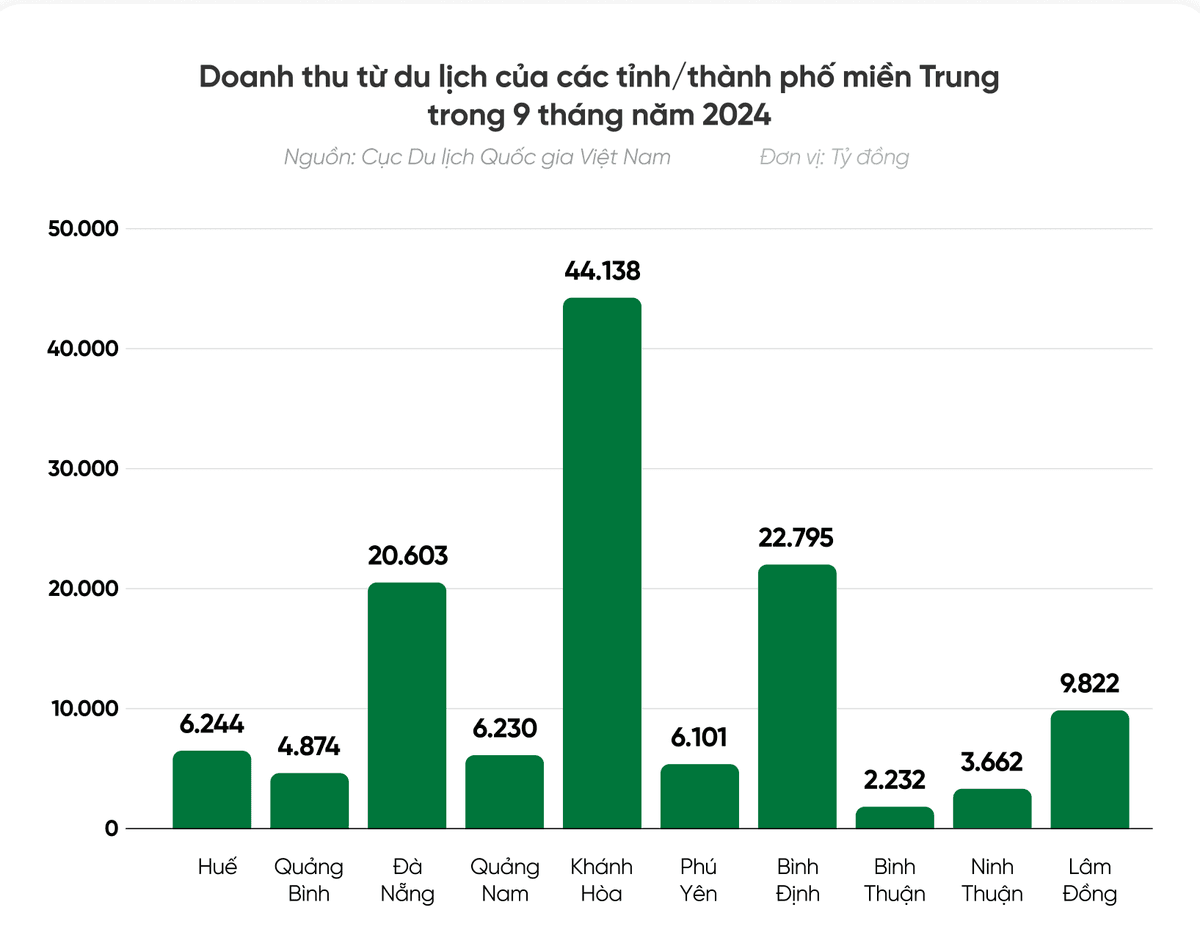
Regional revenue comparison across 10 Central Vietnam destinations
VNAT's nine-month 2024 benchmark reveals sharp revenue clustering around international airports and large coastal resort inventories. Khanh Hoa led the region at VND 44,138 billion, followed by Binh Dinh (VND 22,795 billion) and Da Nang (VND 20,603 billion). A middle revenue tier included Lam Dong (VND 9,822 billion), Hue (VND 6,244 billion), Quang Nam (VND 6,230 billion), and Phu Yen (VND 6,101 billion). Quang Binh generated VND 4,874 billion, placing ahead of Ninh Thuan (VND 3,662 billion) and Binh Thuan (VND 2,232 billion):
| Central Vietnam & Highlands Destination (9M 2024) | Tourism Receipts (VND billion) | Domestic Visitors (million) | International Visitors |
|---|---|---|---|
| Khanh Hoa | 44,138 | 5.400 | 4,200,000 (page 12 narrative) |
| Binh Dinh | 22,795 | 8.000 | 60,995 |
| Da Nang | 20,603 | 5.490 | 3,170,000 |
| Lam Dong | 9,822 | 6.900 | 426,000 |
| Hue | 6,244 | 2.100 | 996,300 |
| Quang Nam | 6,230 | 2.200 | 3,600,000 (page 12 narrative) |
| Phu Yen | 6,101 | 3.376 | 23,620 |
| Quang Binh | 4,874 | 4.100 | 117,042 |
| Ninh Thuan | 3,662 | 3.110 | 87,000 |
| Binh Thuan | 2,232 | 7.000 | 293,000 |
Quang Binh's 2021–2024 visitor recovery and hospitality capacity
Provincial records come from the Quang Tri Department of Culture, Sports and Tourism (operating as the Quang Binh Department of Tourism in 2024). In the first nine months of 2024, Quang Binh welcomed 4.24 million total visitors. Arrivals climbed 13.4% year-on-year and fulfilled 94% of the province's annual plan.
Multi-year records demonstrate a rapid recovery from pandemic lows. Domestic arrivals rose from 564,126 in 2021 to 1,979,933 in 2022 and 4.4 million in full-year 2023. International volume jumped more than twentyfold from 5,700 visitors in 2021 to 30,787 in 2022 and 118,000 in 2023.
During the first nine months of 2024, Quang Binh hosted 117,042 foreign visitors, led by travelers from the United States, the United Kingdom, and Japan. Domestic tourists mostly arrived in friend or family groups traveling by private car. Dedicated accommodation revenue exceeded VND 454 billion over the nine-month period. Across the four-day National Day holiday in September 2024 alone, Quang Binh drew 175,000 visitors (+9.4% YoY) and earned VND 201.3 billion. Provincial hospitality supply stood at 532 lodging properties offering 8,475 rooms and 16,200 beds. Roughly 3,000 dining outlets, 48 travel agencies, and 15,300 tourism workers supported daily operations.
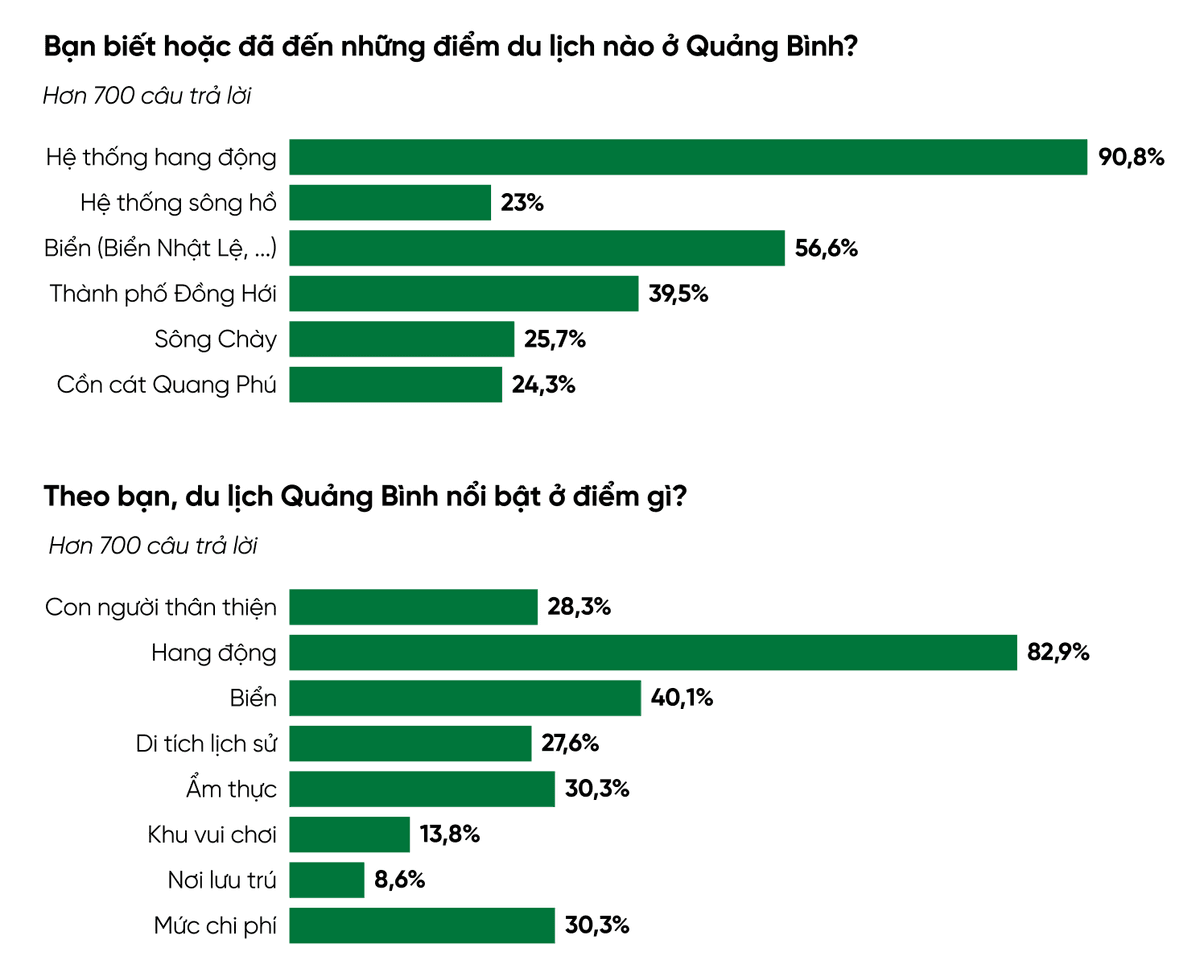
The gap between 90.8% cave awareness and 8.6% lodging appeal
Many local operators assume Quang Binh earns less than Da Nang or Binh Dinh due to low destination awareness. AppotaPay's primary survey of over 700 travelers disproves that assumption:
- Natural awareness and repeat intent are remarkably high. Fully 90.8% of respondents knew or had visited Quang Binh's caves (Phong Nha, Paradise Cave, Son Doong, and En Cave). Nhat Le beach followed at 56.6%, ahead of Dong Hoi City (39.5%), Chay River (25.7%), Quang Phu Sand Dunes (24.3%), and rivers or lakes (23%). Nearly two in five respondents (39.5%) had never visited but planned a future trip. Another 21.7% intended to return after one visit, and 19.7% had visited more than twice. Only 9.2% expressed no interest in visiting. Over 52% of past visitors actively recommended Quang Binh to friends and family, versus 14.5% unwilling to recommend it.
- Commercial leakage occurs in lodging and evening entertainment. When rating standout attributes, 82.9% picked caves and 40.1% picked beaches. Local cuisine (30.3%), reasonable costs (30.3%), friendly locals (28.3%), and historical sites (27.6%) formed a solid secondary tier. By contrast, entertainment venues scored just 13.8% and accommodation scored only 8.6%.
Those two bottom scores explain why Quang Binh's average revenue per visitor hovers near VND 1.15 million. Strong daytime sightseeing demand leaks away because mid-scale experiential stays and evening leisure options remain scarce.
How do young Vietnamese travelers plan itineraries, budget for stays, and research trips?
Chapter 3 analyzes Millennials and Gen Z, who generate 72% of online travel discussions in Vietnam. Gen X accounts for 16% of social chatter, while Baby Boomers represent 13%. Men contribute 68% of online discussions, focusing heavily on mountain climbing, trekking, and backpacking. Women contribute 32% and share detailed post-trip reviews and photo diaries.
Summer 3–5 day getaways, small-group travel, and 70% independent planning
AppotaPay's survey of 700+ respondents highlights a decisive shift toward short, self-planned group trips outside crowded public holidays:
- Seasonality and trip duration. Summer months from June to August lead demand at 60.5%. Shoulder seasons in March–May and September–November tie at 40.1%, followed by December–February at 33.6%. Only 28.3% travel during major public holidays or Lunar New Year (Tet) to avoid crowds. More than half (55.6%) take 3–5 day trips, while 38.6% take short breaks under 3 days.
- Travel companions and transport modes. Trips with friends lead at 73.7%, followed by family travel at 61.8% (especially among ages 28 and up). Couple trips account for 37.5% and solo trips represent 9.9%. Both AppotaPay and Coc Coc surveys confirm that 70% of young travelers plan itineraries independently instead of buying package tours. Air travel leads intercity transport at 74.3%, ahead of private vehicles (52.6%), intercity buses (49.3%), and trains (14.5%).
Mid-range nightly room budgets (VND 500,000–1,000,000) and cost barriers
For trips lasting under five days, travelers aged 25–34 typically spend VND 5–10 million per person overall. Travelers aged 35–44 budget more conservatively between VND 2 million and under VND 10 million. While young tourists pay readily for flights, nearly three in five anchor nightly lodging budgets below VND 1 million:
| Accommodation & Cost Dimension | AppotaPay Survey (N > 700) | Coc Coc Travel Survey (March 2024) |
|---|---|---|
| Preferred lodging types | Hotels lead at 65.8%. Homestays follow at 63.8%. Resorts reach 44.7%, serviced apartments 19.1%. | Sample N = 799: Hotels 32.7%, homestays 23.8% (2023: 20.8%). Guesthouses 23.4%, resorts 15.2% (2023: 13.3%), Airbnb 4.8%. |
| Nightly lodging budget | VND 500,000–1,000,000 leads at 57.9%. VND 1–3 million takes 28.3%, under VND 500,000 takes 13.2%. | Sample N = 799: 36.9% prioritize low cost. Safety (46.4%) and suitable weather (44.7%) rank higher. |
| Barriers to upcoming travel | Non-travelers were not sampled. | Sample N = 190: High cost 46.3%, work constraints 43.2%. Few options 15.8%, paperwork 13.7%, language 11.1%, health 6.3%, security 4.2%. |
Within Coc Coc's non-traveler sample (N = 190), roughly two-thirds of ages 18–24 cited high travel costs. Nearly 60% of women flagged budget barriers, compared with roughly 40% of men. Conversely, over half of respondents aged 25–34 delayed trips due to work schedules.
Coc Coc's March 2024 survey (N = 799) also shows 35.7% of travelers value convenient local transit between hotels and attractions. Shopping attracts 33.7% of ages 18–24 and 31.7% of ages 25–34. Those rates are more than 1.5 times higher than ages 35–44 (19.9%) and ages 45+ (15.6%). Meanwhile, Q&Me's survey (N = 350) shows travelers pick cities for nature (66%) and unique culture (56%). Great food and local specialties tie at 55%, topping good lodging (46%), fresh air (46%), good prices (39%), entertainment (39%), and history (34%).
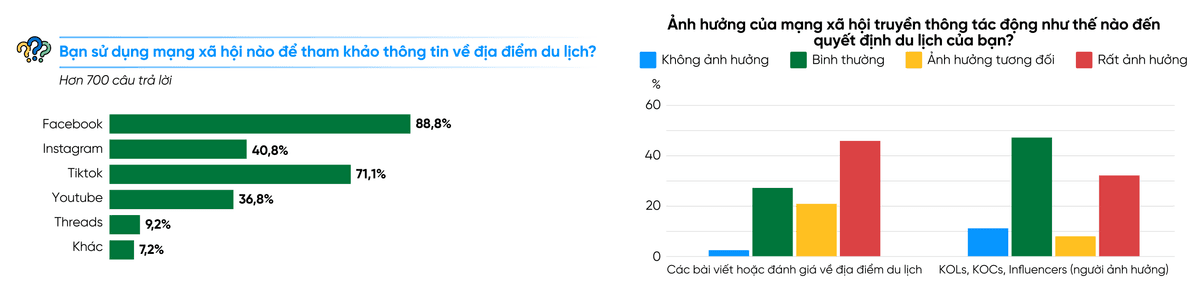
Facebook (88.8%), TikTok (71.1%), and peer reviews outweigh celebrity KOL posts
In pre-trip social research (AppotaPay survey, N > 700), Facebook leads at 88.8% and TikTok follows at 71.1%. Both platforms far outpace Instagram (40.8%), YouTube (36.8%), Threads (9.2%), and other channels (7.2%).
Peer validation carries decisive weight among young and female buyers. Fully 43.4% of women weigh reviews from prior travelers, nearly double the 23% rate among men. By age, 37.6% of under-25 travelers rely on peer reviews, versus a 20% average among ages 35 and older. As the right-hand chart confirms, direct destination review posts earn a much higher "strong influence" share than KOL, KOC, or Influencer posts.
Which four trends shape independent youth travel and ticket agency selection?
Synthesizing 2024 survey findings, Chapter 4 identifies four demand shifts guiding how young travelers choose destinations and booking channels:
- Domestic trips anchor short weekend demand. Across Coc Coc's February 2024 (N = 1,090) and March 2024 (N = 799) waves, 62.5% planned domestic travel. Only 21.5% planned abroad trips, while 16% remained undecided. Domestic preference benefits peri-urban homestays and Central Vietnam provinces connected by short flights or new expressways.
- Restorative wellness overtakes packed sightseeing schedules. More than 78% of surveyed travelers prefer resort and relaxation getaways. Young workers prioritize quiet natural settings, cool climates, and mental recharge.
- Payment convenience beats low prices when booking through agencies. Because 70% of young tourists build modular itineraries themselves, they purchase flights, rooms, and attraction tickets separately. In Coc Coc's March 2024 survey (N = 799), the top reason travelers bought tickets via an agency was convenient, flexible payment (45.3%). Payment convenience ranked above brand reputation (40.6%), good service (35.9%), and low prices (34.4%).
- Small-group bonding fuels bundled lodging and dining packages. High shares of friend trips (73.7%) and family trips (61.8%) shift demand toward connecting rooms, group villas, shared local dining, and group outdoor activities.
Which five priorities help Central Vietnam hospitality operators lift booking deposits?
Building on Chapter 5's recommendations, hotel and homestay owners, tour operators, and ticket agencies in Quang Binh (now part of Quang Tri province) and Central Vietnam should execute five upgrades:
Upgrade mid-scale stays, last-mile transit, and peer-review video marketing
- Redesign VND 500,000–1,000,000/night stays around on-site leisure amenities. Target the 57.9% core room-budget bracket directly. To fix Quang Binh's 8.6% lodging and 13.8% entertainment scores, hotels and homestays should add evening relaxation spaces, local specialty dining, and scenic photo corners near major caves and beaches.
- Operate last-mile shuttle links and multi-province Central Vietnam loops. Remote eco-lodges should run scheduled shuttles from Dong Hoi airport and train station to serve the 35.7% of travelers prioritizing local transit convenience. Tour operators can bundle Phong Nha and Son Doong cave trips with heritage and beach stays across Quang Tri, Hue, and Da Nang.
- Focus media budgets on short itinerary videos and verified guest reviews. Concentrate content on Facebook (88.8%) and TikTok (71.1%). Pair travel vloggers with post-stay guest review incentives using our framework for choosing and combining KOLs and KOCs.
Deploy instant deposit checkout and automated peak-season reconciliation
- Replace manual bank transfers with instant deposit links and 24/7 card acceptance. Screenshot-based wire transfers cause booking drop-offs outside business hours. Merchants should embed an online payment gateway on booking sites, send remote Payment Links in chat consultations, and deploy contactless SmartPOS terminals at front desks. According to AppotaPay's travel-payment benchmarks in the report, real-time multi-method checkout lifts customer booking deposit rates by 10% and supports 24/7 foreign-card collection. Engineering teams can verify webhook reliability with our payment gateway integration checklist for websites and mobile apps.
- Automate daily T+1 reconciliation before the June–August summer peak. With 60.5% of youth travel compressed into three summer months, reservation desks face heavy volumes of deposits, add-ons, date changes, and weather refunds. Finance teams should adopt a three-layer daily payment reconciliation workflow and explore related cash-flow guides in our fintech and digital payments hub.
This web edition synthesizes the verified market benchmarks and execution priorities from AppotaPay's tourism study. Complete the download form on this page to access all 44 pages of monthly charts, age-group budget breakdowns, and hospitality recommendations compiled by AppotaPay.
Sources
- Báo cáo Nghiên cứu và phân tích xu hướng thị trường du lịch 2024 tại Quảng Bình và các tỉnh miền Trung, Công ty Cổ phần AppotaPay, 2024-10-01, accessed 2026-10-30
- Thông tin du lịch tháng 9 và 9 tháng đầu năm 2024, Cục Du lịch Quốc gia Việt Nam, 2024-10-02, accessed 2026-10-30
- Báo cáo tình hình kinh tế – xã hội tháng Chín và 9 tháng năm 2024, Cục Thống kê — Bộ Tài chính (thời điểm công bố là Tổng cục Thống kê), 2024-10-06, accessed 2026-10-30
- Thống kê kết quả hoạt động du lịch Quảng Bình 9 tháng đầu năm 2024 và giai đoạn 2021–2024, Sở Văn hóa, Thể thao và Du lịch tỉnh Quảng Trị (thời điểm công bố là Sở Du lịch Quảng Bình), 2024-09-25, accessed 2026-10-30
- Báo cáo và khảo sát xu hướng du lịch Việt Nam (Cốc Cốc Travel tháng 2/2023, tháng 2/2024 và tháng 3/2024), Cốc Cốc Research, 2024-04-10, accessed 2026-10-30
- Khảo sát tiêu chí lựa chọn điểm đến du lịch tại Việt Nam (N = 350), Q&Me (Asia Plus Inc.), 2024-03-01, accessed 2026-10-30