How to Choose Cloud Infrastructure and CDN for Games and High-Traffic Apps
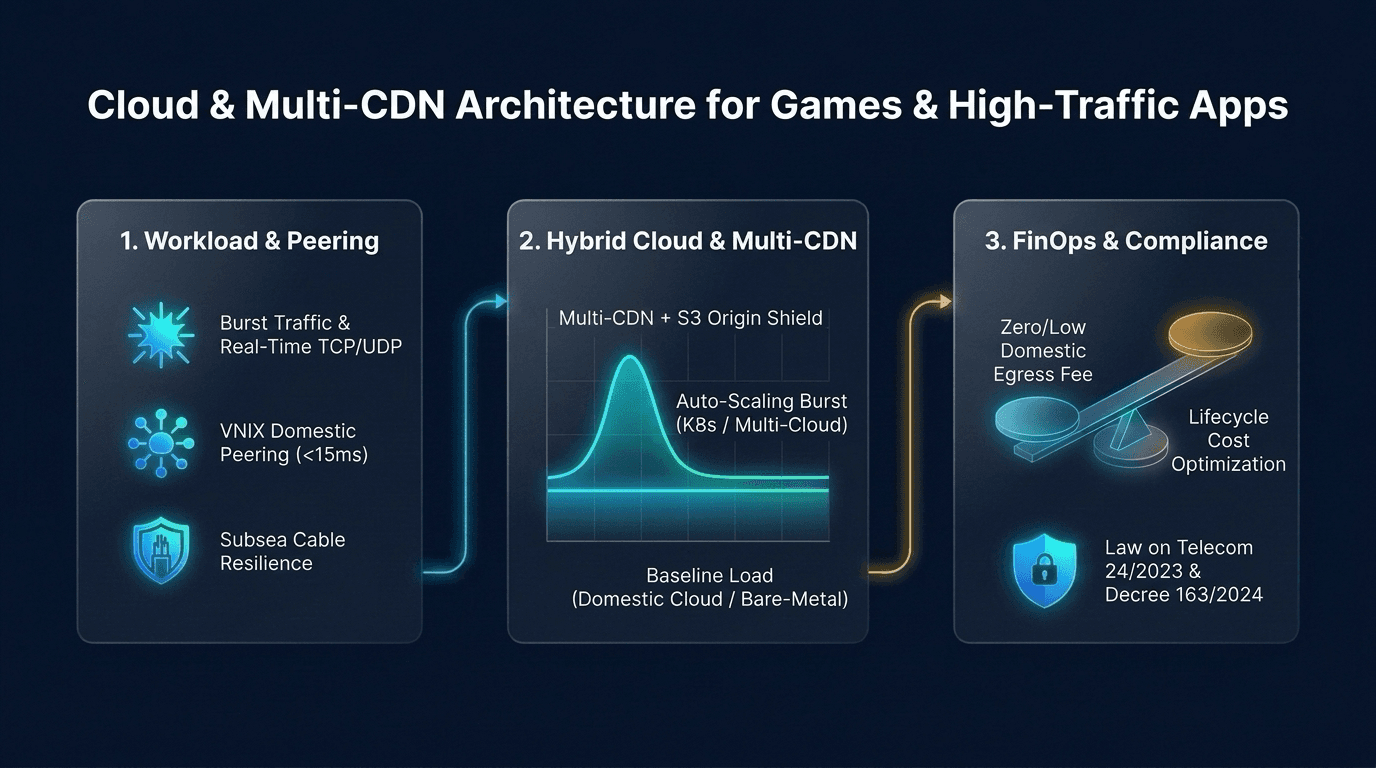
Choosing cloud infrastructure for games and high-traffic applications requires combining cloud instances, bare-metal servers, and Content Delivery Networks (CDNs) across each product lifecycle stage. A Hybrid Cloud model placing 60%–70% baseline load in Vietnam Tier III data centers peered via VNIX and 30%–40% peak burst on auto-scaling nodes keeps domestic latency under 15–20ms.
Key takeaways
- No single hosting model fits every stage: soft-launch testing favors pay-as-you-go cloud instances, launch day requires auto-scaling clusters paired with Multi-CDN, and steady-state operations benefit from shifting 60%–70% baseline load to committed domestic cloud or bare-metal servers.
- According to the Vietnam Internet Network Information Center (VNNIC, 2024–2025), the Vietnam National Internet eXchange (VNIX) interconnects over 53 member networks with total connected bandwidth exceeding 503 Gbps; hosting real-time stateful servers domestically keeps latency below 15–20ms and insulates apps from subsea cable disruptions.
- Offloading game installers, client patches, and video streams to S3-compatible Object Storage fronted by Multi-CDN and Origin Shielding eliminates cache stampedes on origin servers and cuts international data egress costs.
- Infrastructure teams operating in Vietnam must align deployment architectures with value-added telecom regulations under Law on Telecommunications No. 24/2023/QH15 and Decree 163/2024/ND-CP, alongside data residency rules under Decree 53/2022/ND-CP, Decree 147/2024/ND-CP, and Law on Data No. 60/2024/QH15.
Decisions around choosing cloud infrastructure for games and consumer digital applications directly shape Day-1 player retention (Retention D1) and operating margins. According to the Vietnam Mobile Game Market Report 2024 by Gamota R&D (February 2025), Vietnam's mobile game sector surpassed 1.6 billion downloads in 2024 (ranking 9th globally) and generated over USD 800 million in revenue, with domestic publishers releasing 127 new titles. A single login queue failure or packet-loss spike during the first 30 minutes of launch day can wipe out tens of thousands of paid installs.
According to Appota's Vietnam Mobile Application Report 2021 (May 2021, citing Ookla Speedtest Global Index and We Are Social), 95% of internet users in Vietnam connect via mobile devices at an average mobile download speed of 60.88 Mbps (up 40.7% year-on-year). Because last-mile access speeds are already high, performance bottlenecks now stem from how engineering teams architect origin servers, route domestic traffic across national internet exchanges, and distribute client patches through a Content Delivery Network (CDN).
How do mobile game and digital app workloads differ when choosing cloud infrastructure for games?
When choosing cloud infrastructure for games, livestream commerce platforms, or super-apps, solutions architects cannot copy server templates built for traditional enterprise software (ERP, CRM). Consumer entertainment workloads present three distinct engineering challenges:
- Event-driven spiky and burst traffic: Enterprise back-office software experiences predictable daytime utilization. By contrast, Concurrent Users (
CCU) in mobile games and entertainment apps routinely surge 5x to 15x within 15 minutes of server opening (Open Beta), evening prime time (19:00–22:00), or flash-sale campaigns. - Strict low-latency requirements on stateful connections (TCP/UDP sockets): Standard web applications communicate over stateless
HTTP/HTTPSrequests that scale easily behind conventional load balancers. Real-time combat servers, matchmaking lobbies, and interactive chat rooms maintain persistentTCP/UDP socket,WebSocket, orgRPCsessions. Round-trip latency above 80–100ms or unstable packet timing (jitter) causes character rubber-banding and dropped transactions. - Massive egress bandwidth for client patches and media assets: Ahead of every major version update or seasonal event, hundreds of thousands of mobile devices simultaneously download binary patches ranging from several hundred megabytes (MB) to multiple gigabytes (GB). Serving static patch files from the same cluster that processes login authentication and payments saturates network interfaces and crashes core services.
Workload comparison between traditional enterprise IT and mobile games or consumer apps
The table below contrasts traditional enterprise workloads with real-time gaming and digital entertainment systems:
| Technical Dimension | Traditional Enterprise Systems (ERP, CRM, B2B Web) | Mobile Games, Entertainment Apps & Livestream Commerce |
|---|---|---|
| 1. Traffic Volatility | Predictable business hours (08:00–18:00); peak load rarely exceeds 1.5x – 2x average baseline |
Extreme event-driven spikes at launch and 19:00–22:00 prime time; peaks jump 5x – 15x in minutes |
| 2. Protocol & Session State | Stateless REST/GraphQL over HTTP/HTTPS; any worker node can replace another seamlessly |
Stateful TCP/UDP sockets, WebSocket, or gRPC tied to specific match rooms or world instances |
| 3. Latency Tolerance | API response times of 200ms – 500ms remain acceptable for form submissions and dashboards |
Domestic ping must stay ≤ 15–20ms for action/MOBA titles and ≤ 50ms for RPG/strategy |
| 4. Egress Bandwidth Profile | Lightweight payloads (JSON, HTML, office documents of a few hundred KB to several MB) | Full APK/IPA installers, AssetBundle patches (300 MB – 3 GB), and HD video streams consuming tens of Gbps |
The misconception of lifting and shifting enterprise web architectures to game servers
A frequent mistake among engineering teams is placing transactional databases, stateful game logic, and patch download repositories inside a single public cloud cluster, relying on CPU-based horizontal auto-scaling (Auto-scaling) to absorb launch spikes.
Operational telemetry across Gamota and Kdata shows why reactive CPU scaling fails on launch day. When tens of thousands of players tap a 10:00 AM push notification simultaneously, the first bottlenecks hit network interface throughput (Network I/O), connection tracking tables (conntrack / file descriptors), and database row locks long before CPU utilization crosses the 70% scaling threshold. Furthermore, a stateful game server node often takes 90 to 180 seconds to provision, boot, and load map data into memory—meaning the initial wave of players hits Connection Timeout errors before new nodes ever join the pool.
How do domestic cloud, international hyperscalers, and bare-metal servers compare across 6 criteria?
To balance network latency and bandwidth economics in Vietnam, Chief Technology Officers (CTOs) evaluate three infrastructure tiers: domestic cloud providers, international hyperscalers (AWS, Google Cloud, Azure, or Alibaba Cloud hosted in Singapore, Hong Kong, or Tokyo regions), and dedicated physical servers (Bare-metal / Colocation).
According to statistics from the Vietnam Internet Network Information Center (VNNIC, 2024–2025), the Vietnam National Internet eXchange (VNIX) operates Points of Presence (POPs) across Hanoi, Da Nang, and Ho Chi Minh City, peering over 53 member networks with total connected bandwidth exceeding 503 Gbps and peak traffic around 80 Gbps. Moreover, 100% of VNIX members route IPv6 traffic, supporting a national IPv6 adoption rate of 65%–67.68% (reaching roughly 80% on fixed broadband and 88% on mobile broadband).
This domestic peering fabric creates a measurable performance and cost gap between hosting workloads inside Vietnam versus routing traffic offshore:
| Evaluation Criterion | Domestic Cloud (Vietnam Tier III Data Centers) | International Hyperscalers (Singapore / HK Regions) | Dedicated Bare-Metal / Colocation (Vietnam) |
|---|---|---|---|
| 1. Latency to Vietnam Users | Ultra-low (5ms – 20ms), routed directly across VNIX and domestic ISP peering links |
Moderate (45ms – 80ms) normally; spikes to 150ms – 300ms+ with packet loss during subsea cable faults |
Lowest and most consistent (5ms – 15ms), with zero virtualization hypervisor overhead |
| 2. Instant Elasticity | Spins up virtual machines (VMs) or Kubernetes worker nodes within minutes for live events |
Rapid large-scale auto-scaling across global regions; ideal for multi-country publishing | Low; provisioning additional physical hardware takes hours to days without a pre-staged pool |
| 3. Managed PaaS Ecosystem | Covers core production stack (Compute, K8s, S3 Object Storage, Managed DB, CDN) |
Broadest catalog of proprietary PaaS, Big Data, and AI services, but carries higher vendor lock-in | Requires in-house Linux/DB engineering or a managed infrastructure service contract |
| 4. Data Egress Pricing | Highly cost-effective; bundled with generous domestic bandwidth (100 Mbps – 10 Gbps+) |
Expensive (USD 0.08 – 0.12/GB internet egress), quickly inflating bills during patch rollouts |
Most economical for sustained high throughput; billed at flat committed port rates |
| 5. 24/7 Technical Support | Local Vietnamese NOC engineers coordinating directly with domestic ISPs within 15–30 minutes | Global ticket queues; 15-minute critical response requires costly Enterprise support tiers | 24/7 on-site data center engineers for immediate hardware replacement and link troubleshooting |
| 6. Vietnam Data Residency | Natively satisfies statutory requirements to store user and operational data inside Vietnam | Requires cross-border database replication pipelines back to servers physically located in Vietnam | Full physical control over storage drives, dedicated cages, and isolated network zones |
Statutory compliance for cloud computing, data centers, and data residency in Vietnam
Beyond latency and cost, infrastructure architectures serving users in Vietnam must comply with national telecommunications, gaming, and data laws:
- Regulation of data center and cloud computing services: Under Law on Telecommunications No. 24/2023/QH15 (passed November 24, 2023, effective July 1, 2024; specific provisions governing data center and cloud computing services effective January 1, 2025) and Decree 163/2024/ND-CP (issued December 24, 2024, effective January 1, 2025), data center and cloud computing services are classified as value-added telecommunications services. Enterprises must select providers that meet statutory registration, technical, and information security standards.
- Technical system requirements for online games: Under Decree 147/2024/ND-CP (signed November 9, 2024, effective December 25, 2024), enterprises operating G1, G2, G3, and G4 games in Vietnam must maintain technical equipment systems capable of managing player accounts, verifying players via Vietnamese mobile phone numbers, and retaining accurate user and payment logs.
- Data localization and cross-border data governance: Under Decree 53/2022/ND-CP (issued August 15, 2022, effective October 1, 2022) guiding the Law on Cybersecurity, personal data, data generated by users in Vietnam, and user relationship data must be stored in Vietnam for a minimum of 24 months upon regulatory request. Simultaneously, Law on Data No. 60/2024/QH15 (passed November 30, 2024, effective July 1, 2025) establishes strict governance for data classification, protection, and cross-border data transfers. (Editorial note: Corporate legal counsel should verify primary Official Gazette texts before finalizing cross-border database topologies.)
For a deeper examination of data center tiers and regulatory frameworks, see our research overview on the Vietnam cloud, data center, and CDN infrastructure landscape.
How should you architect Multi-CDN for client patches, game bundles, and media delivery?
During server launches or major seasonal updates, static binary downloads (client patches, event banners, promotional videos) account for 80% to 90% of total network throughput. The foundational engineering rule is isolating static asset delivery completely from stateful application and database servers (Origin / Game Servers).
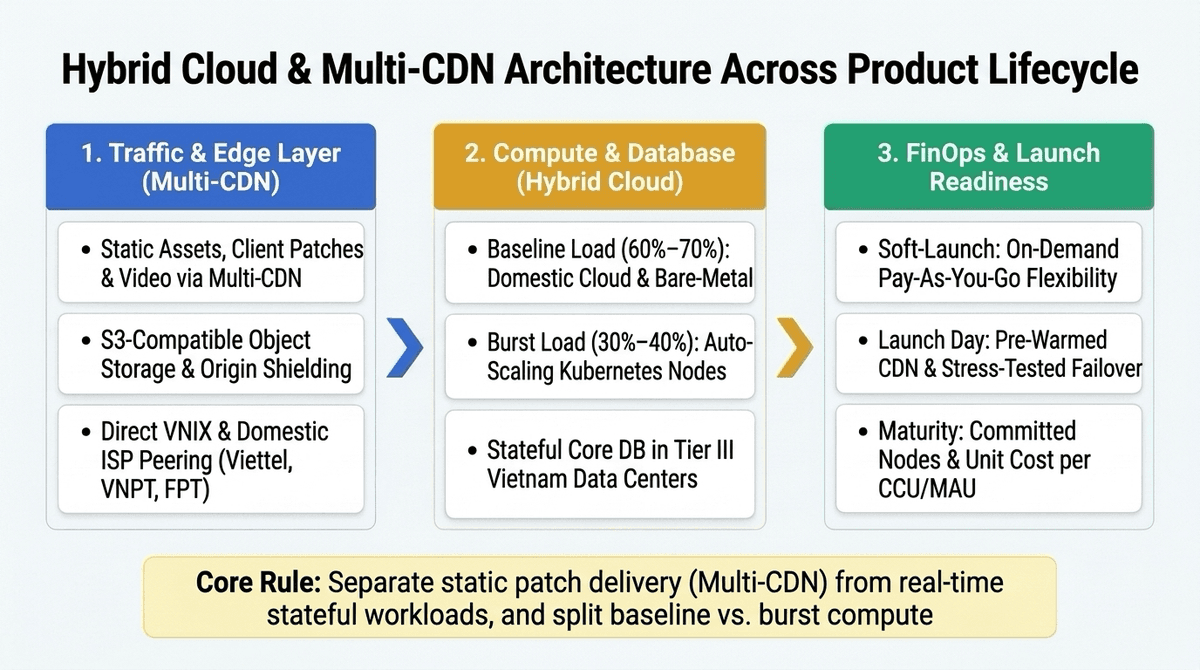
As the architecture diagram above illustrates, a resilient production topology separates workloads into three layers: a Multi-CDN edge layer backed by S3 Object Storage and Origin Shielding to absorb patch downloads; a hybrid compute layer pairing domestic baseline servers with auto-scaling Kubernetes nodes; and a FinOps governance layer adapting capacity to each product stage.
Four engineering rules for Multi-CDN and Origin Shielding during peak patch rollouts
Drawing from large-scale content delivery deployments at Kdata for game publishers and streaming platforms, infrastructure teams should enforce four configuration rules:
- Step 1 — Offload all static patches to domestic S3-compatible Object Storage: Never serve binary patches (
AssetBundle,OBB,PAK, video files) from local disks attached to game or API servers. Store master files in S3-compatibleObject Storageinside a Vietnam data center under a dedicated hostname (such ascdn-patch.game-domain.vn) strictly isolated from authentication endpoints (api.game-domain.vn). - Step 2 — Enable Origin Shielding and Request Coalescing: When a new client patch goes live or cache Time-to-Live (
TTL) expires simultaneously, tens of thousands of concurrentCache Missrequests can slam the origin storage bucket—a failure mode known as acache stampede. Enabling an intermediateOrigin Shieldlayer collapses identical concurrent requests: even if 50,000 devices requestpatch_v2.zipat the same second, the shield forwards only a single fetch request to the S3 origin and fans the cached response out to edge POPs. - Step 3 — Split binaries into chunked delta patches with immutable version hashes: Rather than packaging a monolithic 1.5 GB update file that forces mobile 4G users to restart from zero if their connection drops at 90%, client engineers should split updates into smaller
10 MB – 50 MB chunkssupportingHTTP Range Requests. Append version strings orSHA-256hashes to filenames withCache-Control: public, max-age=31536000, immutableheaders to keep theCache Hit Ratioabove 95%–98%, while assigning a short30–60 second TTLonly to the lightweightmanifest.jsonindex file. - Step 4 — Route across Multi-CDN and pre-warm edge caches before launch: Combining two or more CDN providers with edge POPs embedded directly inside major Vietnamese ISPs (Viettel, VNPT, FPT) keeps download traffic on-net. Exactly 12 to 24 hours before opening servers, SRE teams should execute
Cache Pre-warming / Prefetchscripts to push heavy patch files to edge nodes ahead of player demand, paired with edge scrubbing as detailed in our guide to DDoS mitigation and peak uptime architecture.
How does the Cloud FinOps framework optimize infrastructure costs across 3 product lifecycle stages?
Over-provisioning peak server capacity 24/7 for a few evening hours erodes profitability, whereas under-provisioning crashes the service mid-campaign. The solution is applying a lifecycle-aware Cloud FinOps model that separates steady baseline demand from elastic burst capacity:
$$\text{Total Infrastructure Cost} = \text{Baseline Compute (60%–70%)} + \text{Auto-Scaling Burst (30%–40%)} + \text{CDN & Egress Bandwidth}$$
Resource allocation strategy across Soft-Launch, Open Beta, and Long-Term Maturity
As an application progresses from limited cohort testing (see our mobile game soft-launch checklist) to commercial launch and long-term LiveOps, infrastructure commitments should evolve across three phases:
| Lifecycle Phase | Technical & Business Objective | Compute & Database Topology | CDN & Bandwidth Strategy | Optimal Billing Model |
|---|---|---|---|---|
| 1. Soft-Launch (Testing) | Validate stability and D1/D7 Retention across a few thousand users; iterate rapidly |
100% On-Demand Cloud VMs / K8s to resize or tear down environments within minutes |
Single domestic CDN fronting S3 Object Storage; usage-based bandwidth billing |
Pay-as-you-go hourly or monthly billing; zero long-term hardware lock-in before passing Go/Kill gates |
| 2. Commercial Launch (Open Beta) | Absorb 5x–15x launch spikes and heavy UA campaigns; protect login and checkout flows | High-IOPS NVMe SSD database cluster; stateless gateway and lobby tiers set to 2x–3x Auto-scaling headroom |
Active Multi-CDN + Origin Shield; execute Pre-warm cache 24 hours prior to server opening |
Monthly base cluster plus hourly billing for elastic Burst nodes during the first 14–30 launch days |
| 3. Steady-State & LiveOps (Maturity) | Minimize unit infrastructure cost per 1,000 CCU / MAU to maximize long-term Net LTV |
Shift 60%–70% steady baseline load to Bare-metal or committed Cloud; keep 30%–40% on elastic Cloud for events |
Committed bandwidth tier (95th percentile or flat port commitment) inside Vietnam data centers |
6-to-12-month reserved commitments on baseline nodes to reduce compute and bandwidth unit rates by 30%–50% |
When should an enterprise NOT build a complex Multi-cloud setup or rent bare-metal servers early?
While Hybrid Cloud and Multi-cloud architectures deliver strong unit economics at scale, engineering leaders should not adopt them prematurely in three scenarios:
- During early MVP or Soft-launch testing before retention metrics are proven: Signing 12-month bare-metal leases or spending months engineering cross-cloud orchestration before a title clears
D1/D7 Retentiongates turns infrastructure into sunk cost if the product pivots or sunsets. - When a lean DevOps/SRE team (fewer than 2–3 engineers) splits stateful tiers across separate clouds: Placing application servers on one cloud provider while hosting the primary transactional database on another over the public internet introduces cross-cloud query latency, bidirectional egress charges, and operational fragility.
- For lightweight hyper-casual games or utility apps with no real-time multiplayer state: When 95% of gameplay runs locally on the handset and backend calls are limited to asynchronous leaderboards or ad configuration fetches, a standard single-cloud cluster fronted by a CDN is simpler and more cost-effective than managing dedicated bare-metal nodes.
To implement cost allocation tags and audit idle cloud resources monthly, see our detailed Cloud FinOps cost optimization guide.
What is the 8-point infrastructure readiness checklist before launch day or major live events?
At least 72 hours before opening a new game server or launching a major promotional campaign, the CTO and lead SRE should verify eight technical gates alongside their infrastructure provider:
| # | Readiness Gate | Mandatory Engineering Action | Acceptance Threshold (Pass Gate) |
|---|---|---|---|
| 1 | Stress & Soak Load Testing | Simulate concurrent logins, matchmaking, and payment IPN webhooks at 1.5x – 2x target CCU continuously for 2–4 hours |
Error rate ≤ 0.1%; p99 latency within target SLA; zero memory leaks or connection pool exhaustion |
| 2 | CDN Cache Pre-Warming | Upload all installer and patch chunks to domestic S3 Object Storage, enable Origin Shield, and run edge Pre-warm scripts |
Cache Hit Ratio ≥ 95%; origin bandwidth egress remains flat during simulated patch download spikes |
| 3 | VNIX Peering & IPv6 Routing Check | Run traceroute / MTR probes from Viettel, VNPT, and FPT mobile 4G/5G and fiber networks across both IPv4 and IPv6 |
Domestic traffic routes directly through VNIX (≤ 15–20ms) with zero international tromboning |
| 4 | Pre-Scaled Capacity & Login Queue | Raise minimum node counts (minReplicas) 60 minutes before launch; enable a virtual Login Queue and API Rate Limiting |
Excess traffic beyond design ceiling enters an orderly waiting queue rather than crashing authentication nodes |
| 5 | Multi-Layer Anti-DDoS & WAF Shield | Mask origin server IP addresses completely (Origin IP masking); whitelist ingress solely from Scrubbing Center / WAF / CDN IPs |
Volumetric network attacks (L3/L4) and application floods (L7) are scrubbed at the edge before reaching core servers |
| 6 | Database Failover & Backup Drill | Verify replication lag between Primary DB and Read Replicas; execute a live failover drill and test point-in-time Backup Restore |
Recovery Time Objective (RTO) ≤ 60–120 seconds; zero loss of confirmed payment transactions (RPO = 0) |
| 7 | Cloud Quota & Port Ceiling Lift | Audit and raise soft limits (vCPU quotas, load balancer connections, Linux file descriptors, NIC bandwidth) with Cloud/ISP teams |
Automated scaling never hits quota rejections mid-spike; alerts fire to Slack/Telegram/PagerDuty at 75% load |
| 8 | Compliance & Data Residency Audit | Verify Vietnamese phone number verification flows, 60/180-minute under-18 timers (for games), and domestic log storage in Vietnam | Full compliance with Decree 147/2024/ND-CP, Decree 53/2022/ND-CP, Law on Telecom 2023, and Law on Data 2024 |
(Editorial note: The Hybrid Cloud, Multi-CDN reference architecture and 8-point readiness checklist above will be verified by Kdata's Cloud & Infrastructure specialists prior to publication approval.)
Ahead of your next server launch or seasonal campaign, decouple binary patch delivery onto S3 Object Storage with Multi-CDN, benchmark your baseline-to-burst traffic ratio to right-size Hybrid Cloud commitments, and run a full stress test against the 8-point checklist above. Explore additional technical guides in the Cloud and Infrastructure topic hub on Appota Insights.
If your studio or digital enterprise needs to architect a low-latency Hybrid Cloud setup, deploy dedicated Tier III bare-metal servers peered directly via VNIX, or configure Multi-CDN for high-concurrency launches in Vietnam, connect with Kdata's cloud and CDN engineering team for a workload assessment and custom architecture plan.
Sources
- Luật Viễn thông số 24/2023/QH15 và Nghị định 163/2024/NĐ-CP quy định chi tiết một số điều và biện pháp thi hành Luật Viễn thông, Quốc hội & Chính phủ Việt Nam, 2024-12-24, accessed 2026-11-03
- Nghị định 147/2024/NĐ-CP về quản lý, cung cấp, sử dụng dịch vụ Internet và thông tin trên mạng, Chính phủ Việt Nam (dẫn qua Cổng TTĐT Bộ Khoa học và Công nghệ), 2024-11-09, accessed 2026-11-03
- Nghị định 53/2022/NĐ-CP quy định chi tiết một số điều của Luật An ninh mạng và Luật Dữ liệu số 60/2024/QH15, Quốc hội & Chính phủ Việt Nam, 2022-08-15, accessed 2026-11-03
- Báo cáo Tài nguyên Internet Việt Nam và thống kê Trạm trung chuyển Internet quốc gia (VNIX), Trung tâm Internet Việt Nam (VNNIC — Bộ Khoa học và Công nghệ), 2024-12-15, accessed 2026-11-03
- Báo cáo thị trường game mobile Việt Nam 2024 và Báo cáo ứng dụng di động Việt Nam 2021, Appota Group & Gamota R&D, 2025-02-15, accessed 2026-11-03
- Tài liệu giải pháp Cloud Server, Bare-metal, Object Storage và Multi-CDN của Kdata, Kdata (Appota Group), 2026-01-15, accessed 2026-11-03