
Vietnam Esports Guidebook 2019
Produced by Appota Esports and OTA Network, the Vietnam Esports Guidebook 2019 delivers the first complete directory and audience study of Vietnam's competitive gaming ecosystem. In 2018, Vietnam recorded over 15 million esports players, 10 million weekly viewers, and USD 787,000 in tournament prizes. A random survey of 1,500 viewers shows 60% are aged 19–24, 58% earn monthly income, and 61% watch on smartphones.
Appota Esports and OTA Network's inaugural ecosystem directory and 1,500-viewer survey mapping Vietnam's 15 million esports players, USD 787,000 prize pools, and 34 pro teams.
Key findings
- 15M → 26M playersVietnam's active esports player base expanded from 3 million (2016) and 5 million (2017) to over 15 million in 2018 and was projected to reach 26 million in 2019, alongside over 10 million weekly viewers rising toward 16 million (Appota Esports).
- USD 787K+ prize poolsTotal amateur and professional tournament prize money across 18 esports titles in Vietnam in 2018, growing at a 38.2% compound annual rate from USD 216K (2015), USD 390K (2016), and USD 685K (2017), excluding multi-million-dollar event sponsorships.
- 37.5M mobile downloadsFirst-half 2018 downloads for mobile esports games in Vietnam (nearly triple H2 2016's 12.8 million), lifting top-50 App Store and Google Play esports revenue from USD 1 million to over USD 6 million and capturing up to 30% of national prize pools.
- 94% male, 83% Gen ZDemographic profile from OTA Network's December 2018 random survey of 1,500 gaming livestream viewers across all 63 provinces and cities (Hanoi 42%, Ho Chi Minh City 25%); young adults aged 19–24 represent 60% of viewers and 58% earn a monthly income.
- 61% watch on mobileShare of Vietnamese esports viewers who watch gaming livestreams on smartphones more often than PCs (39%), rising to 71% among ages 13–18; meanwhile, 52% watch livestreams of games they do not play themselves (OTA Network).
- 86% watch weekly+Livestream viewing frequency comprising 37% daily, 49% weekly, and 14% monthly viewers; 58% watch 1–3 hours per day (33% under 1 hour, 7% for 3–4 hours, 2% for 5+ hours) with prime hours between 18:00 and 02:00 (55% each in 18–22h and 22h–2h).
- 35% donated in 30 daysShare of surveyed livestream viewers who donated to streamers in the preceding 30 days; 71% prefer funny, entertaining streams (versus 6% pure gaming technique and 24% both), while 41% enjoy both gameplay and streamer life stories.
What market baseline does the Vietnam Esports Guidebook establish for 2019?
Released in March 2019 by Appota Esports and OTA Network, the Vietnam Esports Guidebook 2019 is Vietnam's first complete ecosystem directory and audience survey report for competitive gaming. Drawing on Appota's 7 years of game publishing, tournament operations, and community management data, this Vietnam esports guidebook provides a quantitative reference for publishers, brands, and organizers. Readers tracking subsequent market phases can compare our Vietnam Esports Whitebook 2021 and Vietnam Esports Whitebook 2022–2023.
Section 01 links Vietnam's esports growth to demographic momentum and affordable mobile broadband. Following the 1986 Doi Moi economic reforms, young and economically active citizens came to exceed 60% of the national population. Since mass Internet adoption began around 1997, online access expanded to over 64 million users (67% penetration) alongside 51 million 3G/4G mobile subscribers by 2018.
In the GSMA Mobile Connectivity Index 2018, Vietnam achieved an overall score of 63.0, surpassing regional peer Indonesia. That composite index reflects four pillars: Infrastructure (49.1), Affordability (72.1), Consumer Readiness (74.1), and Content & Services (60.1). Strong 3G/4G cost-to-speed value meant roughly 1 in 2 mobile Internet subscribers in Vietnam played video games (32.8 million gamers across 51 million 3G/4G subscribers).
Player growth, tournament prize pool CAGR, and Southeast Asian benchmarks
Competitive gaming in Vietnam began in early-2000s Internet cafes (quan net) with tournaments in Age of Empires, StarCraft, World of Warcraft, MU, Gunbound, and Audition, then scaled rapidly across Facebook groups after 2010. According to Newzoo (2018), Vietnam's 32.8 million gamers ranked second in Southeast Asia behind Indonesia (43.7 million). Annual gaming revenue exceeded USD 365 million, lifting Vietnam from 35th to 28th globally.
According to Appota Esports' market tracker, Vietnam's esports player base grew fivefold between 2016 and 2018. Active players rose from 3 million (2016) to 5 million (2017), surpassed 15 million (2018), and were projected to reach 26 million in 2019. Regular viewers watching at least once per week exceeded 10 million in 2018 and were projected to pass 16 million in 2019.
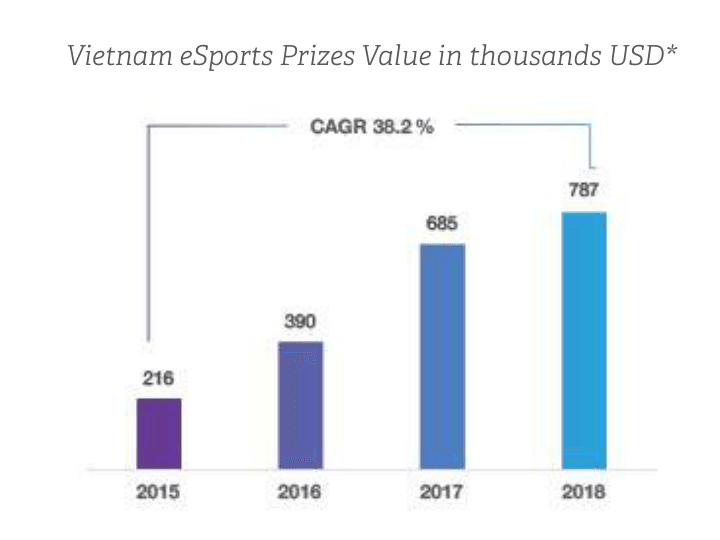
As the chart illustrates, aggregate prize pools across amateur and professional tournaments for 18 esports titles in Vietnam grew at a 38.2% compound annual growth rate (CAGR) from 2015 to 2018. Prize money climbed from USD 216,000 (2015) to USD 390,000 (2016), USD 685,000 (2017), and over USD 787,000 in 2018. That USD 787,000 figure reflects direct prize purses alone; total sponsorship budgets covering event production, media rights, and marketing reached millions of US dollars.
| Southeast Asian Market | 2017 Average Revenue Per Player (Newzoo, 2018) | Online Media GMV 2015 → 2018 (Google & Temasek) | Projected 2025 Online Media GMV (2018–2025 CAGR) |
|---|---|---|---|
| Vietnam | USD 11.1 | USD 0.6B → USD 2.2B (57% CAGR) | USD 6.0B (27% CAGR) |
| Indonesia | USD 20.1 | USD 0.6B → USD 2.7B (66% CAGR) | USD 8.0B (30% CAGR) |
| Thailand | USD 32.6 | USD 0.8B → USD 2.4B (44% CAGR) | USD 7.0B (24% CAGR) |
| Philippines | USD 11.8 | USD 0.4B → USD 1.3B (45% CAGR) | USD 4.0B (26% CAGR) |
| Malaysia | USD 40.6 | USD 0.6B → USD 1.6B (35% CAGR) | USD 3.0B (18% CAGR) |
| Singapore | USD 109.5 | USD 0.8B → USD 1.3B (17% CAGR) | USD 3.0B (13% CAGR) |
The regional benchmark table highlights an important monetization gap. Despite ranking second in total gamers, Vietnam recorded a 2017 average revenue per player (ARPU) of USD 11.1, trailing Malaysia (USD 40.6) and Singapore (USD 109.5). However, Google and Temasek's e-Conomy SEA 2018 report described Vietnam as "a dragon being unleashed," with gaming and online advertising growing over 50% year-on-year. Vietnam's Online Media GMV grew at a 57% CAGR from USD 0.6 billion (2015) to USD 2.2 billion (2018) toward a projected USD 6 billion by 2025 within Southeast Asia's USD 10 billion gaming market.
Mobile esports surge, Battle Royale momentum, and 2018 international medals
MOBA and FPS titles—led by League of Legends, Arena of Valor, and CrossFire—accounted for the largest share of domestic prize pools during 2015–2018. In League of Legends, Vietnam became an independent competitive region with direct entry into Riot Games' international events. From 2017–2018, Battle Royale titles surged across PC and mobile. Globally, Newzoo tracked Fortnite and PUBG at 20.6% of total hours viewed on Twitch and YouTube Gaming; in China, PUBG overtook League of Legends in August 2017 to reach 51.8% PC cafe share by February 2018 (versus 23.3% for League of Legends).
In Vietnam, mobile esports downloads nearly tripled from 12.8 million in H2 2016 to 37.5 million in H1 2018, surpassing casual games. Across the top 50 grossing App Store and Google Play titles, Esports genre revenue jumped sixfold from USD 1 million (H2 2016) to over USD 6 million (H1 2018), while MMORPG and casual revenues stagnated. Within three years, mobile esports titles (Arena of Valor, PUBG Mobile, Crossfire Legends, Vainglory, Rules of Survival) captured up to 30% of Vietnam's total prize pools.
Vietnamese teams also secured major regional podiums in 2018 while national broadcasters VTVPlay and VTVcab launched dedicated esports coverage:
- Asian Games 2018 (Jakarta–Palembang): Vietnam won four bronze medals (3rd place) in Arena of Valor, Pro Evolution Soccer 2018, StarCraft II, and Clash Royale; Vietnam's Arena of Valor qualifier drew 300,000 hours watched and over 79,000 peak concurrent viewers (CCV).
- Arena of Valor International Championship (AIC) 2018: Vietnam's national representative placed 3rd overall.
- 2018 Regional PUBG Championships: Divine eSports won 1st place at the JIB PUBG Southeast Asia Championship 2018 in Bangkok (USD 25,000), Rate Me Five Stars placed 3rd (USD 9,000), and Refund Gaming finished 2nd at the PUBG SEA Championship 2018 (USD 20,000).
- WESG 2018 SEA Qualifier: StarCraft II pro MeomaikA earned 2nd place (USD 2,250).
How is Vietnam's esports value chain and 2019 ecosystem directory structured?
Section 02 maps the industry value chain and catalogs every major domestic stakeholder. Money entering the esports economy originates from Brands (via sponsorships, advertising, and in-game purchases) and eSports Fans (via tickets, merchandise, and streamer donations).
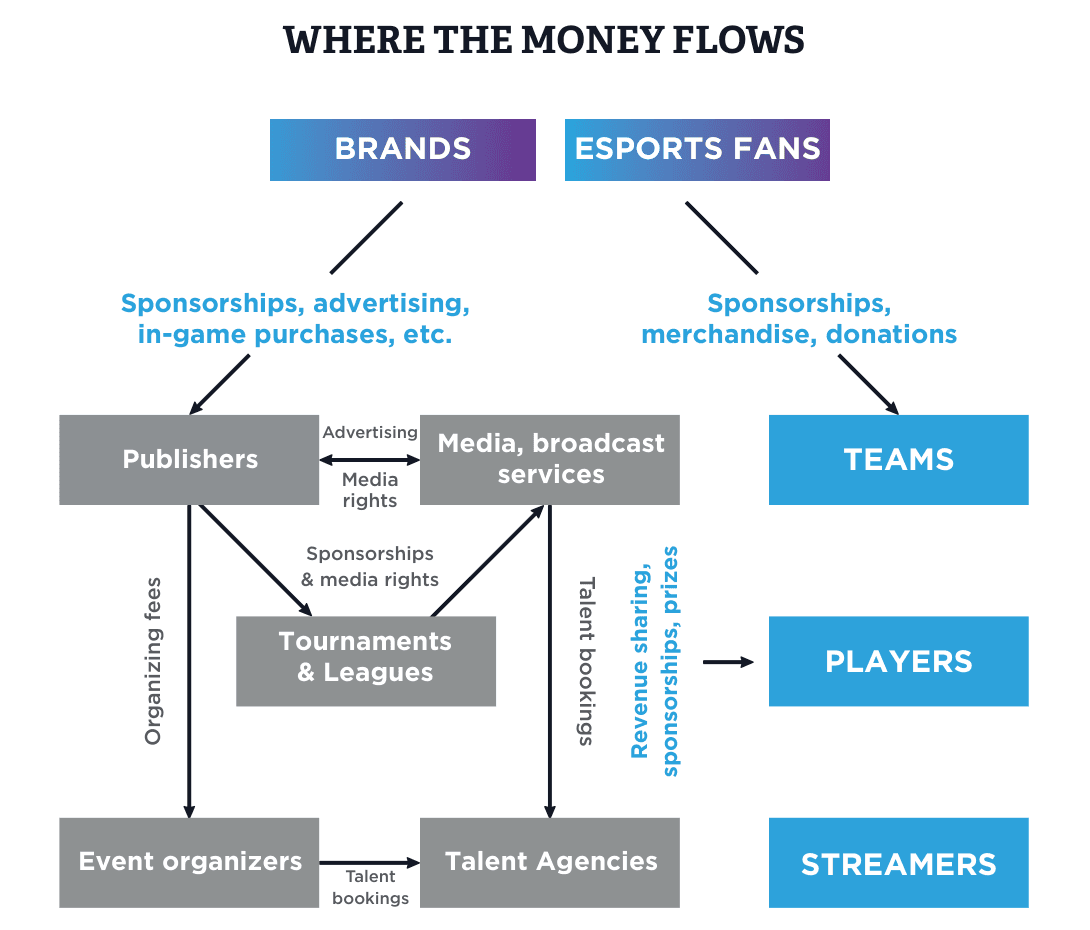
As the diagram shows, Tournaments & Leagues sit at the center of the ecosystem, supported by publishers, broadcasters, and event organizers. Talent Agencies operate as the newest intermediary category, connecting brands, organizers, and media outlets to streamers with millions of followers.
Four esports publishers, six flagship leagues, and 34 professional teams
Out of 15 active game publishers in Vietnam in 2018, four invested heavily in esports: VNG, Garena, VTC Game, and Gamota. Locally published games sustain structured pro leagues, whereas classic titles without local publishers (Age of Empires, Dota 2, StarCraft, Tekken, PES, CS:GO) rely on small community events. A major exception is PUBG: strong viewer demand enabled local leagues, with Gamota and Gank Studio's mobile Fighting League generating over 3 million views and 335,000 livestream hours watched.
Vietnam hosted roughly 100 amateur and professional tournaments plus thousands of micro-tournaments in 2018. The table below summarizes the Guidebook's directory:
| Ecosystem Pillar | Notable Organizations / Leagues | Prize Pools, Traffic & Operational Benchmarks |
|---|---|---|
| 4 Esports Publishers | Garena, VNG, Gamota, VTC Game | Garena (LoL, FO3/FO4, AoV, Blade & Soul); VNG (Vo Lam Truyen Ky >20M players, CFL, MLBB, RoS, PUBG Mobile); Gamota (>10M players inside Appota's >50M-user ecosystem, Vainglory, Arena of Glory, Survival Heroes); VTC Game (CrossFire, VND 500M CF Elite League, VND 2B Vietnam Pro League 2017) |
| 6 Flagship Leagues | Arena of Fame (AoV), VCS (LoL), Vietnam Divine League (PUBG), CF Elite League, 360 Mobi MLBB, CFL Star League | Arena of Fame: 8 teams, USD 130,000 in 2018 and USD 86,000 in Spring 2019 (AoV >12M players; Winter 2018 hit 5M hours watched across 111 hours aired); VCS: up to USD 60,000/season, >12M hours watched / 300+ hours aired; Divine League: 3 tiers, >370 teams, USD 6,000/month; CF Elite League & 360 Mobi MLBB: USD 22,000/season; CFL Star League: USD 14,000 |
| Independent Organizers | 23 Creative VN, 500Bros, Gank Studio, GameTV, DivineTV, Box Studio | Box Studio + 23 Creative + VTV Play (Vietnam Master Championship: USD 30,000); Gank Studio (Fighting League PUBG Mobile: USD 20,000); 23 Creative (VPGL Dota 2: USD 9,000, PUBG SEA VN Qualifier: USD 2,800); 500Bros (NimoTV PUBG All-Star: USD 5,000); GameTV (Be Yeu Cup AoE: USD 4,000) |
| 34 Notable Pro Teams | GAM eSports, EVOS eSports, Team Box Gaming, Phong Vu Buffalo, Friends Forever, Team Flash | Facebook followers: GAM (226,096), EVOS (119,736 — the only club with a permanent gaming house at the time), Box Gaming (107,056), Phong Vu Buffalo (84,467), Friends Forever (77,694), Team Flash (65,175), Refund (52,104), Cherry (39,840), GameTV (35,729), Divine (29,680) |
| 11 News & Guide Portals | GameK, Lienminh 360, EXP.GG, Game8, Game Hub, LagVN, GameTV, Lien minh sam soi, XemGame, Vikings.GG, 2Game | SimilarWeb monthly visits: GameK (16.2M+, 1.5M+ FB), Lienminh 360 (3.7M+), EXP.GG (1.7M+), Game8 (1.5M+), Game Hub (998K+), LagVN (881K+), GameTV (798K+), Lien minh sam soi (768K+), XemGame (737K+), Vikings.GG & 2Game (606K+), Thanh Nien Game (363K+) |
| 6 Broadcast Studios | Vietnam eSports TV (VETV), 23 Creative TV, 500Bros, VTV Play eSports, Gank eSports, Divine TV | VETV (garena.live): 2,565,000+ YouTube, 1,109,000+ FB, 650,000+ monthly visits; 23 Creative TV: 200,000+ YouTube; 500Bros: 100,000+ YouTube; VTV Play eSports: 41,000+ FB; Gank eSports: 20,000+ FB, 18,000+ YouTube |
Among the 34 profiled teams, most lacked formal accounting, finance, HR management, and coaching staff. At the time, EVOS eSports was the only domestic club operating a permanent gaming house, highlighting an opportunity for shared co-working gaming house rentals.
Gaming centers, the streaming platform arms race, and talent agencies
Traditional neighborhood Internet cafes (quan net) evolved into high-spec eSports gaming center chains featuring Intel Core i5/i7 PCs, restaurant-grade table service, and tournament stages. Hanoi alone boasted six chains: GameHome, Imba, Vikings, Cyzone, KOW Black, and Den Long Do. Six flagship venues profiled nationwide include Cyzone eSports Stadium (Hanoi, 530 PCs), Vikings eSports Arena (Hanoi, 1,500 m², 300 PCs), GG Stadium (Ho Chi Minh City, built by Riot Games for VCS), Virus eSports Stadium (Central Vietnam, 233 PCs), Venus Gaming Center (Hue, 80 PCs), and GG Gaming Center (Can Tho, 900 m², 100+ PCs with VR and mobile zones).
In livestreaming, YouTube led in Vietnam ahead of Twitch, anchored by Vietnam eSports TV (2.5 million subscribers, 1 billion views) and PewPew (>2.5 million subscribers, 250 million views). In 2018, Facebook Gaming entered Vietnam via its Facebook Gaming Creator Program in partnership with OTA Network, onboarding over 100 streamers (including ViruSs with >1 million followers). According to the program, Vietnamese viewers recorded the highest livestream watch hours on the platform.
Platforms CubeTV, NimoTV, and Tamago also competed fiercely for talent and club sponsorships: CubeTV sponsored GAM eSports and FF QTV Gaming, while NimoTV sponsored Phong Vu Buffalo and EVOS eSports. However, Tamago closed in December 2018 after 6 months despite sponsoring Cherry eSports, Rate Me Five Stars, and MYM eSports and hosting the USD 90,000 Tamago 100 Legends tournament. Creators used Streamlabs and XSplit for production, collected Visa/Mastercard and local bank donations via UngHoToi, VRDonate, and Creatory's Tipit, and offered paid fan co-play sessions on PlayerDuo and Ung Ho Live.
Six talent agencies and academies drove creator monetization:
- OTA Network: Vietnam's largest gaming MCN with 109 top gaming creators (ViruSs, Nam Blue, Caster Jay, Tuan Tien Ti, Trau TV, Chim Se Di Nang, Be Chanh) and exclusive local partner of the Facebook Gaming Creator Program.
- Box Studio: Founded in 2017, managing 60+ streamers and 3 pro teams (Arena of Valor, PUBG, Mobile Legends).
- Creatory: Managing 22 streamers (10 gaming creators including MisThy and PewPew) with roughly 10 million followers.
- GameTV, VECTV, 20 Sections (Division X), and Takademy: GameTV (2010) and VECTV (2011) combined tournament broadcasting with pro team incubation, while Division X (10 streamers) and Takademy trained emerging creators.
Active sponsors spanned endemic tech brands (Phong Vu, Logitech G, ASUS ROG, GIGABYTE, Acer, MSI, Tt eSPORTS, Cube TV, Nimo TV) and non-endemic enterprises (MobiFone, Viettel, FPT, Mountain Dew, Traveloka, Nguyen Kim).
What does OTA Network's 1,500-viewer survey reveal about audience behavior?
Section 03 (Audience Snapshot) presents a December 2018 random survey of 1,500 viewers watching OTA Network's gaming streamers. Respondents spanned all 63 provinces and cities, led by Hanoi (42%) and Ho Chi Minh City (25%).
Gen Z income demographics, non-player viewership, and prime-time splits
Contrary to assumptions that viewers are mostly unemployed teens under 19, OTA Network found that 60% are aged 19–24 (with Gen Z aged 13–24 representing 83% in prose and 85% in the page 66 graphic), and 58% earn a monthly income. These young adults strongly influence peer and family purchases of tech gadgets and lifestyle products.
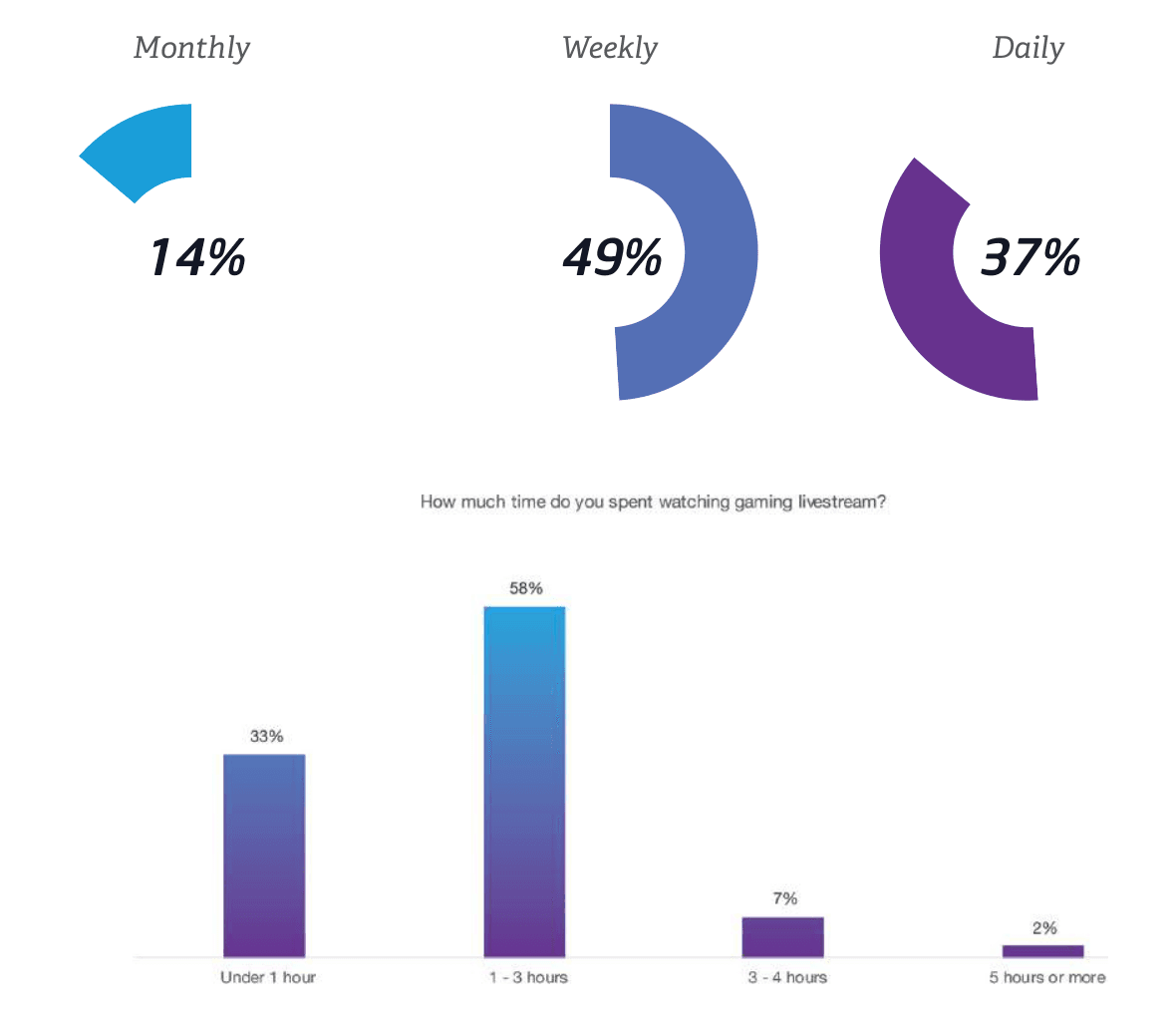
As the charts show, 86% of viewers watch livestreams at least weekly (37% daily, 49% weekly, 14% monthly). Six in 10 daily viewers watch at least 1 hour per day; overall, 58% watch 1–3 hours daily, 33% under 1 hour, 7% for 3–4 hours, and 2% for 5+ hours.
| Audience Survey Metric (n = 1,500, Dec 2018) | Recorded Share | Strategic Implication for Publishers & Brands |
|---|---|---|
| Gender & Geography | 94% male; Hanoi 42%, HCMC 25% | Reaches all 63/63 provinces and cities nationwide |
| Age & Income Status | 60% aged 19–24; 58% have monthly income | Gen Z (ages 13–24) represents 83% in prose (85% in graphic) |
| Primary Viewing Device | 61% smartphone vs. 39% PC | Rises to 71% smartphone preference among ages 13–18 (major-city smartphone penetration at 72%) |
| Non-Player Viewership | 52% watch games they don't play | Fans watch for creator personality and humor, not only gameplay tips |
| All-Ages Prime Hours | 18–22h: 55%; 22h–2h: 55% | Other windows: 10–14h (13%), 14–18h (13%), 6–10h (6%), 2–6h (5%) |
| Ages 19–24 Viewing Hours | 22h–2h: 64%; 18–22h: 50% | Peaks late at night; 14–18h (13%), 10–14h (10%), 2–6h (6%), 6–10h (6%) |
| Ages 13–18 Viewing Hours | 18–22h: 68%; 22h–2h: 35% | Earlier evening peak plus a midday spike at 10–14h (21%); 14–18h (15%) |
| Content Preferences | 41% like gaming & life stories; 71% funny content | 36% more gaming, 20% more life story; 24% both funny and technique, 6% pure technique |
| 30-Day Streamer Donations | 35% donated (65% did not) | Strong conversion into paying supporters for creators and events |
Two behavioral findings directly inform campaign targeting:
- Over half of viewers (52%) watch games they do not play themselves. Viewers prioritize funny, entertaining streams (71%) and streamer life stories (41% enjoy both) over pure gaming technique (6%).
- Prime viewing hours split sharply by age cohort. While 18:00–02:00 is prime time overall (55%), young adults aged 19–24 peak at 22h–2h (64%), whereas teens aged 13–18 peak at 18h–22h (68%) with a secondary midday peak at 10h–14h (21%).
Which six obstacles and four growth drivers shape Vietnam's esports future?
Section 04 outlines four growth drivers from 2019 onward:
- Rising viewership and national TV coverage: Players are projected to hit 26 million and weekly viewers 16 million, supported by mainstream TV coverage of international appearances.
- Livestreaming maturing into a profession: Investments from Facebook Gaming, CubeTV, NimoTV, and talent agencies formalize creator careers.
- Mobile esports taking the lead: Smartphone dominance (61% mobile viewing) and flagship mobile releases from the top 4 publishers drive market expansion.
- Vietnam hosting major international tournaments: In 2019, Vietnam hosted the League of Legends Mid-Season Invitational (MSI 2019) and Arena of Valor World Cup (AWC 2019), welcomed global organizer ESL (Apex Legends), and competed across six official medal titles at the 2019 SEA Games in the Philippines (Dota 2, StarCraft II, Mobile Legends, Arena of Valor, Tekken 7).
The Guidebook also diagnoses six structural obstacles:
- Incomplete ecosystem and few long-running community leagues (Obstacle 01): Limited organizers, talent agencies, and grassroots leagues widen international skill gaps in Dota 2, StarCraft, Hearthstone, and FIFA, alongside a lack of platforms like Skillz or Faceit.
- Insufficient funding (Obstacle 02): Outside well-funded ecosystems like Garena and Vietnam eSports, organizers lack capital to scale leagues, whereas Malaysia's Youth and Sports Minister Syed Saddiq pledged USD 2 million in public esports investment.
- Unprofessional team management (Obstacle 03): Beyond clubs like EVOS eSports and GAM eSports, most teams are player-run without managers, coaches, analysts, or gaming houses.
- Scattered tournament development (Obstacle 04): Publishers run isolated leagues without cross-industry coordination for a unified national multi-title event.
- Lack of official sports recognition (Obstacle 05): Although VIRESA formed in 2009 as an IeSF member, policy and funding support lagged behind South Korea's KeSPA (founded in 2000, managing 25 titles), Malaysia, and the Philippines.
- Social stigma equating gaming with addiction (Obstacle 06): Parental skepticism deters aspiring pros, requiring continued positive coverage on national television.
How should publishers and brands act on this foundational baseline?
Translating the 2019 Guidebook into current Vietnam operations, publishers and brands should prioritize three actions:
- Secure local game licensing and structured league operations. Only locally licensed titles sustain long-term leagues and sponsor confidence. Foreign studios entering Vietnam today must complete G1–G4 licensing under Decree 147/2024/ND-CP (effective December 25, 2024) via our six-stage guide to mobile game publishing in Vietnam.
- Pair tournament sponsorships with entertainment-led creator campaigns by age slot. With 52% watching non-played games and 71% preferring humor, brands should apply our framework for choosing and combining KOLs and KOCs: target 18:00–22:00 and 10:00–14:00 for ages 13–18, and 22:00–02:00 for income-earning 19–24-year-olds (58%).
- Optimize mobile broadcasts and payment checkouts. Because 61% watch on smartphones and 35% donate within 30 days, stream overlays and payment flows must be mobile-first. Explore further sector research in our Gaming industry insights hub.
Complete the download form on this page to receive the full 86-page PDF produced by Appota Esports and OTA Network, including profiles of 34 pro teams, 17 media and broadcast channels, 10 event organizers, and all survey charts.
Sources
- Vietnam Esports Guidebook 2019 (Cẩm nang Thể thao điện tử Việt Nam 2019), Appota Esports & OTA Network, 2019-03-01, accessed 2026-11-02
- Vietnam Esports Guidebook 2019 by Appota Esports (SlideShare Edition), Appota Esports, 2019-03-01, accessed 2026-11-02
- Global Games Market Report 2018 & Southeast Asia Games Market Benchmarks, Newzoo, 2018-04-30, accessed 2026-11-02
- e-Conomy SEA 2018: Southeast Asia's Internet Economy Hits an Inflection Point, Google & Temasek, 2018-11-19, accessed 2026-11-02
- GSMA Mobile Connectivity Index 2018 — Vietnam Country Score, GSMA, 2018-07-01, accessed 2026-11-02
- Nghị định 147/2024/NĐ-CP về quản lý, cung cấp, sử dụng dịch vụ Internet và thông tin trên mạng, Chính phủ, 2024-11-09, accessed 2026-11-02