
COVID-19 Crisis: Business Impact, Consumer Shifts, and Recovery in Vietnam
Adsota's May 2020 report on COVID-19 recovery in Vietnam examines enterprise liquidity pressure, homebound consumption shifts, and brand adaptation frameworks. Surveys show 89% of Vietnamese businesses projected 2020 revenue declines (Statista), while 64% of consumers plan to sustain online delivery and 63% intend to keep shopping online after lockdowns end (Nielsen).
An executive analysis of revenue shocks across 89% of Vietnamese businesses, homebound digital consumption shifts, and a three-phase brand recovery roadmap from Adsota.
Key findings
- 89% of businessesShare of surveyed enterprises in Vietnam projecting 2020 revenue declines following the COVID-19 outbreak, including 25% expecting drops of 16–20% and 25% facing losses above 20% (Statista, 2020).
- 60.2% & 26.2%Share of Vietnamese enterprises expecting revenue drops exceeding 50% (60.2%) and facing bankruptcy risk (26.2%) if the pandemic lasted beyond six months (Vietnam Board of Private Economic Development, 2020).
- +794% & +624%Surge in consumer demand for hand washes during the initial outbreak (+794%, Kantar Worldpanel) alongside March 2020 e-commerce search growth for remote-work webcams (+624%, iPrice).
- +20% & +12%Year-on-year 2020 consumer expenditure growth in Vietnam for online shopping (+20%) and delivery services (+12%), contrasting with declines in communication (-21%) and dining out / entertainment (-19%) (Statista, 2020).
- 119.2M viewsTotal Facebook Gaming livestream views recorded in Vietnam within nearly half a month of April 2020 social distancing, up 81.37% alongside a 79.6% jump in reach and nearly 50% higher engagement (Adsota & OTA Network, 2020).
- 64% & 63%Share of Vietnamese consumers expecting to keep using online delivery services (64%) and e-commerce platforms (63%) frequently post-pandemic, alongside 62% eating at home more and 38% increasing online banking / fintech usage (Nielsen, 2020).
- 66-day habit cycleAverage repetition period required for a new behavior to solidify into an automatic habit according to research in the British Journal of General Practice (2012), anchoring lasting digital routines in the new normal.
What financial shock across 89% of enterprises shapes COVID-19 recovery in Vietnam?
Planning for COVID-19 recovery in Vietnam begins with understanding the acute liquidity squeeze that hit domestic firms in early 2020. According to a 2020 Statista survey cited in Adsota's report, 89% of surveyed businesses in Vietnam expected full-year 2020 revenue declines. Travel restrictions, crowd bans, and freight bottlenecks triggered a simultaneous drop in non-essential demand.
Half of all surveyed enterprises projected revenue contractions of 16% or worse. One-quarter braced for losses exceeding 20%, whereas only 7% anticipated modest 1–5% growth.
Six-month stress scenarios and the crisis-planning gap among Vietnamese SMEs
Balance-sheet pressure intensifies sharply under a six-month pandemic scenario tracked by the Vietnam Board of Private Economic Development (Board IV, 2020). Comparing short-term revenue expectations against Board IV's extended stress test highlights cash-flow fragility:
| Vietnam Enterprise Survey Scenario (2020) | Revenue Change & Solvency Bracket | Share | Source |
|---|---|---|---|
| Expected 2020 revenue change | Decrease >20% / 16–20% / 11–15% | 25% / 25% / 14% | Statista |
| Expected 2020 revenue change | Decrease 6–10% / Decrease 1–5% | 19% / 6% | Statista |
| Expected 2020 revenue change | No impact / Increase 1–5% | 4% / 7% | Statista |
| Outbreak lasting over 6 months | Decrease >50% / 20–50% / <20% | 60.2% / 28.8% / 9.2% | Board IV |
| Outbreak lasting over 6 months | Positive growth (domestic supplies) | 1.8% | Board IV |
| Solvency if outbreak >6 months | Bankruptcy risk / Not at risk | 26.2% / 73.8% | Board IV |
Under a six-month outbreak, more than one-quarter of Vietnamese enterprises faced bankruptcy risk as revenues failed to cover payroll, loan interest, and commercial rent. Growth remained confined to domestic materials and essential-supply producers.
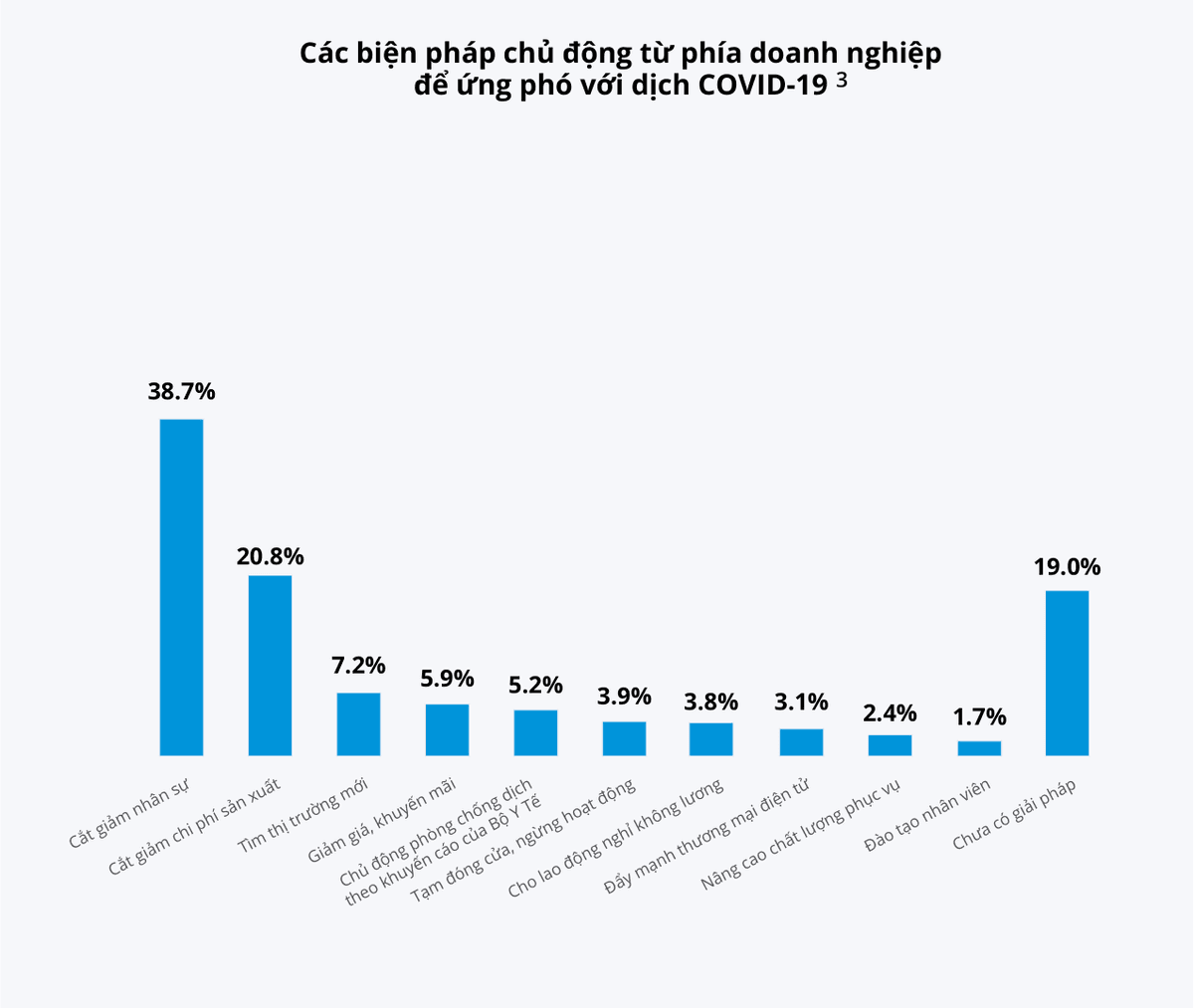
Corporate responses expose a wide gap between defensive cost-cutting and business-model transformation. In Board IV's survey (page 7), 38.7% of firms cut headcount and 20.8% trimmed production costs. Far fewer sought new markets (7.2%), offered discounts (5.9%), applied Ministry of Health prevention guidelines (5.2%), closed temporarily (3.9%), or placed staff on unpaid leave (3.8%).
Treating layoffs as a standalone survival strategy leaves companies exposed. Nearly one in five firms (19.0%) lacked any response plan, while just 3.1% expanded e-commerce, 2.4% upgraded service quality, and 1.7% invested in staff training.
To bridge liquidity gaps, Board IV's policy survey (page 8) shows firms urged the Government to prioritize tax cuts and deferrals (42.9%), preferential loans (41.2%), and interest-rate cuts with debt rescheduling (29.2%). Demand stimulus (5.4%), raw-material customs clearance (3.7%), morale updates (2.8%), and utility discounts (1.6%) ranked much lower.
Regional contagion across East and Southeast Asia and seven-sector polarization
Vietnam's slowdown mirrored supply-chain disruption across Asia. A 2020 survey by The Economist Intelligence Unit (EIU) covering Southeast Asia and East Asia (Japan, China, South Korea) on page 9 found 61.18% of firms suffered strongly negative impacts and 21.18% somewhat negative effects, versus 2.94% reporting no impact and 14.71% recording positive momentum.
More than half of surveyed regional firms downgraded 2020 revenue targets—35.12% certainly downgrading and 18.45% likely downgrading, versus 46.43% unchanged. Across Asia, EIU grouped industry performance into two poles:
- Four hardest-hit sectors: tourism stalled under quarantine rules; logistics faced delivery bottlenecks and courier shortages; manufacturing halted during February–March 2020 factory shutdowns; and luxury goods slumped.
- Three resilient growth sectors: pharmaceuticals and medical hygiene items surged; e-commerce replaced store visits for essentials; and online entertainment (game livestreaming, multiplayer mobile games, video-on-demand) captured rising indoor screen time among Gen Z and Millennials.
Why did hygiene and stockpiling products surge up to 794% while overall sector spending still contracted?
Analysts reviewing early-2020 retail numbers often conflate panic buying in specific hygiene items with net expansion across consumer goods. Pairing Kantar Worldpanel Division Vietnam and Nielsen trackers with Statista's full-sector expenditure data separates pantry loading from broader wallet contraction.
During the initial outbreak peak, 2020 tracking by Kantar Worldpanel and Nielsen (page 12) recorded triple-digit spikes in hygiene and shelf-stable staples alongside sharp beverage drops:
| Pandemic Role | Product Category | Growth | Paired Category | Growth |
|---|---|---|---|---|
| Sanitization | Hand washes | +794% | Liquid washes | +121% |
| Oral & facial care | Mouthwash | +78% | Facial cleanser | +74% |
| Paper & floor care | Paper towel / Bar soap | +35% / +35% | Household cleaner | +24% |
| Shelf-stable meals | Canned food | +121% | Processed food | +74% |
| Dry staples | Instant noodles / Packaged bread | +65% / +59% | Sugar / Cooking oil | +35% / +35% |
| Nutritional dairy | Drinking yogurt | +36% | Adult / Infant milk powder | +33% / +14% |
| Social beverages | Soft drinks | -19% | Beer | -24% |
Infection fears pushed hand-wash purchases up nearly eightfold, while restaurant closures and canceled gatherings drove beer and soft-drink sales sharply lower.
Urban versus rural FMCG stockpiling and net 2020 expenditure contraction
Kantar Worldpanel's 2020 geographic breakdown (page 13) shows stockpiling extended well beyond major cities. Urban households led growth in personal care (+29% versus +18.9% rural) and packaged food (+26.2% versus +4.6% rural). Conversely, rural households outpaced cities in dairy (+16.6% versus +10.0%) and household products (+15.1% versus +11.4%).
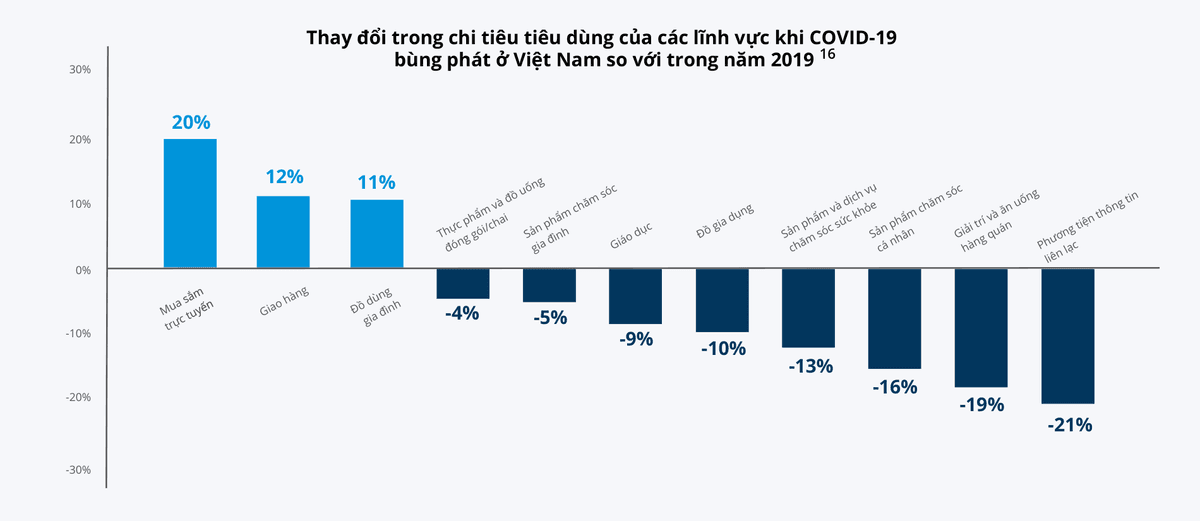
Despite heavy subcategory stockpiling, Statista's 2020 versus 2019 expenditure comparison (page 16) confirms net spending fell in eight of eleven sectors. Only online shopping (+20%), delivery services (+12%), and household utilities (+11%) posted positive full-year growth.
All remaining categories contracted: communication (-21%), entertainment and dining out (-19%), personal care (-16%), healthcare products and services (-13%), home appliances (-10%), education (-9%), household care (-5%), and packaged food and beverage (-4%). Households prioritized urgent staples while cutting discretionary items within those same sectors.
Kantar Worldpanel's budget-intent survey (page 17) reinforces this three-tier hierarchy:
- Increased spend: health and nutrition (73%), personal hygiene (68%), home cleaning (63%), dairy (47%), and fresh meat and seafood (44%).
- Unchanged spend: hair care (58%), dishwashing (53%), makeup (50%), laundry (50%), and skin care (44%).
- Reduced spend: 52% cut luxury purchases and 50% reduced alcohol spending.
How did homebound living accelerate streaming, remote-work tools, and Facebook Gaming livestreams?
Movement restrictions shifted leisure, shopping, and office routines indoors at once. Combined 2020 data from Kantar Worldpanel and Q&Me (pages 18–19) quantifies the rise of indoor digital touchpoints against falling outdoor footfall:
| Daily Activity in Vietnam (2020) | Do More | Same | Do Less | Channel Shift |
|---|---|---|---|---|
| At-home streaming | 69% | 21% | 10% | Video, music, and game streams lead leisure |
| Food delivery | 59% | 25% | 16% | Replaces dine-in meals during lockdown |
| E-commerce shopping | 57% | 24% | 19% | Core channel for groceries and home gear |
| Internet browsing | 49% | 36% | 15% | Lengthens daily social and news exposure |
| Gaming (mobile-led) | 36% | 16% | 48% | Active players increase session duration |
| Outdoor entertainment | 14% (combined) | — | 86% | Cinemas and live events pause operations |
| Eating out | 17% (combined) | — | 83% | Pushes F&B toward delivery kitchens |
| Non-daily shopping | 19% (combined) | — | 81% | Apparel and luxury purchases deferred |
| Outdoor / gym fitness | 28% (combined) | — | 72% | Workouts move to home apps and videos |
| Physical store visits | 52% (combined) | — | 48% | Older shoppers continue nearby store trips |
Although over 80% cut outdoor entertainment and dining out, physical store visits dropped among only 48% of respondents. Older consumers unfamiliar with e-commerce continued buying essentials at neighborhood outlets.
Work-from-home hardware searches, collaboration apps, and April 2020 download leaders
Remote work and school closures sparked immediate demand for home equipment and collaboration software. Google Trends (page 20) shows Vietnamese search peaks around March 22, 2020 for "delivery" and April 1, 2020 for "online shopping" and "e-learning," alongside queries for printers, laptops, keyboards, and air fryers.
March 2020 e-commerce marketplace searches from iPrice confirm this surge: webcams jumped 624%, PC keyboards rose 264%, workout gear climbed 116%, kids' toys grew 30–200%, kitchenware gained 50–80%, and Nintendo Switch consoles rose 56%.
In remote collaboration, Q&Me's 2020 survey (page 21) identifies clear usage leaders:
- Video calls: Skype led at +53%, ahead of Zoom (+33%), Google Hangouts (+19%), and Microsoft Teams (+18%).
- Work messaging: Zalo jumped +83%, followed by Messenger (+46%), Skype (+35%), and Viber (+18%).
App Annie's April 20, 2020 free app rankings in Vietnam (page 22) mirror these shifts. App Store downloads were led by Call of Duty: Mobile VN, ZOOM Cloud Meetings, TikTok, Microsoft Teams, Save The Girl!, Messenger, Facebook, Zalo, 1.1.1.1, and YouTube; Google Play was topped by ZOOM, Save The Girl!, Microsoft Teams, TikTok, Sonic Cat, Câu đố vẽ, Garena Free Fire, Zalo, Messenger, and Brain Out.
The 119.2 million-view gaming livestream surge and four sticky post-pandemic habits
Gaming livestreams captured standout engagement during early-April 2020 social distancing. Tracking across nearly half a month in Vietnam by OTA Network / Adsota (page 23) recorded an 81.37% jump in Facebook Gaming views to 119.2 million, alongside +79.6% reach and nearly +50% engagement.
Local momentum matched global Q1 2020 benchmarks from Streamlabs and Stream Hatchet (page 29). YouTube Gaming Live average concurrent viewers (CCV) rose 15.5% quarter-on-quarter, while Facebook Gaming hours watched tripled, hours streamed doubled, and average CCV quadrupled—alongside TikTok hitting 2 million global downloads during the week of March 16, 2020 (+18% week-on-week, Tinuiti).
Crucially for strategists, Nielsen's 2020 post-COVID study (page 24) shows convenience habits outlast quarantine. In Vietnam, 64% plan to sustain frequent online delivery, 63% will keep shopping online regularly, 62% expect to dine at home more, and 38% plan to use online banking and fintech apps more often. Industry playbooks addressing these shifts appear in Adsota's report on retail and e-commerce adaptation during COVID-19 and its study on online delivery and F&B marketing strategy in Vietnam.
How do the 66-day habit threshold and three-phase recovery matrix guide brand adaptation?
Section 3 (pages 25–33) explains why quarantine routines solidify into lasting consumer norms. Research in the British Journal of General Practice (2012) paired with Canvas8's Pandemic Culture (2020) report on page 32 shows a repeated behavior takes 66 days on average to become an automatic habit. As precautions extended across months without a vaccine, five lifestyle trends took root in Vietnam:
- E-commerce and "mart assistant" grocery delivery: supermarkets and apps including Grab, VinID, Be, and Now launched proxy grocery shopping for contactless fulfillment.
- At-home physical training: workout apps and Plank challenges drove a 25% rise in Google Search traffic for home exercise during late April 2020.
- Million-member home cooking groups: reduced dining out fueled recipe sharing, pushing the Yêu Bếp (Esheep Kitchen family) community past 1 million members.
- Home cleaning and interior decoration: extended indoor hours boosted home-decor demand and communities such as Nghiện Nhà.
- Sustainable consumption: shoppers favored organic foods, environmental protection, and durable essentials over fast fashion.
Commenting on page 33, Mr. Nguyen Thanh Nam (Founder of FUNiX Online University, FPT Education) emphasized that firms need not copy offline workflows verbatim online; instead, brands should harness native digital conveniences that elevate customer experience post-pandemic. Mr. Nguyen Dinh Thanh (Co-founder and Managing Director, Elite PR School) added that recurring outbreaks remain possible before vaccines mature, requiring permanent crisis readiness.
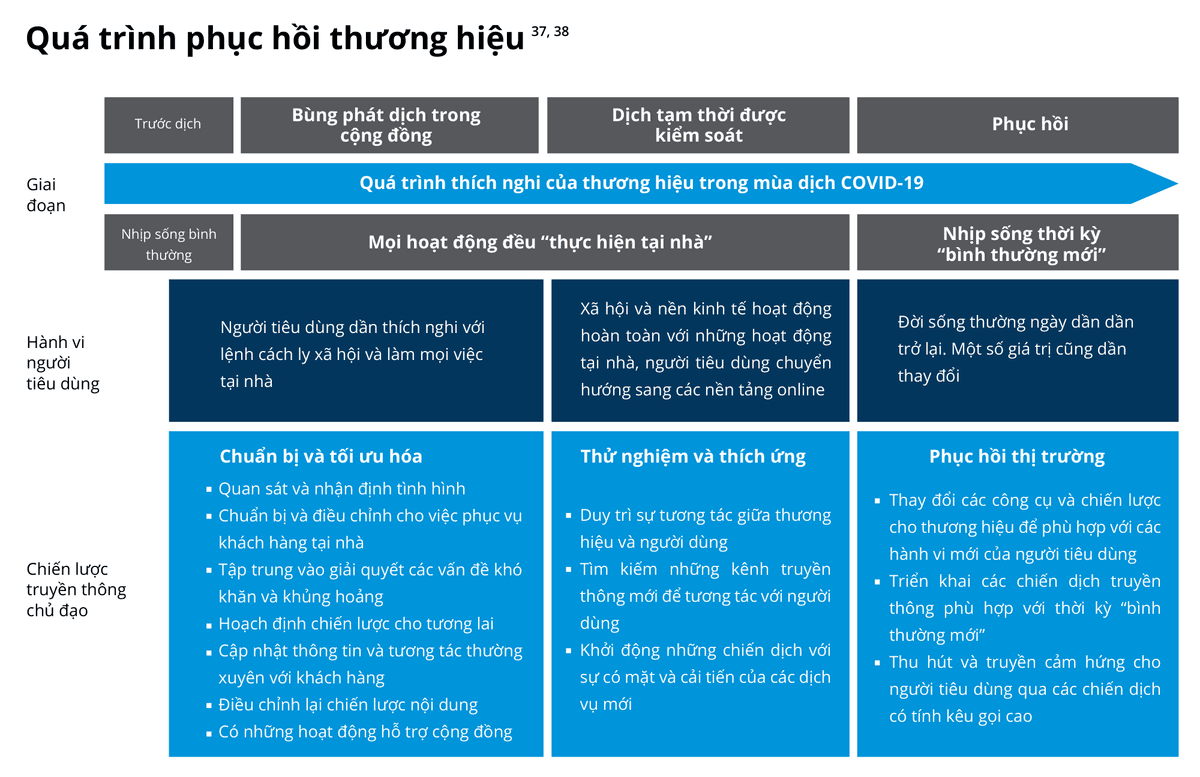
To sequence execution systematically, page 30 synthesizes a three-phase recovery matrix from Sinclair (2020) and Fraser (2020):
| Pandemic Phase | Customer Behavior | Brand Communication Focus |
|---|---|---|
| 1. Community Outbreak | Shift into homebound living and social-distancing routines | Preparation & optimization: adapt fulfillment for homebound buyers, manage crisis scenarios, adjust content, and support the community |
| 2. Containment | Homebound economy anchored in e-commerce and nearby stores | Instant adaptation: sustain digital engagement, test alternative online channels, and launch adapted service campaigns |
| 3. Recovery | Daily life resumes under a "new normal" with shifted value priorities | Market revival: refresh buyer personas and positioning, run "new normal" media plans, and deploy strong call-to-action campaigns |
Top 8 operational checklist for brands and the guardrail against quality erosion
Translating this matrix into operations, Kantar Worldpanel Division Vietnam (page 31) outlines eight brand priorities:
- Invest in online ordering and home delivery, reducing reliance on physical footfall.
- Expand digital presence and O2O (online-to-offline) integration to accelerate digital transformation.
- Stay connected via helpful digital content, extending brand positioning into everyday utility.
- Capture new in-home usage occasions with household-tailored bundles.
- Maintain product accessibility, visibility, and stock availability across active channels.
- Prepare supply capacity for sharp post-lockdown demand rebounds.
- Optimize costs without cutting product quality or customer experience to protect long-term brand trust.
- Dial back hard-sell promotions during acute outbreak stress in favor of meaningful customer value.
How should brands reallocate media budgets to capture pent-up demand after lockdowns?
The closing section (pages 34–37) quantifies pent-up demand once restrictions ease while spotlighting cost efficiency in biddable media. Ogilvy's 2020 survey (page 34) shows suppressed outdoor activities top consumers' post-lockdown priorities:
| Desired Post-COVID Activity (Ogilvy, 2020) | Share | Readiness Implication |
|---|---|---|
| Eat out with friends at city restaurants | 51.2% | F&B chains need digital visibility ahead of group-dining rebounds |
| Travel | 46.5% | Hospitality brands should offer flexible domestic packages |
| Watch movies or exhibitions | 43.8% | Venues should pair online ticketing with hygiene assurance |
| Sports and outdoor fitness | 32.4% | Gyms can bridge home workout apps with club reopenings |
| Go shopping | 23.4% | Retailers can use O2O vouchers to rebuild store footfall |
| Offline games / Stay home / Others | 7.0% / 6.7% / 5.7% | Pure stay-home preference eases while digital habits persist |
Mindshare's 2020 survey (page 34) confirms this rebound order, led by dining out, travel, outdoor entertainment, food and beverage, apparel, and household cleaning, followed by hair salons, gyms, stocks, and cosmetics. Going dark during containment sacrifices brand recall right before pent-up spending unlocks.
Four post-outbreak media opportunities for marketing leaders
Analysis from Ogilvy Social.Lab and OTA Network (pages 35–37) contrasts shrinking offline placements (transit ads, billboards, cinemas) against surging digital video, short-video apps, mobile gaming, and e-commerce platforms. Guided by three ROI-optimization principles, marketers should act on four levers:
- Leverage lower auction competition on Facebook and Google ads. Reduced bidder density lets automated ad auctions deliver cost-efficient reach; teams should audit their media mix and fund the highest-ROI combinations.
- Anchor brand dialogue on high-attention social feeds. Since the WHO declared a pandemic, Facebook, Instagram, and TikTok have captured sustained news and entertainment screen time.
- Deploy interactive integrations across Gaming and Live Streaming. Twitch, YouTube Gaming, and Facebook Gaming enable real-time two-way engagement far beyond static display banners.
- Combine Social Commerce with structured Influencer Marketing. Pairing creator product reviews with livestream checkout shortens conversion funnels across marketplaces and owned webstores. Marketers can apply Appota's framework for selecting and combining KOLs and KOCs by campaign goal and explore ongoing benchmarks on the marketing and creator economy topic hub.
This executive synthesis consolidates verified survey data and phased recovery frameworks from Vietnam's initial pandemic turning point. Readers can complete the form on this page to download the full 38-page PDF report compiled by Adsota with all original charts and matrices.
Sources
- Khủng hoảng COVID-19: Tác động và tiềm năng phục hồi (COVID-19 Crisis: Impact and Recovery), Công ty Cổ phần Adsota Việt Nam, 2020-05-12, accessed 2026-10-31
- Expected change in revenues after coronavirus COVID-19 outbreak among businesses in Vietnam in 2020 & Change in consumption expenditure by sector, Statista, 2020-04-01, accessed 2026-10-31
- Báo cáo đánh giá tác động của dịch COVID-19 đến hoạt động sản xuất, kinh doanh của doanh nghiệp Việt Nam (Effects of COVID-19 on Operation and Business Activities of Vietnamese Enterprises Report), Ban Nghiên cứu Phát triển Kinh tế tư nhân (Ban IV), 2020-03-10, accessed 2026-10-31
- Coronavirus outbreak — economic & business implications, The Economist Intelligence Unit (EIU), 2020-03-20, accessed 2026-10-31
- COVID-19 Initial Impacts on Vietnam FMCG In-home Purchases 2020 & Vietnam COVID-19 Impacts: From Consumers' Thinking to Behaving, Kantar Worldpanel Division Vietnam, 2020-04-01, accessed 2026-10-31
- Impact of COVID-19 on Vietnam Consumer Behaviour Report & Hậu COVID-19: Sẵn sàng cho một cuộc sống mới, Nielsen Vietnam, 2020-04-15, accessed 2026-10-31
- Corona Virus Impact on Vietnamese Behaviours Report & Remote Work Satisfaction By Social Distancing Report, Q&Me (Asia Plus Inc.), 2020-04-10, accessed 2026-10-31
- 6 mặt hàng đang bán chạy trong mùa dịch & Google Realtime Search Trends Vietnam, iPrice Group & Google Trends, 2020-04-03, accessed 2026-10-31
- App Store & Google Play Free Download Ranking Vietnam (20/04/2020) & Dữ liệu Facebook Gaming Livestream tháng 4/2020, App Annie & OTA Network (Appota), 2020-04-20, accessed 2026-10-31
- Streamlabs & Stream Hatchet Q1 2020 Live Streaming Industry Report & The Rise of TikTok During COVID-19, Streamlabs & Stream Hatchet; Tinuiti (Tara Johnson), 2020-04-02, accessed 2026-10-31
- Making Brands Matter in Turbulent Times & Making Communication Choices in COVID-19; Survey on Change of Media Consumption, Ogilvy, Ogilvy Social.Lab, Mindshare, Sinclair & Fraser, 2020-04-01, accessed 2026-10-31
- Making health habitual: the psychology of 'habit-formation' and general practice, British Journal of General Practice & Canvas8, 2012-12-01, accessed 2026-10-31