E-Magazine 02: Adapting to COVID-19 — Online Delivery and F&B Marketing in Vietnam
Adsota's E-Magazine 02 report on F&B marketing in Vietnam examines pandemic consumer shifts, online food delivery channels, cloud kitchen operations, and creator livestream strategies. Across surveyed Vietnamese consumers, 62% eat at home more frequently (Nielsen, March 2020), while 92% have ordered through food delivery apps and 78% rely on them most often (Q&Me, April 2020).
An executive analysis of 92% food delivery app adoption, 62% home-dining shifts, cloud kitchen models, and creator livestream frameworks for F&B brands from Adsota.
Key findings
- 62% & 33%Share of Vietnamese consumers eating at home more often (62%) and ordering online food delivery more frequently (33%) than before COVID-19 according to Nielsen's March 2020 Asia survey; 62% also expected to keep dining at home post-pandemic.
- 92% & 78%Share of surveyed Vietnamese users who have ordered via food delivery apps (92%) and rely on them as their primary ordering channel (78%), far ahead of brand-owned apps (37% and 5%), phone calls (36% and 8%), and social media (34% and 9%) per Q&Me (April 2020).
- +50% & +30%Delivery revenue surge recorded by Starbucks Vietnam in late March 2020 versus its monthly average (+50%), alongside The Coffee House's week-on-week app delivery revenue growth as of March 29, 2020 (+30%) cited via CafeF.
- 26.2%Proportion of surveyed businesses facing bankruptcy risk if pandemic disruptions lasted beyond 6 months in Adsota's 1,200-enterprise report COVID-19 Crisis: Impact and Recovery, with F&B among the earliest-hit sectors.
- +11%, +42% & +66%Quarter-on-quarter growth in total hours streamed on Facebook Gaming in Q1 2020 (+11%), accompanied by April 2020 gains in audience engagement (+42%) and target-customer reach (+66%) according to Streamlabs & Stream Hatchet.
- 1.1M+ membersMembership scale of Vietnam's Yeu Bep home-cooking Facebook group in April 2020 (1,102,054 members), alongside Ghet Bep, Khong Nghien Nha (1,002,750 members) and Nghien Nha (833,358 members), reshaping Food Blogger content.
- 1M+ viewsViewership of McDonald's 24-hour Bilibili livestream distributing 100,000 promotional coupons in China, alongside Chipotle's #GuacDance TikTok challenge generating over 250,000 videos and over 802,000 guacamole servings sold in one day.
How did social distancing disrupt restaurant operations and reshape Asian dining habits?
Operations and F&B marketing in Vietnam faced an immediate structural shock during the early 2020 COVID-19 lockdowns. Mandatory restrictions on public gatherings and a three-week suspension of dine-in services forced foodservice operators to rethink cost structures overnight. Issue 02 of Adsota's E-Magazine: Adapting to COVID-19 documents three primary operational pressures across F&B enterprises:
- Footprint contraction and branch closures. Restaurants located inside tourism zones suffered the sharpest revenue collapse as visitor traffic halted. Numerous independent eateries closed permanently, while major chains suspended underperforming branches to preserve cash.
- Workforce reductions and split-shift scheduling. Operators reduced daily operating hours and reorganized floor staff into smaller rotating shifts. Many businesses introduced unpaid leave days or placed portions of their service teams on indefinite furlough.
- Perishable supply chain bottlenecks. Food importers and exporters encountered customs and logistics delays. Inside restaurant kitchens, fresh ingredients risked spoilage as daily dine-in volume dropped abruptly.
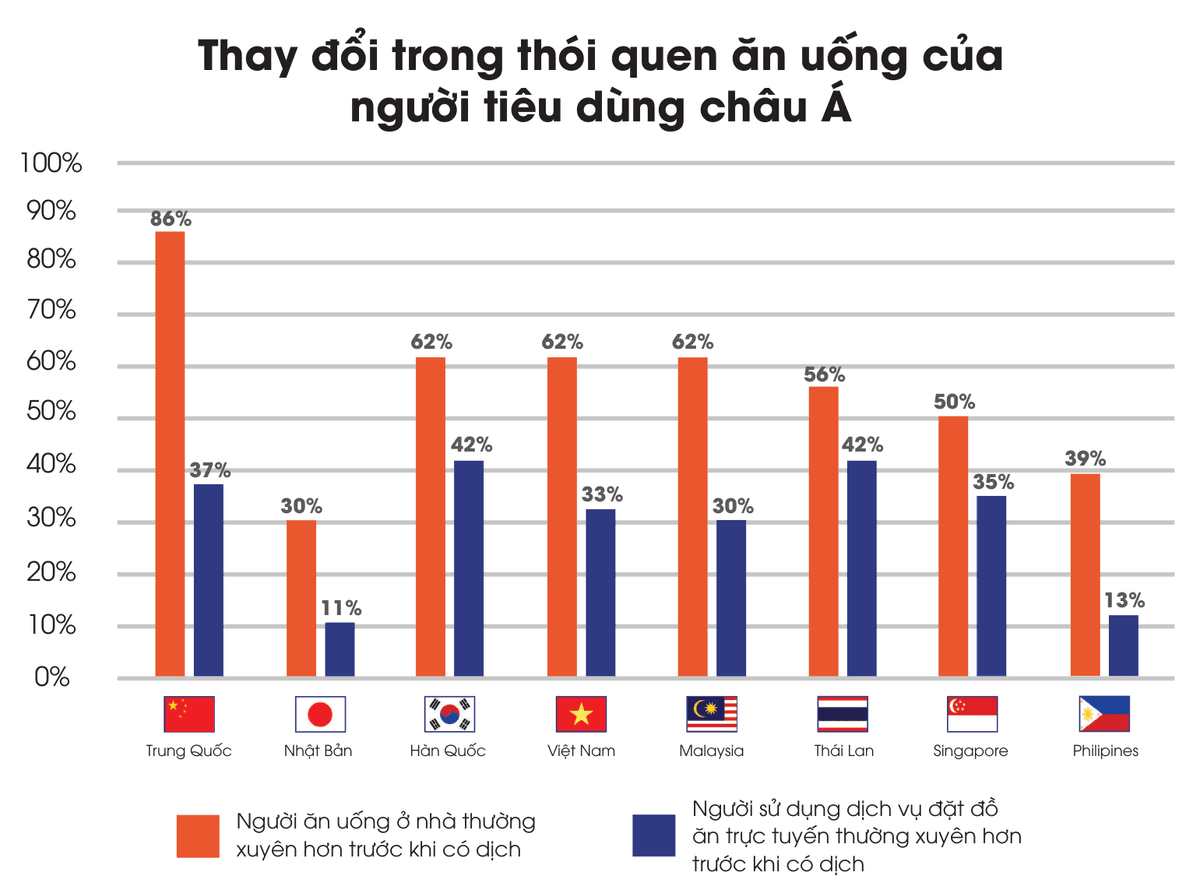
While physical dining rooms emptied, consumer eating occasions migrated rapidly into the home across Asia. Nielsen's March 2020 regional study (COVID-19: Where Consumers Are Heading?) tracked two behavioral indicators across eight Asian economies:
| Surveyed Asian Market | Eating at Home More Often Than Pre-COVID | Ordering Online Food Delivery More Often | Defining Behavioral Pattern |
|---|---|---|---|
| China | 86% | 37% | Highest shift toward home dining across all eight surveyed Asian markets |
| South Korea | 62% | 42% | Tied for the highest regional increase in online food delivery frequency |
| Vietnam | 62% | 33% | Nearly two-thirds cooked or ate at home more; one-third ordered online more |
| Malaysia | 62% | 30% | Matched Vietnam and South Korea in heightened home-dining frequency |
| Thailand | 56% | 42% | Tied with South Korea on accelerated online delivery adoption |
| Singapore | 50% | 35% | Balanced shift combining 50% home dining with 35% higher delivery usage |
| Philippines | 39% | 13% | Moderate delivery acceleration amid fragmented urban logistics |
| Japan | 30% | 11% | Lowest behavioral disruption across both dining indicators in the cohort |
In Vietnam, 62% of surveyed consumers ate at home more frequently than before the outbreak, while 33% increased their use of online food delivery services. Demand for prepared meals and beverages remained active, shifting away from on-premise tables toward home kitchens and doorstep delivery.
Third-party delivery apps capture 78% primary preference alongside million-member cooking groups
Among Vietnamese diners ordering food to their homes, third-party aggregator apps quickly outpaced direct restaurant channels. Q&Me's April 2020 market survey (Food Delivery Demand After COVID-19) measured both cumulative trial and primary channel preference across four ordering methods:
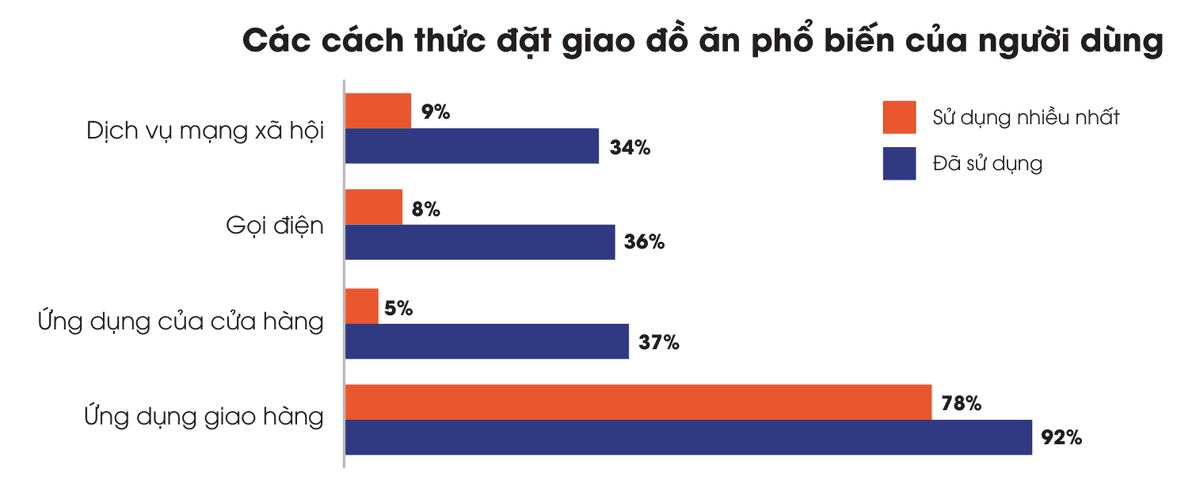
Dedicated food delivery apps dominated consumer habits, with 92% of respondents having used them and 78% naming them their most-used ordering method. By contrast, brand-owned store apps reached 37% cumulative usage but only 5% primary preference. Direct phone calls recorded 36% trial and 8% primary preference, while social media ordering captured 34% trial and 9% primary preference.
Extended time at home also sparked two grassroots cultural movements across Vietnamese social networks. First, home-cooking and lifestyle communities on Facebook expanded dramatically during April 2020. The public culinary group Yeu Bep (Esheep Kitchen family) reached 1,102,054 members, while newly launched groups Ghet Bep, Khong Nghien Nha (created April 8, 2020) and Nghien Nha (created April 4, 2020) quickly amassed 1,002,750 and 833,358 members respectively.
Second, community-backed agricultural rescue campaigns emerged to help farmers and exporters clear stranded produce and seafood such as dragon fruit, watermelon, and lobster. Local bakeries and F&B brands turned these ingredients into viral menu items — including dragon fruit bread, dragon fruit burgers, dragon fruit pizza, and watermelon rice noodles — earning strong organic goodwill from Vietnamese consumers.
How did major F&B chains pivot online and where do cloud kitchens fit?
Confronted with dine-in closures during early 2020, even large restaurant groups that historically protected on-premise exclusivity moved decisively into home delivery. Market reporting cited from CafeF (April 2020) illustrates how three prominent F&B operators in Vietnam restructured their service models:
| F&B Chain | Pre-Pandemic Channel Stance | Pandemic Product & Delivery Pivot | Verified Operational Outcome |
|---|---|---|---|
| Golden Gate | Declined online delivery for upscale table-grill and hotpot concepts (GoGi, Hutong, Manwah) | Launched G-Delivery and I-cook delivering signature BBQ/hotpot combos and ready-to-cook items; loaned tabletop grills and hotpots free of charge | Unlocked at-home revenue for experiential dining concepts previously tied 100% to physical tables |
| The Coffee House | Operated an established proprietary mobile ordering app and internal delivery fleet | Introduced free shipping on all orders from VND 50,000 upward placed through its native ecosystem | App delivery order revenue as of March 29, 2020 rose 30% over the preceding week (CafeF, 2020) |
| Starbucks Vietnam | Focused on third-place urban store experiences supplemented by aggregator delivery | Scaled delivery promotion and fulfillment when major municipalities closed non-essential premises in late March 2020 | Delivery segment revenue in late March 2020 climbed 50% above its monthly average (CafeF, 2020) |
Other established operators such as RedSun similarly accelerated investment into owned digital ordering portals. Convenient at-home access to restaurant-grade hotpot, barbecue, and specialty beverages reshaped customer expectations well beyond the lockdown window, sustaining online demand into Vietnam's hot summer season. Chains upgrading proprietary websites or ordering apps alongside super-app storefronts can apply our payment gateway integration checklist for websites and mobile apps to ensure reliable cashless checkout during peak meal hours.
Agility advantages for small F&B outlets and two operational limits of cloud kitchens
While enterprise chains leveraged brand equity, small and mid-sized F&B businesses compensated through operational speed. Because fixed street-front rent and facility overhead could not be absorbed during prolonged closures, smaller venues pivoted online immediately to limit cash burn.
Most independent cafés and eateries were already familiar with fulfilling orders via GrabFood, Now, and GoViet or taking direct messages through Facebook and Instagram. Leaner headcount allowed owners to reassign kitchen prep, adjust digital menus, and coordinate delivery handoffs faster than multi-layered corporate chains.
This delivery surge propelled the cloud kitchen model — delivery-only commercial kitchens operating without dine-in seating — into the mainstream. With lingering infection concerns keeping cautious diners away from crowded dining rooms, pairing cloud kitchens with targeted digital advertising helped operators trim rent ratios while expanding brand visibility online.
Nevertheless, the report cautions F&B founders against treating cloud kitchens as a friction-free cure-all due to two practical constraints:
- Single-use plastic packaging waste. High-volume delivery relies heavily on non-reusable plastic containers, clashing with heightened consumer scrutiny around personal health and environmental sustainability.
- Absence of on-premise hospitality. Plated presentation and attentive table service remain decisive emotional drivers of restaurant loyalty that doorstep drop-offs cannot fully replicate.
Which three creator and livestream formulas drive F&B marketing in Vietnam?
As consumers traded restaurant outings for mobile screens, social platforms became multi-generational gathering spaces rather than youth-only niches. Adsota outlines three specialized creator formulas tailored to F&B marketing in Vietnam during and after pandemic disruptions.
Reinventing Food Blogger content and avoiding mismatch traps in 24-hour livestreams
The first formula requires overhauling creative briefs for Food Bloggers. Relying on traditional dine-in restaurant reviews loses relevance when storefronts are shuttered and 62% of consumers prioritize home-cooked or healthy meals.
Million-member Facebook groups like Yeu Bep and Ghet Bep, Khong Nghien Nha demonstrate that everyday home kitchens anchor social conversation. F&B marketers partnering with Food Bloggers should shift toward step-by-step home recipes, daily healthy meal plans, and interactive cooking challenges integrating the brand's sauces, meal kits, or packaged staples. Marketing teams can apply the framework for selecting and combining KOLs and KOCs in Vietnam to match culinary creators with campaign conversion goals.
The second formula capitalizes on livestreaming, a natural extension of video-native food formats such as recipe tutorials, Mukbang, and culinary ASMR. The report examines McDonald's launch campaign for McCrispy Chicken on Chinese video platform Bilibili as China's economy began reopening. McDonald's ran a continuous 24-hour livestream featuring popular influencers, drawing over 1 million views and distributing 100,000 promotional coupons (illustrated with a USD 40 voucher graphic in the report).
Crucially, Adsota highlights an execution pitfall inside that viral headline. Although the 24-hour window was intended to let viewers claim coupons at any hour, misaligned influencer casting and repetitive programming made it difficult to sustain audience engagement across the full broadcast. F&B brands running livestreams should prioritize tight host-product fit and dynamic pacing over marathon duration alone.
Tapping gaming streamers as Facebook Gaming engagement climbs 42%
The third formula expands beyond culinary creators into gaming livestreamers (Game Streamers), who command loyal youth communities and deep experience moderating live chat for hours at a time.
According to the Streamlabs & Stream Hatchet Q1 2020 Live Streaming Industry Report cited on page 17 of the publication, total hours streamed on Facebook Gaming rose 11% quarter-on-quarter in Q1 2020 alone. In April 2020, audience engagement and target-customer reach on the platform surged by 42% and 66% respectively.
Commenting on this convergence, a representative of OTA Network — Facebook Gaming's official partner in Vietnam — noted: "2020 marks the rise of Influencers and Livestreaming, and many enterprises will bring this powerful duo into their campaigns." OTA Network emphasized that disciplined campaign planning and selecting creators who authentically fit a brand's personality remain decisive for ROI.
As a benchmark execution, the report details KFC's partnership with four Twitch gaming streamers — including prominent creator Dr.Lupo (518,000 followers at the time of the campaign) — built around the iconic PUBG victory phrase "Winner Winner Chicken Dinner". Whenever the streamers won a match round, viewers typed "winner winner" or posted a custom KFC bucket emote in Twitch chat to win a free chicken meal via a USD 20 gift card.
By pairing two streamers per broadcast to cross-pollinate fanbases, KFC kept its product woven organically throughout a five-hour stream without triggering viewer ad fatigue. Vietnamese F&B brands targeting Gen Z and Millennial diners can work with gaming-specialized creator networks such as Adsota Esports and OTA Network, and benchmark audience scale through the Vietnam Esports Whitebook by VIRESA and OTA Network.
How should F&B brands align content, short-form video, and long-term recovery strategy?
In Adsota's survey of 1,200 enterprises (COVID-19 Crisis: Impact and Recovery), 26.2% of surveyed companies reported facing potential bankruptcy if pandemic conditions persisted beyond six months. Because F&B operators absorb immediate cash-flow shocks and fierce post-lockdown competition, marketing teams must rebuild trust without overspending reduced budgets.
Chapter 4 distills three recovery pillars illustrated by three international brand responses:
| Case Study Brand | Strategic Recovery Pillar | Tactical Execution | Documented Scale & Impact |
|---|---|---|---|
| Burger King (France) | Brand storytelling and open-source home recipes | Published visual step-by-step recipes enabling fans to recreate signature burgers at home using everyday supermarket ingredients during store closures | Kept brand affinity alive inside home kitchens, earned free user-generated social posts, and primed demand for authentic in-store dining post-lockdown |
| Chipotle (United States) | Lean short-form digital video tied to app utility | Built TikTok momentum via music and memes; added a 3-level ingredient customization toggle (light – standard – extra) in its delivery app promoted via "Menu Hacks" videos (Nachos, The Extra Dip, Taco Salad) | Surpassed 549,000 TikTok followers; built on its summer 2019 #GuacDance TikTok challenge generating over 250,000 videos and over 802,000 guacamole servings sold in a single day |
| Starbucks (Global) | Long-term adaptation prioritizing loyalists and community relief | Applied early crisis lessons from its 4,300 stores in China (13% of global outlets) when reopening 90% of European stores around contactless takeaway; partnered with Feeding America | Maintained low-contact store safety while donating over 700,000 meals, 62,000 gallons of milk, and millions of free coffees across the US and Canada |
Behind-the-scenes hygiene storytelling outperforms generic taste claims
A core takeaway across these cases is that post-crisis diners scrutinize food safety far more intensely than indulgent flavor copy. Unplanned promotional posts that merely praise taste quickly induce content fatigue when public health anxiety remains high.
Instead, brands should deploy behind-the-scenes storytelling to make operational discipline visible. Showing active kitchens enforcing sanitation protocols, tamper-evident packaging routines, and candid reflections from cooks and riders reassures cautious households far more effectively than glossy studio commercials.
Evaluating the industry's digital inflection point, Tran Quoc Toan — CEO of advertising agency Adsota — observed: "COVID-19 truly pushed many F&B businesses into a corner. Yet it has also acted as an indispensable catalyst helping enterprises catch up rapidly with digital-era business and communication methods, preventing them from being caught off guard by similar disruptions in the future."
Drawing on campaign execution for Vietnamese F&B brands including Buffet Sen, Nhan Sushi, and Teddy's American Grill, Adsota notes that agile, low-production-cost creative formats distributed across TikTok, Facebook, Instagram, and YouTube consistently outperform expensive traditional ad shoots when marketing budgets tighten.
What three-stage response playbook and post-pandemic trends guide F&B leaders?
Because epidemic waves and localized restrictions can recur unexpectedly, the report urges F&B executives to institutionalize a three-stage operational playbook rather than reacting ad hoc after dining rooms close:
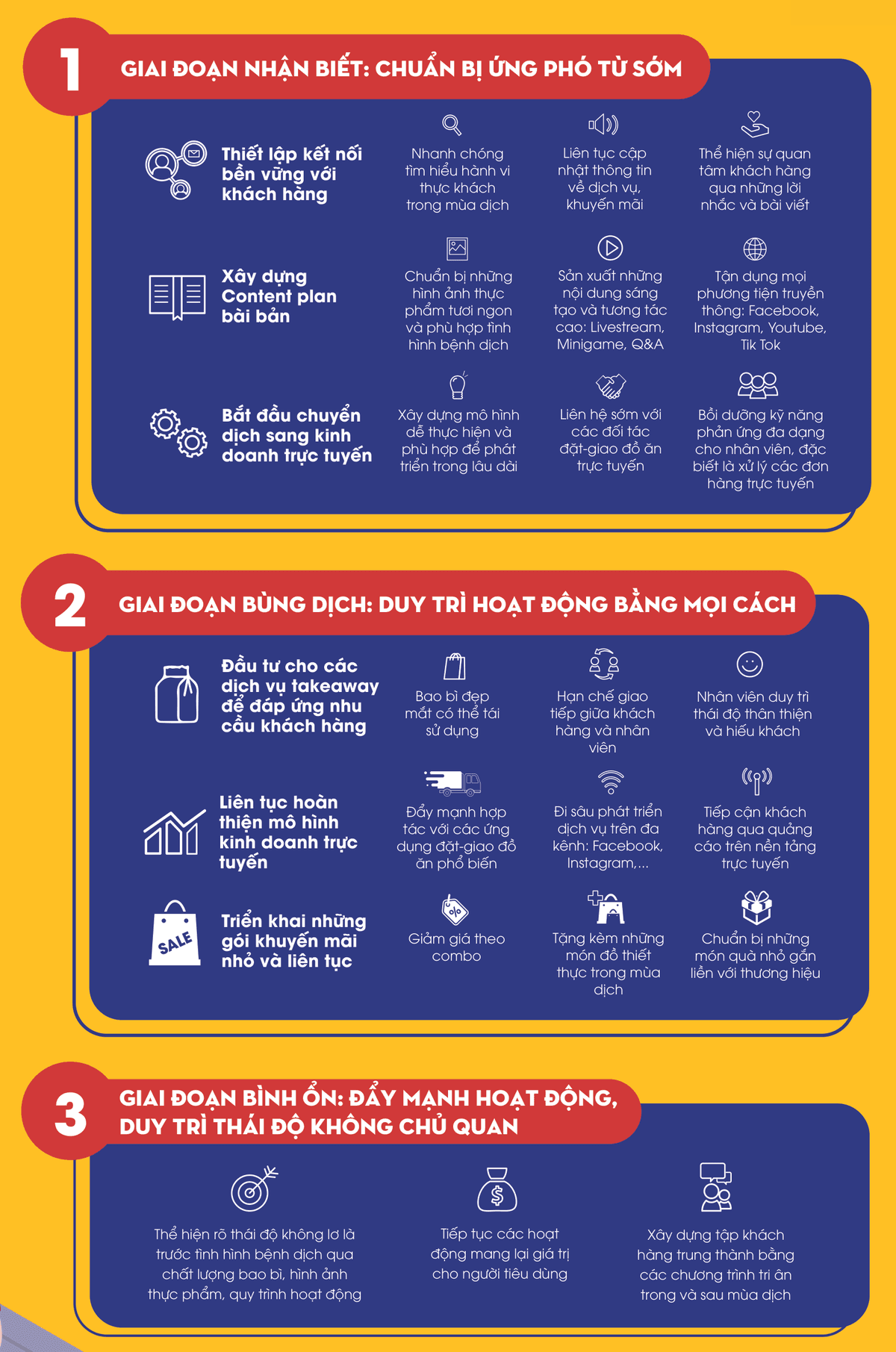
In Stage 1 (Awareness — Early Preparation), operators establish durable customer communication around service updates, build structured content calendars featuring high-interaction formats (livestreams, minigames, Q&As) across Facebook, Instagram, YouTube, and TikTok, onboard delivery app partners early, and cross-train staff to fulfill online orders.
During Stage 2 (Outbreak — Sustaining Operations), execution centers on takeaway and delivery: investing in attractive reusable packaging, minimizing physical staff-guest contact while preserving warm hospitality, running paid social acquisition, and rolling out frequent bite-sized promotions such as combo discounts, practical health-protection giveaways, and branded thank-you gifts.
In Stage 3 (Stabilization — Scaling Without Complacency), brands ramp up commercial campaigns while keeping visible hygiene standards across packaging and kitchen workflows, sustaining value-driven community content, and rewarding loyal customers who supported the venue through lockdown.
Short-term versus medium- and long-term F&B consumer and service shifts
Looking beyond immediate crisis management, Adsota maps how diner psychology and service delivery evolve across short-term recovery and medium-to-long-term market maturity:
| Market Dimension | Short-Term Trajectory | Medium- and Long-Term Trajectory |
|---|---|---|
| At-home dining habits | 62% of Vietnamese consumers choose to keep eating at home (Nielsen, 2020), stocking instant/ready-to-eat foods and cooking more often | Sustained home-dining routines anchored by health consciousness and household budget discipline |
| Food quality & brand trust | Strong preference for immunity-boosting ingredients (echoing Nielsen's Q2 2019 Vietnam health survey) and established heritage brands | Higher baseline demands across food safety, convenience, and nutrition alongside routine multi-platform purchasing |
| Ordering & retail channels | Rapid expansion of food delivery apps (GrabFood, Now, GoViet, Baemin, Be) and convenience-store grab-and-go meals | Deeper enterprise investment into owned online channels integrated directly with performance digital marketing |
| Kitchen formats & meal kits | Traditional sit-down restaurants reallocate kitchen capacity toward delivery-first cloud kitchen workflows | Lower-rent cloud kitchens attract sustained capital; small F&B brands launch pre-portioned DIY meal kits fueled by social cooking groups |
Explaining why established F&B names capture disproportionate trust during turbulent periods, Simon Moore — CEO of behavioral consultancy Innovation Bubble — noted: "During times like these, consumers struggle to open up to unfamiliar brands and instead purchase according to ingrained habits and pre-existing trust." Challenger F&B concepts must therefore work harder to prove hygiene transparency and fulfillment consistency on every order.
Translating the report's benchmarks into execution, F&B founders and marketing directors can act immediately on a five-point checklist:
- Upgrade online ordering and delivery fulfillment. Balance third-party aggregator visibility with direct social or app ordering channels, pairing multi-channel cashless collections with a daily automated payment reconciliation workflow as order volume scales.
- Institutionalize stage-ready digital marketing plans. Maintain pre-built creative assets covering kitchen hygiene storytelling, family combo offers, and rapid service updates across all three operational stages.
- Redesign menus and packaging for home consumption. Introduce immunity-conscious dishes, family sharing bundles, and DIY meal kits packaged in sturdy, reusable containers that preserve food temperature.
- Pilot home-cooking influencers and gaming livestreams. Reorient Food Blogger briefs toward home-kitchen recipes and test co-hosted gaming livestreams with clear interactive reward mechanics for younger demographics.
- Coordinate agile video distribution across Facebook, YouTube, Instagram, and TikTok. Use low-cost short-form video, menu hacks, and community challenges to maximize organic reach; explore additional creator frameworks in our marketing and creator economy insights hub.
This web edition synthesizes the verified market statistics and three-stage operational playbook for foodservice leaders. Complete the download form on this page to access the full 30-page PDF compiled by Adsota, including the original visual infographics and illustrated consumer diaries.
Sources
- E-Magazine 02: Thích nghi với COVID-19 — Ngành Food and Beverage, Công ty Cổ phần Adsota Việt Nam, 2020-05-15, accessed 2026-10-31
- COVID-19: Where Consumers Are Heading? & Xu hướng ăn tại nhà hậu COVID-19 tại Việt Nam, Nielsen, 2020-03-25, accessed 2026-10-31
- Food Delivery Demand After COVID-19, Q&Me Vietnam Market Research, 2020-04-28, accessed 2026-10-31
- Các doanh nghiệp F&B đồng loạt chuyển mình, mảng kinh doanh trực tuyến chưa bao giờ sôi động như bây giờ, CafeF, 2020-04-06, accessed 2026-10-31
- Streamlabs & Stream Hatchet Q1 2020 Live Streaming Industry Report, Streamlabs & Stream Hatchet, 2020-04-08, accessed 2026-10-31
- Báo cáo Khủng hoảng COVID-19: Tác động và tiềm năng phục hồi, Công ty Cổ phần Adsota Việt Nam, 2020-04-20, accessed 2026-10-31
- Tổng hợp tình huống truyền thông F&B quốc tế và cộng đồng ẩm thực mùa dịch trên ấn phẩm Issuu của Adsota, Công ty Cổ phần Adsota Việt Nam, 2020-05-15, accessed 2026-10-31