
Adapting to COVID-19: Retail and E-Commerce Strategy in Vietnam
Adsota's pandemic retail and e-commerce report examines consumer behavior shifts, marketplace livestream competition, and gaming partnerships during COVID-19 lockdowns. First Insight data shows 54% of Millennials altered purchase decisions and 30% shopped online more, while Sendo and OTA Network's gaming livestream showmatch drew over 800,000 views.
An executive analysis of generational shopping shifts, marketplace livestream competition, gaming ad partnerships, and retail adaptation strategies from Adsota.
Key findings
- 73% & 72%Share of Gen Z (73%) and Baby Boomers (72%) expressing concern over COVID-19—the two highest cohorts ahead of Millennials (61%) and Gen X (56%) in First Insight's February 2020 consumer study.
- 54% & 30%Share of Millennials reporting impacted purchase decisions (54%) and more frequent online shopping (30%) due to COVID-19, leading all four surveyed generations (First Insight, February 2020).
- 319% & 262%Week-four retail sales surge in the United States for medical masks (+319%) and protective maintenance masks (+262%) during early pandemic stockpiling tracked by Nielsen in February 2020.
- 280.5%Unit sales growth for shelf-stable oat milk in Nielsen's February 2020 pantry-loading tracker, accompanied by gains of 14.9% in packaged beverages and 4.7% in dry snacks.
- 800,000+ viewsTotal views generated by Sendo's March 2020 SenLive gaming showmatch campaign with Multi-Channel Network OTA Network, alongside more than 1,000,000 interactive comments.
- +75% peak trafficPeak-hour gaming network traffic increase recorded by Verizon in March 2020 during stay-at-home restrictions, outpacing the 12% increase in video streaming while social media traffic held steady.
- +200% Wuhan salesRevenue growth in Wuhan achieved by Chinese cosmetics retailer Lin Qingxuan in early 2020 after redeploying store beauty advisors as digital influencers and livestreamers across Weibo and online channels.
How did COVID-19 reshape consumer behavior across pandemic retail and e-commerce?
The onset of COVID-19 forced leaders in pandemic retail and e-commerce to confront two urgent strategic questions. Did temporary storefront closures push brick-and-mortar retail into a dead end? Conversely, would moving inventory online automatically guarantee survival for consumer brands?
Adsota's E-Magazine Issue 01 addresses both questions through demographic and category data rather than surface traffic assumptions. As social-distancing measures took hold, defensive consumer psychology reshaped both basket composition and channel selection. Yet those behavioral shifts differed sharply across age cohorts and genders.
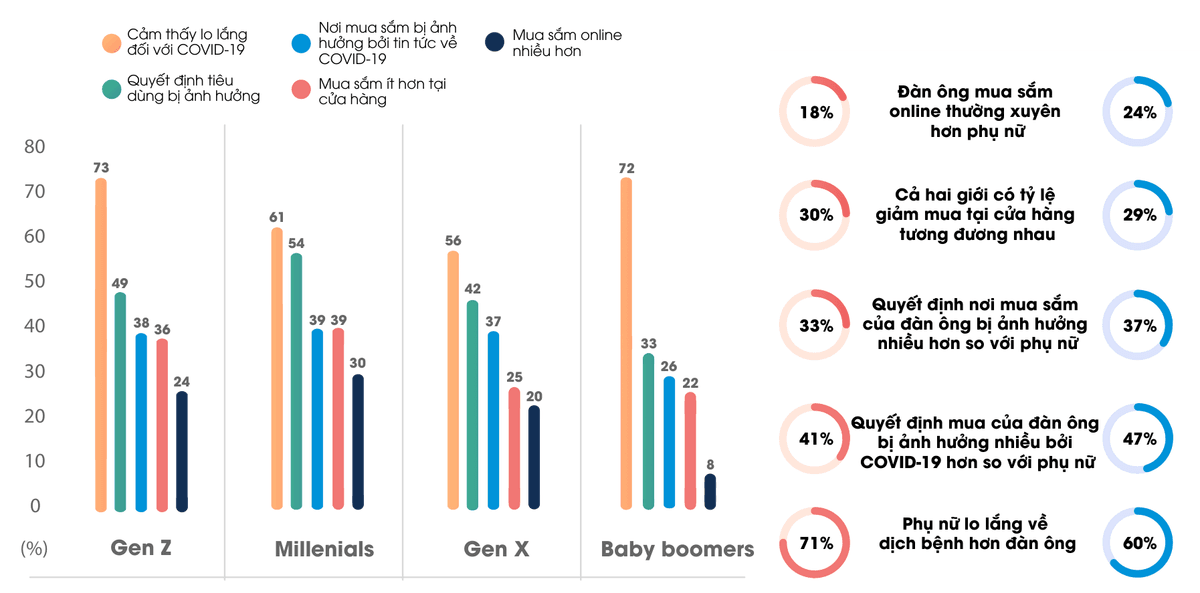
Drawing on First Insight's U.S. consumer study released at the end of February 2020, the report compares five sentiment and shopping indicators across four generations and both genders:
| Consumer Cohort (First Insight, Feb 2020) | Worried About COVID-19 | Purchase Decisions Impacted | Shopping Location Affected by News | Shopping Less In-Store | Shopping More Online |
|---|---|---|---|---|---|
| Gen Z | 73% | 49% | 38% | 36% | 24% |
| Millennials | 61% | 54% | 39% | 39% | 30% |
| Gen X | 56% | 42% | 37% | 25% | 20% |
| Baby Boomers | 72% | 33% | 26% | 22% | 8% |
| Women | 71% | 41% | 33% | 30% | 18% |
| Men | 60% | 47% | 37% | 29% | 24% |
Two planning misconceptions in anxiety and online conversion metrics
Retailers often assume that the shoppers most worried about health risks will migrate fastest to online checkout. First Insight's dataset disproves that assumption on two fronts:
- High health anxiety does not translate linearly into e-commerce adoption. Gen Z (73%) and Baby Boomers (72%) reported the highest concern over COVID-19. Even so, only 8% of Baby Boomers increased online shopping. Millennials ranked third in stated worry (61%) yet led every behavioral shift: 54% changed purchase decisions, 39% cut physical store visits, and 30% shopped online more frequently.
- Women expressed higher concern, whereas men altered shopping channels more aggressively. Some 71% of women reported worrying about the outbreak compared with 60% of men, and both genders reduced physical store visits at nearly identical rates (30% of women versus 29% of men). However, men reported greater impact on purchase decisions (47% versus 41%), store location choices (37% versus 33%), and increased online shopping frequency (24% versus 18%).
Six defensive shopping habits redefining lockdown baskets
Building on those demographic splits, Chapter 1 identifies six core consumer behaviors governing household spending during lockdown periods:
- Prioritizing preventive health. Households reallocate discretionary budgets toward immunity support, wellness, and preventive healthcare items.
- Buying personal protection repeatedly. Masks, thermometers, and hand sanitizers move from occasional purchases to recurring household staples.
- Avoiding crowds and high-traffic venues. Contact avoidance sharply reduces walk-in traffic across shopping malls and urban retail streets.
- Shifting orders to digital channels. Shoppers favor brand websites, marketplaces, and delivery apps to minimize trips outside the home.
- Stocking long-shelf-life groceries. Canned food, dry staples, and packaged goods take precedence over fresh ready-to-eat items.
- Bulk-buying essentials under news-cycle pressure. Dense media coverage and herd psychology trigger sudden pantry-loading spikes within compressed windows.
How sharply did consumer demand diverge across healthcare, pantry staples, luxury, and fashion?
When all six defensive habits hit simultaneously, household spending exits discretionary categories and concentrates in medical protection and shelf-stable nutrition. The report contrasts four retail segments experiencing opposite demand shocks.
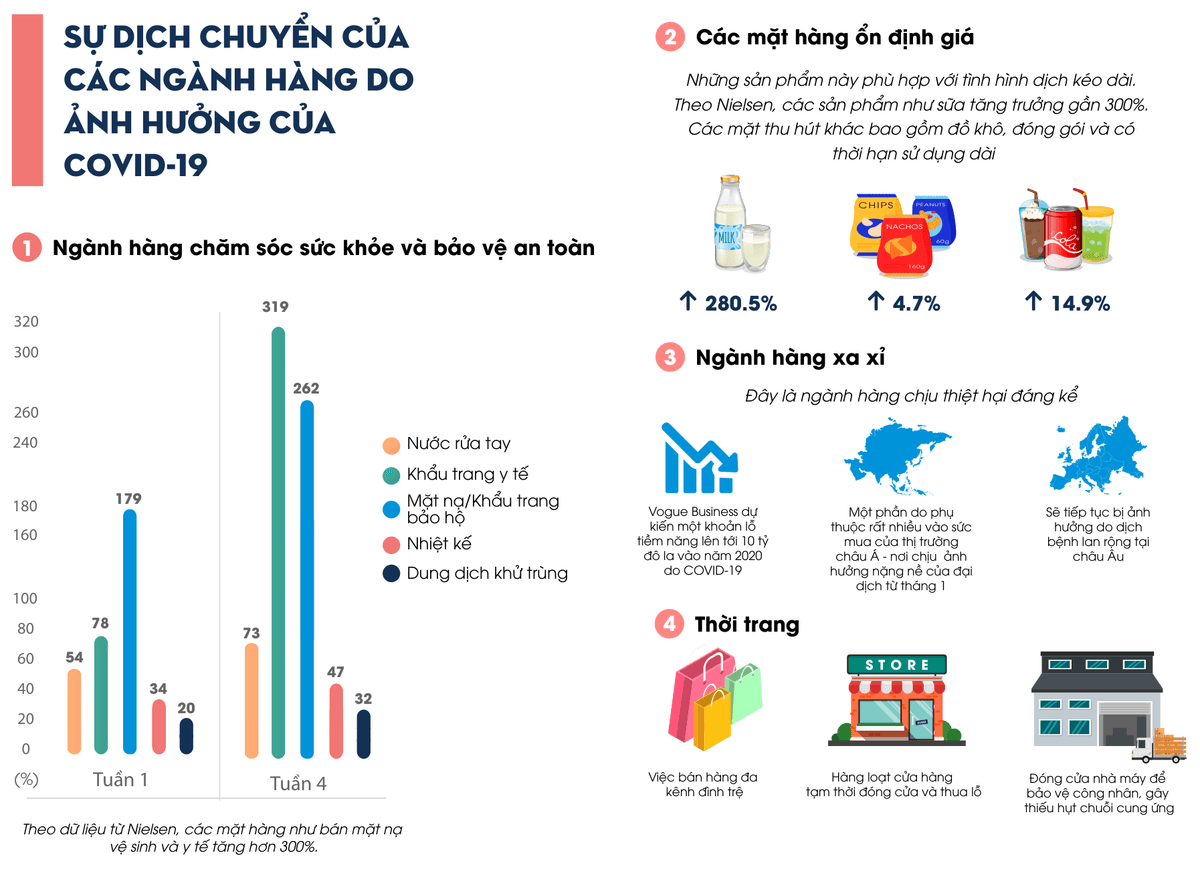
Nielsen's four-week U.S. retail tracking ending February 22, 2020 illustrates week-by-week acceleration in personal protection alongside pantry staples, juxtaposed against contractions in luxury and apparel:
| Retail Segment | Tracked Product or Indicator | Recorded Shift | Source & Period |
|---|---|---|---|
| Healthcare & safety | Medical masks | Jumped from +78% (Week 1) to +319% (Week 4) | Nielsen (Feb 2020) |
| Healthcare & safety | Protective maintenance masks | Rose from +179% (Week 1) to +262% (Week 4) | Nielsen (Feb 2020) |
| Healthcare & safety | Hand sanitizer | Climbed from +54% (Week 1) to +73% (Week 4) | Nielsen (Feb 2020) |
| Healthcare & safety | Thermometers | Increased from +34% (Week 1) to +47% (Week 4) | Nielsen (Feb 2020) |
| Healthcare & safety | Surface disinfectants | Expanded from +20% (Week 1) to +32% (Week 4) | Nielsen (Feb 2020) |
| Shelf-stable groceries | Shelf-stable oat milk, packaged drinks, dry snacks | Milk +280.5%; beverages +14.9%; dry snacks +4.7% | Nielsen (Feb 2020) |
| Global luxury goods | Major international luxury houses | Projected 2020 profit drop up to EUR 10B (rounded as USD 10B in PDF) | Vogue Business / Altagamma, BCG, Bernstein (Feb 2020) |
| Mass-market fashion | Omnichannel apparel chains and factories | Stalled omnichannel sales, store closures, and factory halts disrupting supply | Adsota synthesis (Apr 2020) |
Inventory velocity pressure in essentials versus dual shocks in apparel and luxury
For essential-goods retailers, the primary bottleneck shifted from customer acquisition to replenishment speed. Within four weeks of Nielsen's tracking, medical mask growth more than quadrupled from 78% to 319%. Shelf-stable items led by long-life oat milk (+280.5%), packaged beverages (+14.9%), and dry snacks (+4.7%) anchored order frequency for supermarkets and online marketplaces alike.
By contrast, luxury and fashion suffered simultaneous demand and supply shocks. As cited via Vogue Business (reporting on the February 2020 Altagamma, BCG, and Bernstein survey), global luxury brands relied heavily on Asian buyers hit in January 2020 before losing tourist spending across Europe. In mass-market apparel, factory shutdowns aimed at protecting workers disrupted inventory pipelines just as physical storefronts closed.
Why did influencer marketing and livestreaming become critical revenue drivers during store closures?
Chapter 2 explains why influencer marketing adapted rapidly rather than stalling when physical retail slowed. Even before the pandemic, creator-led campaigns had reshaped marketplace rankings in Vietnam.
According to iPrice Group's Map of E-commerce Vietnam rankings cited in the report, sustained influencer marketing helped propel Shopee and Tiki upward. Starting from the bottom two spots among Vietnam's Top 5 e-commerce brands in Q3 2017, Shopee captured the #1 overall market position while Tiki rose to #3 in mobile app rankings by Q3 2019.
From stay-at-home viral trends to direct on-screen livestream checkout
Lockdowns halted outdoor travel and dining reviews, freezing many traditional sponsorship contracts. At the same time, homebound consumers spent far more hours watching entertaining social content. That shift opened two practical conversion paths for retail brands:
- Embedding products into at-home lifestyle trends. Rather than staging outdoor shoots, beverage and grocery brands partnered with creators on home recipes and routines. During early 2020, the viral Dalgona coffee trend organically lifted G7 instant coffee across social platforms as creators featured its familiar, convenient sachets in home tutorials.
- Pairing influencers with shoppable livestreaming. With shopping malls closed, live video replicated the persuasive energy of in-store sales associates. Adsota highlights Chinese livestreamer Austin Li (Li Jiaqi) on Alibaba's Taobao ecosystem and short-video platforms: expressive live demonstrations paired with instant on-screen purchase buttons compressed discovery and checkout into seconds.
Three execution rules to control influencer campaign risk
As brands crowded into creator marketing, poor partner fit and unmeasured sponsorships became costlier. Adsota outlines three operational safeguards for retail and e-commerce marketers:
- Score creators against prioritized selection criteria. Marketing teams should rank candidates across reach, stay-at-home creative agility, and category relevance rather than follower counts alone. Brands can apply the framework for selecting and combining KOLs with KOCs by funnel stage to protect conversion efficiency.
- Expand beyond niche reviewers into entertainment creators. During stressful news cycles, audiences favor lighthearted entertainment over technical product lectures. Retailers can broaden reach by collaborating with game streamers, lifestyle vloggers, and comic artists.
- Execute through experienced Multi-Channel Networks (MCNs). Brands without dedicated in-house creator teams reduce operational risk by partnering with established MCNs. In March 2020, marketplace Sendo teamed up with OTA Network (an Appota Group MCN and official Facebook Gaming partner) to activate gaming creators, generating over 800,000 views and more than 1,000,000 interactive comments.
How did Shopee, Lazada, and Sendo differentiate their in-app livestreaming strategies?
Chapter 3 compares how three major e-commerce platforms in Vietnam deployed in-app livestreaming during early 2020. Rather than copying identical discount broadcasts, Shopee, Lazada, and Sendo engineered three distinct engagement mechanics:
| Marketplace | Flagship Pandemic Campaign | Broadcast Cadence & Content Format | Core Behavioral Objective |
|---|---|---|---|
| Shopee | "Staying Home Is Easy – Shopee Takes Care of It" | Fixed schedule 2 days/week, up to 3 waves/day; celebrity chats, 8Channel, coin hunts, and exclusive giveaways tied to NowFood and AirPay | Build habitual app opens at fixed time slots similar to mega-sale flash events |
| Lazada | "Shop Safely at Home" (kickoff to Lazada's 8th birthday) | Spread across weekdays under themed hashtags: LazCook, LazMusic (live concerts), LazGetfit, LazLearn, LazHome, LazPlay (board games, family DIY) |
Embed the shopping app into daily household cooking, fitness, learning, and family routines |
| Sendo (SenLive) | "Half-Price Flash Sale – Streamer Showdown" (Mar 23–27, 2020) | Partnered with OTA Network on a Livestream Showmatch featuring top Facebook Gaming creators (MisThy, Nam Blue, Ngan Sat Thu, Hy Nam, Quang Cuon, Ha Mi) | Fuse competitive gaming excitement with half-price deal hunting to capture young audiences |
Owning native in-app live infrastructure while avoiding viewer fatigue
Across all three campaigns, marketplaces invested heavily in native in-app streaming tools even while cross-posting on Facebook. Building proprietary live infrastructure solved two structural challenges at once.
First, native streaming reduced platform dependence on third-party social algorithms. Second, marketplaces could embed merchant-specific commerce tools—such as pinned product cards, timed voucher drops, and instant in-stream checkout—directly inside the viewing window.
At the same time, Adsota warns against creative monotony. Because lockdowns had no fixed end date, repeating identical price-shouting broadcasts week after week quickly triggers viewer fatigue and weakens brand affinity.
How do e-commerce and gaming partnerships unlock crowded digital advertising channels?
As brick-and-mortar advertisers shifted budgets en masse onto standard social and search feeds, conventional digital ad inventory grew congested. Chapter 4 highlights an alternative attention channel that surged during stay-at-home orders: interactive gaming.
Verizon and Mintel data on peak gaming traffic and social connection
Telecom network telemetry and consumer attitude research both confirm why gaming outperformed passive media during lockdown:
- Peak-hour gaming traffic jumped 75%. According to Verizon's March 2020 U.S. network report, peak-hour traffic to gaming-related platforms climbed up to 75%. That surge far outpaced the 12% rise in video streaming, while social media traffic remained steady.
- Adult gaming participation reached 71% even before COVID-19. Mintel's UK gaming research shows the share of adults playing video games climbed from 51% in 2018 to 71% by late 2019, propelled by high-production free-to-play mobile titles across genres.
- Interactive play rivals television and music while fulfilling social needs. In Mintel's UK attitude survey, 40% of gamers preferred playing games to watching TV, and over 33% found gaming more engaging than listening to music. Roughly 25% played specifically to connect with other people—fueling live communities across Twitch, YouTube, and Facebook Gaming.
Because retail and e-commerce serve broad demographic segments, mobile gaming's diverse age and occupational mix offers natural audience overlap. Positive stress relief during isolation also builds durable brand goodwill that outlasts temporary lockdown campaigns.
Three Ecommerce x Gaming activation models by budget tier
Retailers and marketplaces can activate gaming audiences across three budget-aligned models:
- Co-marketing with game developers, publishers, and gaming content platforms. Suited for large retail chains seeking mass reach inside popular mobile titles through cross-promotions or co-branded rewards.
- Hosting online showmatches with direct purchase links. Casual, MOBA, and Battle Royale titles operate entirely online without physical venue constraints. Competitive match arcs hold viewer attention over long broadcasts while pinned order links drive immediate conversions.
- Sponsoring online Esports tournaments or integrating products via gaming streamers. With offline arenas paused, brands can sponsor online tournaments. Leaner marketing teams can place products organically inside streamer broadcasts through specialized partners such as Appota Esports, OTA Network, and Adsota. Subsequent ecosystem growth across competitive tournaments and creator monetization is detailed in the Vietnam Esports Whitebook 2022–2023.
What four operational priorities help retail and e-commerce leaders protect cash flow and adapt long term?
The final chapters of the report (pages 18 and 19) synthesize domestic and regional case studies into a practical adaptation framework. Rather than treating digital channels as a temporary stopgap, successful operators restructured merchandise, store safety, content formats, and media allocation in tandem.
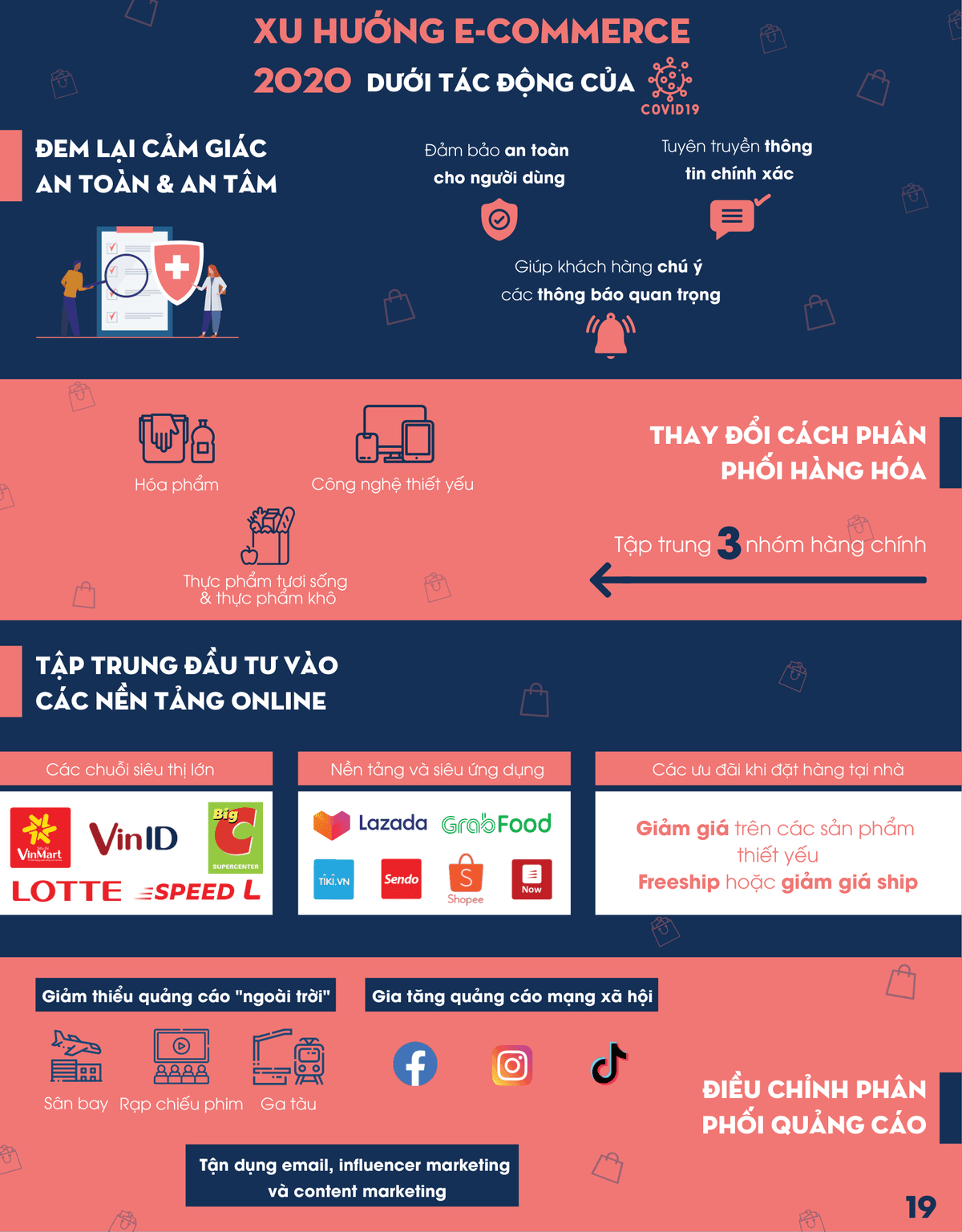
Mapping the report's e-commerce framework against documented enterprise responses reveals four coordinated shifts:
| Adaptation Pillar | Core Operational Shift | Documented Enterprise Examples in the Report |
|---|---|---|
| Merchandise & delivery restructuring | Focus inventory on 3 core groups (household hygiene chemicals; essential remote-work and study tech; fresh and dry food); push app orders via essential discounts and free or reduced shipping | VinMart (now WinMart) and Co.opmart prioritized food, cleaning supplies, and baby care; VinMart waived delivery fees on VinID orders; Grab launched grocery concierge via GrabFood; Big C, Lotte, Speed L, Lazada, Tiki, Sendo, Shopee, Now expanded home-delivery incentives |
| Store safety & transparent alerts | Enforce temperature checks and sanitization at physical outlets; highlight verified operational updates online to maintain shopper confidence | Store entrances staffed with masked guards reminding visitors to sanitize hands, alongside thermometers and sanitizer stations; staff wearing gloves and masks with pre- and post-shift temperature checks |
| Digital content & gamified engagement | Redeploy retail staff onto livestreaming; publish stay-at-home lifestyle content; add in-app games and public-interest relief initiatives | Cosmetics retailer Lin Qingxuan mobilized advisors and Weibo influencers to lift Wuhan sales by 200%; Sendo ran SenLive Streamer Showdown; Shopee deployed reward-backed in-app games; Tiki guided home-deal redemption; Coca-Cola and LEGO redirected marketing funds toward pandemic awareness and education |
| Advertising channel reallocation | Cut Out-of-Home (OOH) spend across transit and entertainment venues with halted footfall; reinvest in social ads and direct retention channels | Scaled back placements at airports, cinemas, and train stations; increased investment across Facebook, Instagram, TikTok paired with Email Marketing, Influencer Marketing, and Content Marketing |
Four action steps for retail executives and marketing directors
Lin Qingxuan's 200% sales surge in locked-down Wuhan demonstrates that shuttered storefronts need not idle a retailer's sales force. Drawing on the report's complete dataset, leadership teams can execute four priorities:
- Re-segment target buyers using behavioral conversion data rather than stated anxiety. Direct rapid online-conversion campaigns toward Millennials and male shoppers showing high channel elasticity, while simplifying mobile ordering and delivery assurance for older cohorts.
- Concentrate working capital in resilient essentials and turn store staff into digital advisors. Prioritize inventory turnover across health, hygiene, shelf-stable groceries, and home-office gear while training store associates to host consultative livestreams. How these early pandemic shifts matured into full omnichannel retail and cashless checkout across Vietnam is examined in the Vietnam Retail Market Research and 2025 Trend Forecast.
- Diversify livestream formats and test gaming creator partnerships. Replace repetitive discount broadcasts with home-lifestyle utility, in-app gamification, and MCN-managed gaming showmatches to escape inflated auction prices on standard ad feeds.
- Reallocate offline transit media budgets into social and owned retention loops. Shift frozen OOH spend from airports, cinemas, and stations into Facebook, Instagram, TikTok, helpful content, and email lifecycle flows; explore further playbooks in the marketing and creator economy topic hub.
This executive synthesis consolidates the source-verified behavioral metrics and adaptation frameworks from the opening issue of the pandemic response series. Readers can complete the download form on this page to access the full 20-page PDF compiled by Adsota, including all original category infographics and campaign breakdowns.
Sources
- E-Magazine 01 — Thích nghi với COVID-19: Ngành Bán lẻ và Thương mại điện tử, Công ty Cổ phần Adsota Việt Nam, 2020-04-15, accessed 2026-10-31
- The Impact of Coronavirus on Consumer Purchase Decisions and Behaviors, First Insight, 2020-02-28, accessed 2026-10-31
- COVID-19: Tracking the Impact on FMCG, Retail and Media (Pandemic Pantries), Nielsen, 2020-03-05, accessed 2026-10-31
- Luxury faces €10 billion profit hit from coronavirus (Altagamma, BCG & Bernstein survey), Vogue Business, 2020-02-27, accessed 2026-10-31
- Bản đồ Thương mại điện tử Việt Nam (Map of E-commerce Vietnam) giai đoạn Q3/2017 – Q3/2019, iPrice Group, 2019-10-25, accessed 2026-10-31
- Báo cáo chiến dịch SenLive 'Săn sale nửa giá - Streamer tranh bá' (Sendo x OTA Network), OTA Network & Adsota (Appota Group), 2020-04-02, accessed 2026-10-31
- Verizon Network Report: COVID-19 Peak-Hour Traffic Shifts (Gaming & Video Streaming), Verizon, 2020-03-18, accessed 2026-10-31
- UK Video Games Market Report & Consumer Attitudes Towards Gaming, Mintel, 2019-12-15, accessed 2026-10-31
- How Chinese Cosmetics Brand Lin Qingxuan Achieved 200% Wuhan Sales Growth via Livestreaming, Alibaba Group / Harvard Business Review Case Study, 2020-03-20, accessed 2026-10-31