
E-Magazine 04: Webinar Marketing Strategy and B2B Lead Conversion in Vietnam
Adsota's E-Magazine 04 report on webinar marketing strategy examines virtual event adoption in Vietnam, a three-stage campaign playbook, and lead-conversion risk management. Across more than 330 surveyed Vietnamese firms, over one-third planned to launch webinar marketing within 12 months and 47% cited low attendance as their top hurdle, while up to 40% of attendees convert into qualified leads (ReadyTalk).
An executive analysis of Adsota's 330+ business survey in Vietnam, 40% webinar attendee-to-lead conversion benchmarks, a 3-stage execution playbook, and 5 operational risk controls.
Key findings
- 97.6%Share of Vietnamese internet users who watch online video content (including webinars) each month—ranking first among all digital content formats in Adsota's Vietnam Digital Advertising Report 2021.
- 7 hours/dayAverage daily time Vietnamese consumers spent online after the COVID-19 outbreak, up from 6.5 hours per day pre-pandemic according to Adsota's Vietnam Digital Advertising Report 2021.
- Over 1.2BMonthly viewers on Facebook Watch consistently surpassed during the pandemic period, according to platform metrics disclosed at Facebook Video Summit 2021.
- Over 1/3Proportion of respondents among more than 330 surveyed Vietnamese enterprises in Adsota's research planning to deploy webinar marketing over the following 12 months.
- Up to 40%Average share of webinar attendees who convert into qualified sales leads according to industry benchmark data from web conferencing provider ReadyTalk.
- 50% and 16.7%Share of scored survey responses rating webinar marketing's lead-generation effectiveness strongly on a 1-to-5 scale (50% rating level 4 and 16.7% rating level 5 on Adsota's survey chart).
- 47%Share of respondents across Adsota's 330-enterprise survey identifying low attendee turnout as the primary barrier when hosting webinars, alongside navigating over 70 platforms tracked by G2.
Why do 7 daily online hours and 97.6% video reach accelerate webinar marketing strategy in Vietnam?
In enterprise growth and brand communications, a structured webinar marketing strategy uses browser-based online seminars to educate target audiences, build brand authority, and capture high-intent leads. Coined from web and seminar, webinars originated in internal training and remote conferencing. Applied to marketing, virtual seminars directly power product launches, press briefings, customer education workshops, and VIP client appreciation programs.
Web conferencing infrastructure dates back to the late 1980s during the early commercial Internet era. The term webinar entered mainstream public awareness in 1996 alongside Microsoft's launch of NetMeeting. Subsequent generations of cloud tools—including Zoom Webinar, Google Meet, GoToWebinar, ClickMeeting, and Gather—eliminated dedicated hardware requirements, enabling any organization to broadcast interactive sessions worldwide directly through web browsers.
In Vietnam, webinar adoption began inside multinational corporations and large domestic enterprises using Cisco Webex to collaborate with overseas partners. Beginning in 2020, COVID-19 mobility restrictions forced education, corporate negotiation, and commerce onto digital channels simultaneously. Two-way real-time video interaction quickly matured from a temporary pandemic workaround into a permanent customer acquisition and retention channel.
Rising daily internet duration and video dominance across Vietnamese digital media
Two measurable shifts in Vietnamese digital behavior underpin the commercial viability of virtual events. According to Adsota's Vietnam Digital Advertising Report 2021 (synthesizing Digital 2021: Vietnam benchmarks by We Are Social and Hootsuite), average daily time spent online by Vietnamese consumers rose from 6.5 hours before COVID-19 to 7 hours per day after the pandemic began.
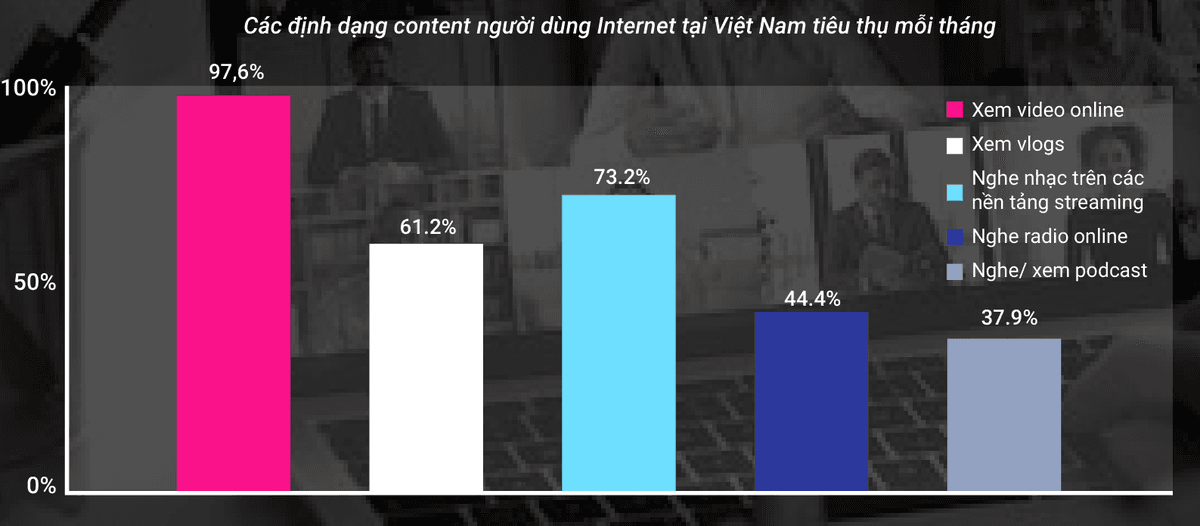
Monthly media consumption data on page 09 of the report confirms that online video—which encompasses live and recorded webinars—leads every digital content format in Vietnam at 97.6% reach among internet users:
| Digital Behavior & Enterprise Adoption Metric | Benchmark Recorded in Report | Source and Reference Period |
|---|---|---|
| Daily time spent online (pre- vs. post-outbreak) | Increased from 6.5 hours/day to 7 hours/day | Adsota Digital Advertising Report (2021) |
| Monthly online video consumption reach | 97.6% of internet users in Vietnam | Adsota & Digital 2021 Vietnam (2021) |
| Monthly music streaming consumption | 73.2% of internet users in Vietnam | Adsota & Digital 2021 Vietnam (2021) |
| Monthly vlog viewing reach | 61.2% of internet users in Vietnam | Adsota & Digital 2021 Vietnam (2021) |
| Monthly online radio and podcast reach | Online radio at 44.4%; podcasts at 37.9% | Adsota & Digital 2021 Vietnam (2021) |
| Facebook Watch global monthly viewership | Consistently surpassed 1.2 billion monthly viewers | Facebook Video Summit (2021) |
| Vietnamese enterprise 12-month adoption intent | Over 1/3 of more than 330 surveyed enterprises | Adsota Webinar Marketing Survey (Aug 2021) |
Platform-level video momentum reinforces this consumption pattern. Metrics presented by Facebook (now Meta Platforms) at Facebook Video Summit 2021 showed monthly viewership on Facebook Watch consistently exceeding 1.2 billion during the pandemic. Responding to this shift, Adsota's survey of more than 330 Vietnamese businesses found that over one-third planned to execute webinar marketing campaigns within the next 12 months.
Which four conversion advantages give webinar marketing an edge over traditional venue events?
Chapter 2 evaluates four economic and marketing advantages that keep virtual seminars central to B2B and high-consideration B2C funnels well beyond pandemic recovery.
Multi-format content repurposing and organic search visibility through video assets
The first advantage is systematic content repurposing. Built-in screen sharing, multi-camera feeds, and live audience prompts turn a webinar into a rich production studio. Once the live broadcast concludes, marketing teams can edit the master recording into four evergreen asset classes:
- Executive speaker commentary. Extract sharp industry predictions and expert viewpoints into visual quote cards and vertical short-form clips.
- Real-world case narratives. Package operational lessons and crisis-management stories shared during panel discussions into standalone case posts.
- In-depth domain guides. Transform technical slide presentations into structured long-form articles for corporate blogs and email newsletters.
- Comprehensive event recaps. Summarize key statistics and panel takeaways for prospective buyers who registered but missed the live broadcast.
Adsota illustrates this workflow through its own August 11, 2021 Zoom Webinar talkshow "Which Lighthouse Helps Businesses Weather the COVID-19 Storm" (hosted to launch the Repota 2021 report), featuring senior leaders from Bitexco, Daikin, and Pizza Home. Following the live discussion, Adsota repurposed the session archive into vertical-specific marketing guides, market data updates, and career insights that drove sustained organic follower growth across its owned channels.
The second advantage is improving search engine optimization (SEO) without inflating content production budgets. Many mid-sized firms hesitate to fund standalone SEO programs due to high upfront costs and long payback horizons. With 97.6% of Vietnamese internet users watching online video (Adsota, 2021) and major social platforms investing aggressively in TikTok, Instagram Reels, and YouTube Shorts, search engines including Google, Bing, and Coc Coc increasingly prioritize video-enriched pages. Publishing webinar recordings alongside structured text summaries lifts organic search rankings at near-zero marginal cost.
Converting up to 40% of attendees into leads at VND 3–4 million in monthly software cost
The third—and commercially decisive—advantage is high-intent lead generation. Industry benchmark research from ReadyTalk (cited as The Ready Talk in the PDF) demonstrates that up to 40% of webinar attendees convert into qualified sales leads.
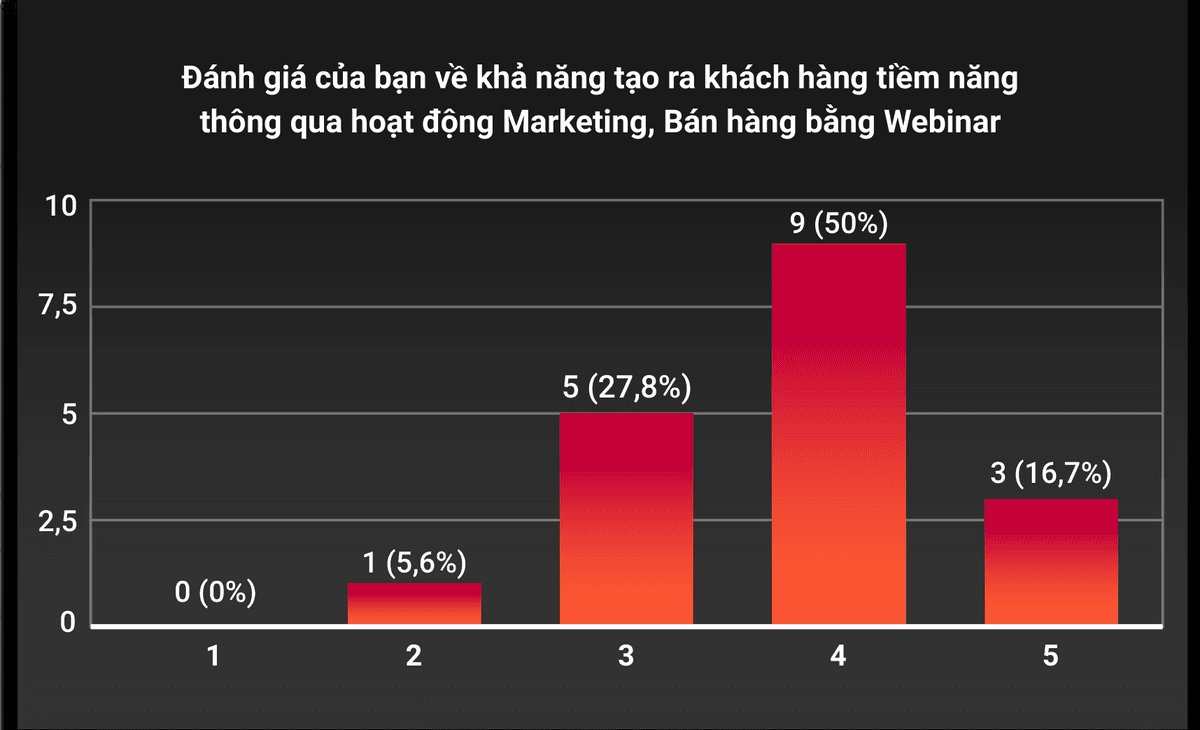
In Adsota's survey chart evaluating webinar lead-generation effectiveness across marketing and sales on a 1-to-5 scale (page 12, reflecting n = 18 respondents who submitted granular ratings within the 330+ enterprise survey), zero respondents selected level 1 (0%), only 5.6% selected level 2, and 27.8% selected level 3. By contrast, 50% rated effectiveness at level 4 and 16.7% at level 5—meaning two-thirds of scored evaluations confirmed strong lead-capture performance.
Adsota explains this conversion efficiency through a behavioral "content slide" mechanism. Unlike passive display ad viewers, professionals who register for a thematic webinar already carry a specific business problem seeking resolution. When the session diagnoses that pain point accurately and weaves product capabilities naturally into the solution, attendees progress smoothly toward commercial consultation—often before the broadcast ends.
The fourth advantage combines real-time two-way engagement with a fraction of offline venue costs:
| Comparison Dimension | Virtual Seminar (Webinar Marketing) | Physical Venue Event (Offline Seminar) |
|---|---|---|
| Platform & venue cost baseline | Roughly VND 3–4 million/month for full-featured plans (plus free tiers) | Hundreds of millions of VND per large customer event in Hanoi or Ho Chi Minh City |
| Audience capacity & geography | Scales to thousands of nationwide or global attendees with unlimited monthly sessions | Capped by ballroom seating capacity and guest travel constraints |
| Structured engagement mechanics | Pre-scripted quizzes, live polling, moderated Q&A, and breakout rooms | Relies on manual floor moderation; harder to capture instant audience data |
| Post-event data capture | Automatic video archive, digitized registrant profiles, and individual Q&A logs | Requires separate film crew budgets; floor interactions rarely sync to digital records |
How should teams govern a three-stage webinar marketing strategy from preparation to follow-up?
Chapter 3 stresses that virtual seminars demand the same operational rigor as flagship physical conferences, coordinated across three sequential phases: pre-event preparation, live execution, and post-event relationship nurturing.
Pre-event preparation: locking SMART targets, the big idea, and media distribution
During early planning, a frequent misstep is overloading a single broadcast with conflicting corporate goals. Adsota advises separating performance-driven lead generation from broad brand-awareness goals upfront, then locking campaign KPIs using the SMART goal framework:
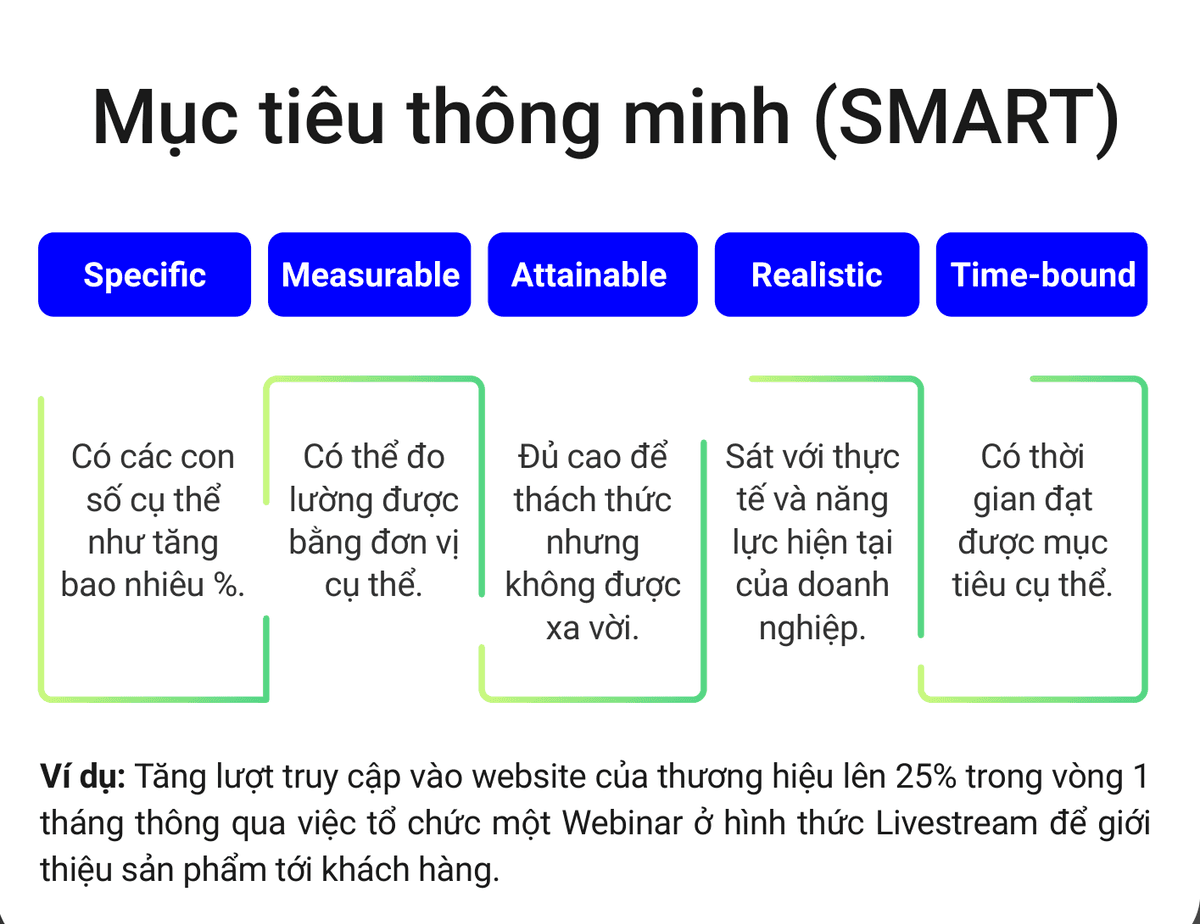
The framework on page 16 anchors SMART planning with a concrete benchmark example: lifting brand website traffic by 25% within one month by hosting a product-introduction livestream webinar. Campaign leads should cascade that top-line target into granular sub-metrics across creative production, media buying, and technical hosting so every workstream stays accountable.
Next, creative teams craft an overarching big idea connecting the company's domain strengths with target buyers' operational pain points and professional interests. That central theme unifies every pre-event touchpoint—from key visuals and teaser trailers to press articles and brand social posts. Because guest speaker credibility heavily influences registration conversion, marketing managers can apply the framework for selecting and combining KOLs and KOCs in Vietnam to recruit authoritative domain voices.
First-time organizers choosing among dozens of webinar formats and software tools should evaluate three practical variables:
- Allocated campaign budget. Balance software licensing tiers against speaker honorariums, studio gear, and paid acquisition spend.
- Expected turnout and room scalability. Verify concurrent attendee caps and ensure the platform can expand capacity seamlessly if registrations surge past projections.
- Required depth of two-way interaction. Decide whether the agenda needs simple comment feeds or structured breakout rooms, live voting, and audience audio permissions.
Pre-event promotion closes the preparation stage across three deliverables: a content asset checklist (speaker profiles, event trailer video, thematic educational posts); a channel mix pairing owned media with paid social and media partnerships that accompany the event throughout its lifecycle; and a master timeline assigning clear deadlines and owners.
Live broadcast orchestration and post-event nurturing for pipeline conversion
Across live delivery and post-broadcast follow-up, the report structures execution around an end-to-end operational matrix:
| Campaign Stage | Core Operational Priorities | Coordinated Formats & Tools | Target Management Outcome |
|---|---|---|---|
| 01. Pre-event preparation | Set SMART KPIs, define big idea, select platform, run registration campaigns | Speaker spotlights, teaser videos, paid social ads, and press media partnerships | Hit qualified registration targets matching ideal buyer personas |
| 02. Live webinar execution | Run minute-by-minute run-of-show, staff attendee tech support, push real-time social clips | Visual slides, live quizzes, digital whiteboards, instant quote cards, and short clips | Maintain high full-session retention and uninterrupted audiovisual delivery |
| 03. Post-event follow-up | Send thank-you emails and surveys, distribute press releases, publish recap assets | Automated emails, feedback forms, PR coverage, video recaps, and attendee testimonials | Convert engaged attendees into sales pipeline and build demand for future editions |
During the live session, a detailed run-of-show script acts as operational armor synchronizing hosts, speakers, and technical moderators. Every opening sequence should cover three essentials so viewers orient immediately: a welcome briefing explaining platform controls and exact start time; speaker and guest introductions; and a concise roadmap of session topics. Simultaneously, a dedicated attendee-care desk must troubleshoot viewer login or audio issues and route audience questions to the moderator. For public livestream webinars, social editors should clip standout speaker quotes into instant graphics, stories, and short videos shared across relevant professional communities to pull additional live viewers.
Post-event communications convert fleeting viewer attention into lasting brand trust. Sending thank-you emails paired with feedback surveys within 24–72 hours segments high-intent prospects; teams can connect registration and attendance logs using standardized UTM tracking and automated CRM lead-pipeline workflows so sales counselors act promptly. Following up over subsequent days with press releases, highlight videos, and attendee reflections builds anticipation for the next series installment.
Which five operational risks cause 47% of firms to struggle with turnout—and when should you skip pricey software tiers?
Chapter 4 diagnoses five execution failures that routinely undermine virtual events through wasted software spend, audiovisual breakdowns, or early viewer drop-off.
Software over-provisioning across 70+ platforms and audiovisual infrastructure failures
The first risk is platform mismatch or over-investing in enterprise tiers that internal teams cannot fully utilize. According to enterprise software review directory G2 cited in the report, more than 70 webinar software platforms compete across overlapping feature sets. From Adsota's hands-on event operations, standard Zoom Meeting already encompasses roughly 10 distinct functional modules—including breakout rooms, virtual backgrounds, waiting rooms, and speaker spotlighting—while upgrading to Zoom Webinar adds dedicated polling and structured Q&A suites.
Observing that many companies pay steep fees for Zoom Webinar licenses yet run sessions like basic video calls, the report establishes clear guardrails on when not to purchase expensive webinar software tiers:
- No trained technical moderator on staff. Without a practiced operator who has rehearsed permissions, live polling cues, and security locks, complex software suites increase on-air fumbling rather than engagement.
- One-way presentation agendas for modest audience sizes. When the script omits structured interactive modules and headcount fits comfortably inside standard meeting tiers, premium webinar licenses create pure budget waste.
The second risk stems from unstable network connections, faulty microphones, and poor lighting. Hosting a webinar over shared office Wi-Fi or public café networks frequently triggers packet loss, frozen frames, or abrupt host disconnections mid-broadcast. Similarly, untested microphones cause audio dropouts or vocal distortion during pivotal keynote moments, while relying on built-in laptop webcams or smartphone cameras in poorly lit rooms produces grainy video that erodes brand credibility.
Content misalignment per ON24, the 47% low-turnout barrier, and schedule overruns
The remaining three risk categories directly govern registration turnout and full-session viewer retention:
| Operational Risk Category | Observed Symptoms & Report Benchmarks | Preventive Controls Recommended by Adsota |
|---|---|---|
| 01. Platform mismatch & waste | Confusion across 70+ G2 platforms; buying premium Zoom Webinar tiers with unused tools | Match software to budget, scalability, and interaction depth; train dedicated technical hosts |
| 02. Network & AV breakdowns | Shared Wi-Fi lag or host disconnects; muted/distorted mics; grainy, dim laptop webcams | Use dedicated wired bandwidth plus pre-tested external microphones, lighting, and cameras |
| 03. Sales-heavy, static content | Mismatch between corporate pitch and viewer goals (ON24); text-heavy slides lacking motion | Anchor topics where buyer problems meet brand expertise; mix opener videos, infographics, and motion |
| 04. Low turnout & flat interaction | 47% of 330 surveyed firms cite low attendance; early drop-off or competitor room disruption | Launch multi-channel promos early; enable room security alerts; pair Q&A with polling and minigames |
| 05. Schedule overruns & bad timing | Announced 2-hour sessions stretching to 3 hours without buffers; clashing with personal hours | Script minute-by-minute segments with buffer time and Q&A caps; schedule during weekday office hours |
On content quality, US webinar marketing platform ON24 notes that unengaging webinars typically fail because the organizer's goal (pitching a product) does not intersect with the attendee's goal (solving an operational problem). Visual format diversity is equally vital. Adsota cites Facebook Video Summit 2021, which combined opener videos, animated infographics, speaker interviews, and smooth slide transitions to sustain viewer curiosity—just as a food-and-beverage brand showcasing short bakery production films outperforms dry product-spec slides.
On audience reach, Adsota's "Webinar Marketing Demand Survey" across 330 respondents revealed that nearly half (47%) regard low attendee turnout as their single biggest obstacle. Weak turnout stems from late, sporadic promotion alongside security anxieties over competitors entering open sessions to post disruptive comments or distracting visuals—requiring hosts to master admission alerts and moderation controls on platforms like Google Meet and Zoom. Because plain Q&A blocks rarely stop mid-session drop-offs alone, Adsota paired live Q&A with instant polling and interactive minigames during its 2021 annual digital advertising report launch webinar; brands can also expand organic reach through co-hosted industry-academia thematic seminars and workshops.
On time management, failing to build contingency buffers into each agenda block often stretches an announced 2-hour seminar into a fatiguing 3-hour marathon. Run-of-show scripts must cap speaking durations and pre-set the maximum number of live Q&A responses. For white-collar and B2B audiences, scheduling broadcasts during standard weekday office hours avoids evening family routines and weekend downtime.
When should brands deploy interactive 3D virtual studios—and what four actions come first?
In Chapter 5, the report examines upgrading flagship virtual conferences and major product unveilings from flat webcam grids to interactive 3D virtual studios. For high-stakes brand showcases, static split-screen layouts struggle to hold visual attention across multi-hour agendas.
Adsota's managed webinar production model addresses this gap by combining customizable 3D auditorium environments, multi-angle virtual camera switching similar to broadcast television studios, and synchronized real-time interaction across Zoom and livestream feeds. Enterprises gain broadcast-grade visual immersion while still saving substantially compared with constructing physical stage sets.
Translating E-Magazine 04's benchmarks into immediate practice, marketing directors and growth leads can standardize their next virtual event around four priority actions:
- Lock SMART KPIs and anchor topics on buyer problem-solving. Separate lead-capture targets from awareness goals upfront, then frame the webinar theme at the exact intersection of customer pain points and company capabilities following ON24's alignment principle.
- Right-size software licensing and harden audiovisual infrastructure. Skip pricey enterprise webinar licenses unless trained moderators actively use advanced interactive modules, and run every broadcast on dedicated bandwidth with pre-tested external audio, lighting, and camera gear.
- Script interactive touchpoints and strict time buffers. Respect announced session lengths (favoring weekday office hours for B2B buyers), weave live polling and minigames alongside moderated Q&A, and staff a dedicated viewer tech-support desk.
- Repurpose recordings across search and CRM nurturing pipelines. Dispatch post-event surveys and thank-you emails immediately to qualify warm leads while slicing master recordings into short videos, quote cards, and SEO articles; explore related frameworks in our marketing and creator economy insights.
This web edition synthesizes the verified enterprise survey findings, three-stage campaign workflow, and five-point risk control matrix for business decision-makers. Readers can complete the download form on this page to obtain the full original PDF compiled by Adsota, including complete visual layouts and campaign examples.
Sources
- E-Magazine 04: Nắm bắt chiến lược triển khai Webinar Marketing hiệu quả, Công ty Cổ phần Adsota Việt Nam, 2021-08-30, accessed 2026-10-31
- Vietnam Digital Advertising Report 2021 & Digital 2021: Vietnam, Công ty Cổ phần Adsota Việt Nam, We Are Social & Hootsuite, 2021-08-11, accessed 2026-10-31
- Facebook Video Summit 2021: Số liệu tăng trưởng người xem Facebook Watch, Facebook (Meta Platforms), 2021-07-15, accessed 2026-10-31
- Khảo sát Nhu cầu triển khai Webinar Marketing tại Việt Nam (2021), Công ty Cổ phần Adsota Việt Nam, 2021-08-30, accessed 2026-10-31
- Webinar Lead Generation Benchmarks: Attendee-to-Qualified-Lead Conversion, ReadyTalk (PGi), 2020-06-01, accessed 2026-10-31
- G2 Grid for Webinar Software, G2, 2021-08-01, accessed 2026-10-31
- Webinar Benchmarks Report & Audience Content Alignment, ON24, 2021-04-15, accessed 2026-10-31