
Vietnam Tourism Market Research and 2024 Trend Analysis
AppotaPay's 2024 Vietnam Tourism Market report examines industry revenue recovery, digital booking behavior, and six experience trends shaping travel demand. In the first half of 2024, Vietnam generated VND 436.5 trillion from 66.5 million domestic trips and 8.8 million international arrivals. Across transactions, 97% of surveyed Vietnamese travelers favor cashless payment methods and 91% book based on social creator recommendations.
An executive analysis of Vietnam's VND 436.5 trillion H1 2024 tourism recovery, 97% cashless traveler preference, social creator influence, and six emerging travel trends from AppotaPay.
Key findings
- VND 436.5TEstimated total tourism revenue in Vietnam during the first 6 months of 2024 (1.3 times H1 2023), pacing toward the full-year 2024 target of VND 840 trillion (Vietnam National Authority of Tourism).
- 8.8M arrivalsInternational visitor arrivals to Vietnam in the first half of 2024, surging 58.4% year-on-year and exceeding H1 2019 pre-pandemic levels by 4.1%, alongside 66.5 million domestic travelers (Vietnam National Authority of Tourism).
- 47.2%Combined share of Vietnam's top two international source markets in H1 2024: South Korea (2,282 thousand arrivals, 25.8%) and China (1,891 thousand arrivals, 21.4%) per the Vietnam National Authority of Tourism.
- 97%Share of surveyed Vietnamese travelers using cashless payments on trips, led by credit cards (92%), debit cards (87%), and e-wallets (64%) according to Visa's Global Travel Intentions (GTI) Study 2023.
- 91%Share of Vietnamese travelers selecting or booking travel services based on social content creator recommendations and reviews, with 61% trusting non-celebrity creators (Klook).
- 81%Share of Vietnamese travelers ready to change itineraries spontaneously at the destination, paired with 65% trusting AI to plan spontaneous activities and 49% paying for accommodation via e-wallets (Booking.com).
- 35M arrivalsNational 2030 target for international arrivals (13–15% annual growth) alongside 160 million domestic travelers under Vietnam's Tourism Marketing Strategy to 2030 (Decision 440/QD-BVHTTDL).
How did Vietnam's VND 436.5 trillion H1 2024 tourism recovery break down across destinations and source markets?
First-half 2024 performance confirms that Vietnam tourism market trends have moved from post-pandemic recovery into real demand expansion. According to the Vietnam National Authority of Tourism, full-year 2023 tourism revenue reached an estimated VND 678.3 trillion, beating the annual plan by 3.38% and reaching 93% of 2019 output. In the first six months of 2024, total tourism revenue reached an estimated VND 436.5 trillion (1.3 times H1 2023) from 66.5 million domestic travelers and over 8.8 million international arrivals.
Inbound international demand in the first half of 2024 jumped 58.4% year-on-year and surpassed H1 2019 pre-COVID levels by 4.1%. Rather than merely clawing back lost volume, cross-border arrivals entered net expansion territory ahead of the second-half autumn and winter inbound season.
Monthly domestic and international arrival seasonality in H1 2024
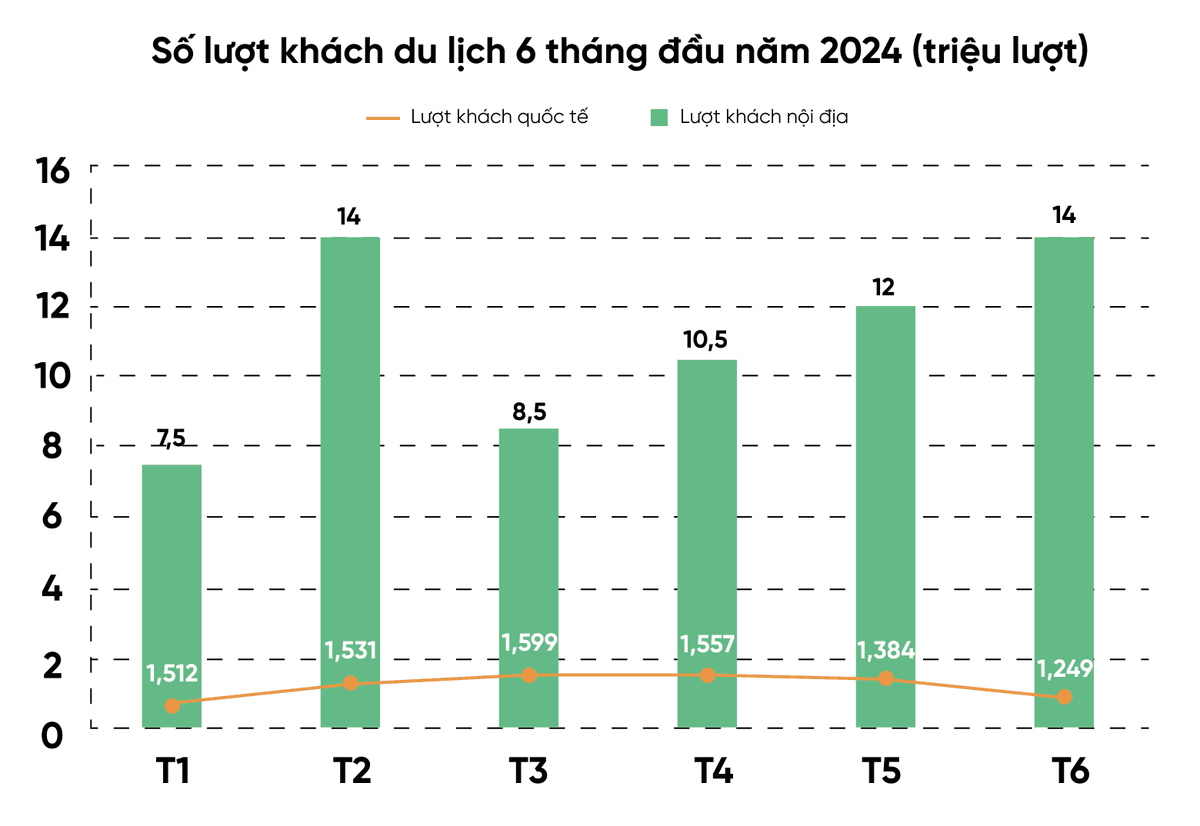
Monthly tracking from the Vietnam National Authority of Tourism reveals two counter-cyclical seasonality curves for hotel and tour capacity planning. Domestic travel spiked to twin peaks of 14 million trips in February (Lunar New Year, up from 7.5 million in January) and June. Between those peaks, domestic demand climbed steadily from 8.5 million in March to 10.5 million in April and 12 million in May.
Conversely, international arrivals held above 1.5 million per month across the first four months, peaking at 1.599 million in March (after 1.512 million in January, 1.531 million in February, and 1.557 million in April). Volume then tapered to 1.384 million in May and 1.249 million in June.
Ten localities exceeding VND 10 trillion in H1 2024 revenue
Geographically, provincial tourism figures compiled via VnExpress show 10 Vietnamese cities and provinces surpassing VND 10 trillion in tourism revenue during the first half of 2024, led by the two primary aviation and commercial gateways:
| Rank | Locality (First Half of 2024) | Tourism Revenue (VND trillion) | Primary Revenue Profile |
|---|---|---|---|
| 1 | Ho Chi Minh City | 92.6 | Year-round international gateway, urban leisure, MICE events, and retail spending |
| 2 | Hanoi | 55.4 | Heritage and culinary hub anchoring northern cultural and nature circuits |
| 3 | Khanh Hoa | 26.0 | Coastal resort destination backed by direct charter and commercial flights from Northeast Asia |
| 4 | Quang Ninh | 22.2 | Ha Long Bay world-heritage complex, international cruise calls, and weekend leisure |
| 5 | Thanh Hoa | 19.8 | High-volume domestic summer beach demand in Sam Son and eco-tourism zones |
| 6 | Nghe An | 16.6 | North-central coastal leisure in Cua Lo paired with cultural-historical tourism |
| 7 | Da Nang | 16.0 | Central coastal resort city, festival calendar, and direct regional air connectivity |
| 8 | Binh Dinh | 15.0 | Emerging Quy Nhon coastal corridor benefiting from upgraded transport links |
| 9 | Kien Giang | 13.3 | Phu Quoc island resort ecosystem supported by visa-exemption policies for international guests |
| 10 | Binh Thuan | 11.8 | Mui Ne – Phan Thiet beach corridor boosted by expressway access from Ho Chi Minh City |
Top 10 international inbound source markets
On the inbound demand side, H1 2024 arrival data from the Vietnam National Authority of Tourism highlights strong concentration in Northeast Asia. South Korea remained Vietnam's largest source market with 2,282 thousand arrivals (over 2.2 million trips, accounting for 25.8% of all international visitors), followed closely by China at 1,891 thousand arrivals (over 1.8 million trips, or 21.4%). Together, these two markets generated 47.2% of Vietnam's total H1 2024 inbound volume.
| Rank | Inbound Source Market (H1 2024) | Visitor Arrivals (thousand trips) | Regional Profile |
|---|---|---|---|
| 1 | South Korea | 2,282 | Northeast Asia (25.8% of total international arrivals) |
| 2 | China | 1,891 | Northeast Asia (21.4% of total international arrivals) |
| 3 | Taiwan | 630 | Northeast Asia |
| 4 | United States | 415 | North America (long-haul, higher length-of-stay segment) |
| 5 | Japan | 336 | Northeast Asia |
| 6 | Malaysia | 254 | Southeast Asia |
| 7 | Australia | 243 | Oceania |
| 8 | India | 239 | South Asia (fast-growing outbound wedding and leisure market) |
| 9 | Cambodia | 231 | Southeast Asia |
| 10 | Thailand | 227 | Southeast Asia |
This source-market mix carries direct operational consequences for inbound tour operators and resorts. Checkout flows cannot rely solely on Western credit cards, but must support cross-border cards, QR payments, and mobile wallets familiar to Korean, Chinese, Taiwanese, and ASEAN travelers.
What international accolades and 2024–2030 national targets anchor Vietnam's tourism roadmap?
Chapter 1 underscores how Vietnam's 3,260-kilometer coastline and cultural diversity translated into global brand recognition in 2024. Travel Off Path ranked Vietnam the safest country to visit in Asia in 2024, while Tripadvisor's Travelers' Choice Best of the Best Destinations 2024 awards recognized six destinations across northern, central, and southern Vietnam:
- Northern culinary and trending hubs: Hanoi was crowned the world's top culinary destination, while Ha Long ranked third and Sapa ranked fifth among the world's top trending destinations for 2024.
- Central heritage and southern urban magnets: Hoi An placed among the top two global honeymoon destinations, Hue was spotlighted among Asia's notable "hidden gems," and Ho Chi Minh City ranked among Asia's top 10 city destinations.
- Broader international media recognition in 2024: Global outlets cited in the report placed Vietnam among the top 10 post-graduation trips for 2024, one of eight recommended countries for retiree travelers, and an ideal hub for regenerative travel. Pho also ranked second among the world's 20 best soup dishes, and Noi Bai International Airport entered the world's top 100 airports.
National visitor and revenue milestones through 2030
To convert destination awareness into sustained economic output, the report benchmarks performance against Vietnam's Tourism Marketing Strategy to 2030 (promulgated under Decision 440/QD-BVHTTDL by the Ministry of Culture, Sports and Tourism, effective March 2, 2023) and 2024 sector targets:
| Milestone Year | International Arrival Target | Domestic Traveler Target | Revenue & Compound Growth Targets |
|---|---|---|---|
| 2024 | 17–18 million arrivals | 110 million trips | Total tourism revenue of VND 840 trillion (1.25x full-year 2023) |
| 2025 | 18 million arrivals | 130 million trips | Maintain domestic visitor growth of 8–9% per year |
| 2030 | 35 million arrivals | 160 million trips | International growth of 13–15%/year; domestic growth of 4–5%/year |
Scaling international arrivals from 18 million in 2025 to 35 million by 2030 requires 13–15% compound annual growth over five consecutive years. Achieving that trajectory demands shifting from volume-driven budget tours toward higher per-visitor yield—supported by longer stays, ancillary on-property experiences, and frictionless digital payment collection.
How have discovery, accommodation preferences, and payment habits shifted among Vietnamese travelers?
Chapter 2 maps five forces reshaping traveler decisions: macroeconomic conditions (GDP growth, personal income, market prices, exchange rates), psychology (rest, exploration, "YOLO" mindset), social influence, mobile technology, and external catalysts (weather, events, policies). Digitally, Vietnamese travelers move through a five-stage social loop: sharing post-trip reviews, exchanging itinerary tips, researching promotions via video, booking flights and hotels online, and joining travel communities.
Social tracking across Facebook, TikTok, YouTube, and Google Trends identifies nine dominant travel hashtag themes: green, community, experiential, cultural, culinary, resort leisure, business-leisure (workcation), medical, and spiritual tourism. Engagement diverges sharply by platform: on Facebook, resort leisure (exceeding 100,000 posts) and workcation (approaching 95,000 posts) dominate; on TikTok, experiential travel peaks highest (around 10,000 posts), trailed by workcation and spiritual tourism.
Rising disposable incomes among Vietnam's middle class are lifting travel budgets across both domestic and outbound trips following the domestic rebound noted in the 2023 Vietnam Consumer Trends report. Survey data from ezCloud shows 72% of respondents prefer trips combining exploration and relaxation, while 85% intend to travel abroad within 12 months. Visa's Global Travel Intentions (GTI) Study 2023 lists top motivations as relaxation (68%), shopping (43%), discovering new things (43%), and reconnecting with family and friends (20%). In parallel, 73% care about sustainable tourism and half actively seek eco-friendly options.
Generational accommodation priorities across Gen Z, Millennials, and Gen X
Demographically, Visa's GTI 2023 identifies Gen Z and families with children as primary engines of domestic tourism. Families raising young children and the Silver generation (aged 60 and above) record the highest leisure frequency at an average of 2.4 trips per year. Accommodation priorities split sharply across age cohorts:
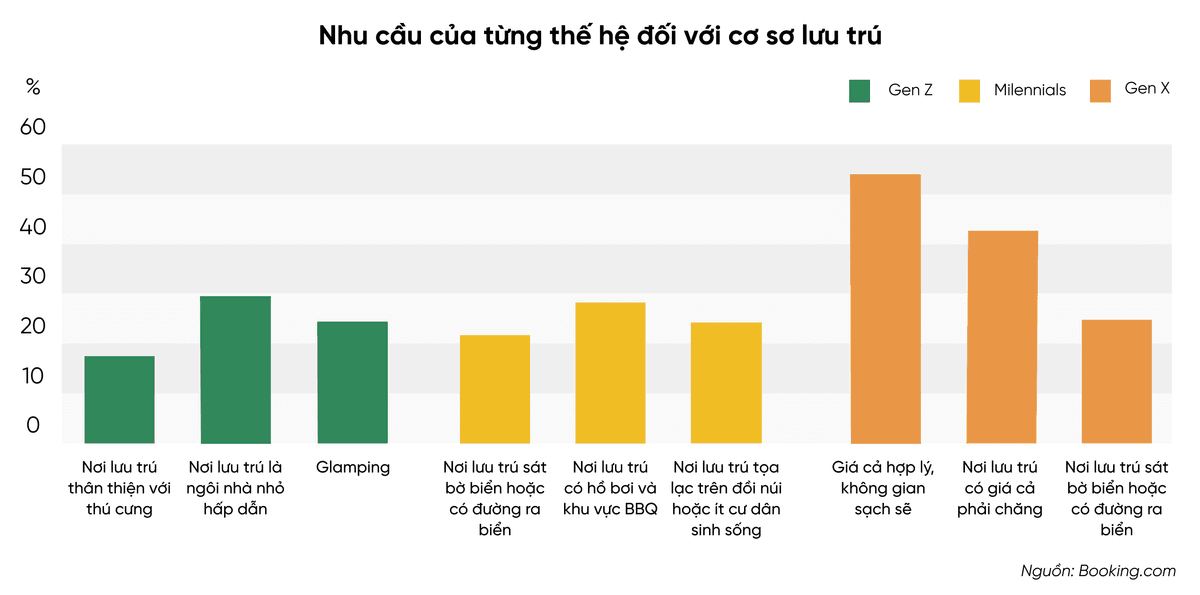
As Booking.com's generational breakdown illustrates, hospitality marketers cannot rely on one-size-fits-all room positioning. Gen Z travelers gravitate toward distinctive small homes, glamping sites, and pet-friendly stays (clustering in the 15–30% range). Millennials prioritize shared leisure amenities such as swimming pools with BBQ areas, secluded mountain or low-density locations, and beachfront access. By contrast, Gen X buyers apply pragmatic value filters first, with reasonable pricing paired with clean spaces exceeding 50% and overall affordability approaching 40%.
Cashless adoption at 97% and the credit-card versus e-wallet checkout split
Where all traveler cohorts converge is transaction convenience. According to Visa's GTI 2023 study presented on page 20 of the report, 97% of surveyed Vietnamese travelers prefer cashless payment methods to streamline spending throughout their trips.
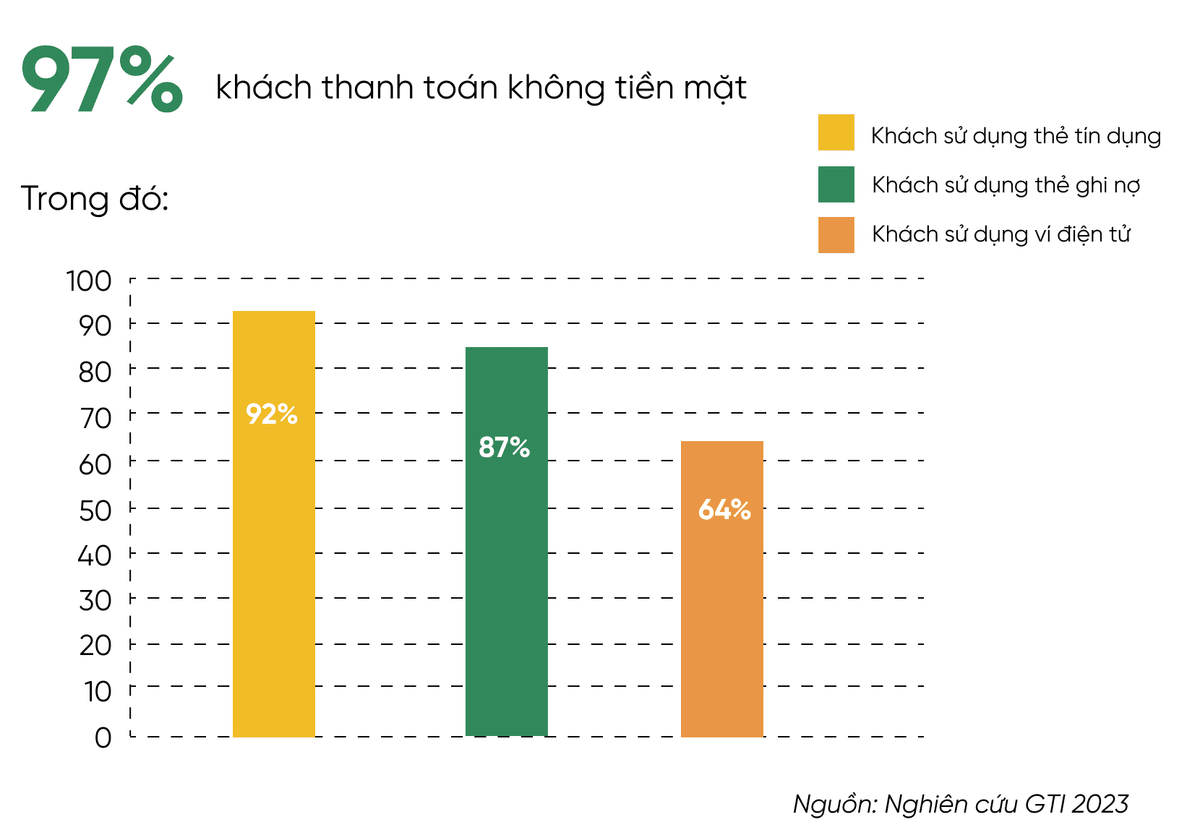
Within that 97% cashless traveler base (where respondents could select multiple payment instruments used across the entire journey), 92% use credit cards, 87% use debit cards, and 64% use e-wallets. A common strategic misreading among hotels and tour agencies is looking at the 92% credit-card usage figure in isolation and assuming an international card gateway alone covers online booking conversion.
Cross-checking Booking.com's 2024 online accommodation checkout data in Chapter 3 (page 27) exposes the operational nuance: 49% of Vietnamese users pay for accommodation bookings via e-wallets, outpacing 29% paying via credit cards. Both datasets are accurate because they measure different stages of the same trip. During online domestic room booking, nearly half of Vietnamese travelers default to e-wallets for one-tap mobile authentication. Conversely, credit and debit cards dominate high-ticket in-trip spending, hotel pre-authorizations, and international travel. Omitting either payment rail creates preventable cart abandonment.
Which six Vietnam tourism market trends are reshaping product design and digital marketing?
Synthesizing behavioral shifts and destination opportunities, Chapter 3 details six Vietnam tourism market trends guiding product development and marketing execution from late 2024 onward:
| Travel Trend | Verified Benchmark Metrics in Report | Cited Survey Source | Product & Marketing Implications |
|---|---|---|---|
| 1. Family travel & community connection | 3 in 5 travelers prioritize family trips; 95% use Facebook, 83% use TikTok; 73% plan via social media; 63% consume video; 91% book via creator recommendations; 61% trust non-celebrity creators | Klook (alongside Vietnam.vn) | Build multi-generational room-and-activity bundles; shift ad spend from static banners to authentic short-video reviews |
| 2. Verifiable sustainable tourism | 83% want nature-inspired green accommodation spaces; 78% want to see sustainable initiatives applied in practice; 73% seek distinctive architecture addressing environmental and social challenges | Booking.com (cited alongside Cong Thuong Newspaper) | Replace generic eco-slogans with visible energy-saving design, biophilic spaces, plastic reduction, and local community sourcing |
| 3. Local culinary exploration | 97% of Vietnamese travelers want to experience traditional flavors at destinations; international tourists allocate 25–35% of total trip budgets to food and dining | Booking.com & World Food Travel Association | Embed heritage food tours, cooking workshops, and regional tasting menus directly into room and tour packages |
| 4. Wellness healing & alter-ego travel | 78% stay anonymous while traveling; 76% view travel as time to fully enjoy themselves; 65% feel true to themselves; 62% of single travelers hope to find romance; 60% of Asian parents plan solo trips; 56% rent luxury cars for confidence | Booking.com (cited alongside Bazaar Vietnam – Phu Nu Online) | Design solo wellness retreats (yoga, meditation, hydrotherapy) alongside privacy-focused upgrades and premium vehicle add-ons |
| 5. Cool-climate & waterside escapes | 82% of Vietnamese travelers feel more relaxed near oceans or waterways; 75% choose cool-weather destinations for vacations | Booking.com | Expand highland, mountain, coastal, and riverside packages featuring early-morning and sunset outdoor itineraries |
| 6. Digital payments & AI-assisted spontaneity | 60% do not plan trips in advance; 81% are ready to alter itineraries spontaneously on arrival; 65% trust AI to build spontaneous destination plans; 40% book flights directly on airline websites; 49% pay stays via e-wallet, 29% via credit card | Booking.com | Enable instant-confirmation mobile booking for last-minute walk-ins; deploy AI itinerary assistants and multi-method digital checkout |
Non-celebrity creator trust and AI-assisted spontaneous itineraries
Two commercial insights stand out across Chapter 3. First, Klook's creator metrics challenge the habit of concentrating marketing budgets on a single celebrity ambassador. While 91% of Vietnamese travelers choose services based on social creator content, 61% specifically trust non-celebrity creators. Prospective guests want unfiltered short videos (63%) on Facebook (95%) and TikTok (83%) showing real room conditions, transit access, and meal pricing before committing a deposit.
Second, Booking.com's spontaneity metrics transform on-destination inventory management. With 60% of travelers skipping rigid pre-trip schedules, 81% willing to pivot plans mid-trip, and 65% trusting AI tools to assemble spontaneous local itineraries, excursion operators and restaurants can capture substantial last-minute revenue when travelers can book and pay on mobile in seconds.
Which four operational priorities help travel and hospitality businesses capture peak-season bookings?
Translating the report's conclusions (pages 28–29) and AppotaPay's travel-sector payment deployment experience into an execution roadmap, hospitality executives, tour directors, and CFOs should prioritize four actions:
- Configure dual payment rails across online pre-booking and on-property touchpoints: On direct booking websites and mobile apps—where 40% of travelers book flights directly on airline portals and 49% settle accommodation via e-wallets—enable domestic e-wallets, dynamic QR transfers, and domestic plus international cards side by side; for social-chat reservations, equip sales agents with branded Payment Links to lift deposit completion without manual bank-account typing. At hotel front desks, restaurants, and ticket counters, deploy 24/7 international-card-ready SmartPOS terminals to serve Vietnam's 8.8 million H1 international arrivals. Engineering teams can validate Instant Payment Notification (IPN) signature checks and PCI DSS card-security scoping against our payment gateway integration checklist for websites and mobile apps.
- Reallocate media spend toward short-form video and everyday peer reviewers: Anchor content calendars on Facebook and TikTok around high-velocity hashtag themes (resort leisure, experiential travel, and workcation). Rather than betting the entire campaign budget on macro-celebrities, pair domain travel voices with waves of relatable peer reviewers—the non-celebrity creators trusted by 61% of Vietnamese travelers—using our framework for choosing and combining KOLs and KOCs.
- Modularize packages for multi-generational families, cool-weather escapes, and last-minute add-ons: Structure family-and-senior bundles targeting households averaging 2.4 leisure trips per year, weaving in traditional culinary experiences (sought by 97% of domestic travelers and capturing 25–35% of international tourist budgets) alongside verifiable green practices (expected by 78–83% of guests). Unbundle half-day tours, wellness sessions, and vehicle rentals into instant-confirmation mobile add-ons tailored for the 81% of travelers who modify plans after arrival.
- Automate real-time transaction reconciliation across deposits, ancillaries, and weather refunds: Peak-season hospitality bookings routinely split a single reservation across multiple asynchronous payments—an online e-wallet deposit weeks ahead, on-site SmartPOS dining or upgrade charges, and partial refunds or foreign-exchange adjustments when weather shifts itineraries. Manual spreadsheet tracking invites unrecorded deposits and fee variances. Finance teams should bind every payment leg to a unified booking identifier and run a three-layer daily payment reconciliation workflow, alongside related operational guides in our fintech and digital payments hub.
This web edition synthesizes the verified market benchmarks and execution priorities from AppotaPay's tourism research. To explore the complete Facebook-versus-TikTok hashtag volume charts, the five-stage online traveler discussion journey, the 2024 Vietnam destination awards map, and AppotaPay's Payment Gateway, Payment Link, and SmartPOS suite for travel businesses compiled by AppotaPay, submit the download form on this page to receive the full 30-page PDF report.
Sources
- Báo cáo Nghiên cứu và phân tích xu hướng thị trường du lịch 2024, Công ty Cổ phần AppotaPay, 2024-09-01, accessed 2026-10-30
- Thông tin du lịch tháng 6 và 6 tháng đầu năm 2024; Thống kê kết quả du lịch năm 2023, Cục Du lịch Quốc gia Việt Nam — Bộ Văn hóa, Thể thao và Du lịch, 2024-07-01, accessed 2026-10-30
- Tổng hợp doanh thu du lịch 10 tỉnh, thành phố đạt trên 10.000 tỷ đồng trong 6 tháng đầu năm 2024, VnExpress (tổng hợp từ Sở Du lịch và Sở Văn hóa, Thể thao và Du lịch các địa phương), 2024-07-05, accessed 2026-10-30
- Quyết định số 440/QĐ-BVHTTDL phê duyệt Chiến lược marketing du lịch Việt Nam đến năm 2030, Bộ Văn hóa, Thể thao và Du lịch, 2023-03-02, accessed 2026-10-30
- Nghiên cứu Xu hướng Du lịch Toàn cầu 2023 (Visa Global Travel Intentions Study — GTI 2023), Visa, 2023-11-15, accessed 2026-10-30
- Báo cáo Dự đoán Du lịch 2024 (Travel Predictions 2024) và Báo cáo Du lịch Bền vững 2024, Booking.com, 2023-11-20, accessed 2026-10-30
- Nghiên cứu hành vi du khách Klook Travel Pulse 2024 tại thị trường Việt Nam, Klook, 2024-03-12, accessed 2026-10-30
- Travelers' Choice Awards Best of the Best Destinations 2024 và xếp hạng điểm đến an toàn châu Á 2024, Tripadvisor & Travel Off Path, 2024-01-10, accessed 2026-10-30
- Khảo sát nhu cầu du lịch của người Việt năm 2023 và thống kê chi tiêu du lịch ẩm thực quốc tế, ezCloud & Tổ chức Du lịch Ẩm thực Thế giới (World Food Travel Association), 2023-12-01, accessed 2026-10-30